Q.Verify: ∫2x+32x−1dx=x−log∣(2x+3)2∣+C
Concept understanding — Verification of Solution
Verifying a Solution of a Differential Equation
A function y=ϕ(x) is called a solution of a differential equation if, when you substitute it and its derivatives into the equation, the two sides become equal for every x in the domain. Verification is the act of carrying out that substitution and checking that it holds as an identity.
The useful point: you do not have to solve the equation to verify a candidate. You are only checking a function that is already handed to you — which is exactly how many exam questions are phrased: "Show that … is a solution of …."
The steps
- From the given y=ϕ(x), compute exactly the derivatives that appear in the equation.
- Substitute y and those derivatives into the left-hand side.
- Simplify and check that it equals the right-hand side for all x (an identity, not just at one point).
Example 1
Verify that y=e−3x is a solution of dx2d2y+dxdy−6y=0.
Here y′=−3e−3x and y′′=9e−3x. Substituting:
9e−3x+(−3e−3x)−6e−3x=(9−3−6)e−3x=0.
The left side is 0 for every x, so y=e−3x is a solution.
Example 2 (a solution with constants)
Verify that y=acosx+bsinx satisfies dx2d2y+y=0 for any constants a,b.
Since y′′=−acosx−bsinx=−y, we get y′′+y=0. It holds for all a,b, so this two-constant family is a solution.
Verification links your answer back to the definition of a solution: a function is a solution not because of how you found it, but because it makes the differential equation true. If the substitution does not reduce to an identity, the function is simply not a solution.
Verifying that a given function solves a differential equation is explicitly listed as an exercise type in the NCERT Class 12 Mathematics textbook's Differential Equations chapter, and "verify the solution of differential equation examples" is a common CBSE and JEE Main search. This is often the easiest full-mark question in the chapter once the substitution steps are practiced a few times.
To verify an antiderivative, differentiate the right side and check it returns the integrand.
Let F(x)=x−log∣(2x+3)2∣+C. Using log∣(2x+3)2∣=2log∣2x+3∣,
F′(x)=1−2⋅2x+31⋅2=1−2x+34=2x+3(2x+3)−4=2x+32x−1.
This is exactly the integrand, so the statement is verified.
True. dxd[x−log∣(2x+3)2∣]=2x+32x−1, so the given result is correct.
True. Differentiating x−log∣(2x+3)2∣+C gives 2x+32x−1, so the stated antiderivative is correct.
The fastest way to verify a claimed integral is to differentiate the proposed answer: if you recover the integrand, the statement holds. No integration is needed.
Differentiate the right-hand side
Let F(x)=x−log∣(2x+3)2∣+C. First simplify the logarithm with the power rule log∣a2∣=2log∣a∣:
F(x)=x−2log∣2x+3∣+C.
Now differentiate term by term:
- dxd(x)=1,
- dxd(−2log∣2x+3∣)=−2⋅2x+31⋅2=−2x+34.
So
F′(x)=1−2x+34=2x+3(2x+3)−4=2x+32x−1.
Compare with the integrand
This matches 2x+32x−1 exactly, and the domains agree (x=−23). Hence F is a valid antiderivative and the identity is correct.
Writing the constant as log∣(2x+3)2∣ instead of 2log∣2x+3∣ is just a stylistic choice — the two are equal, so both forms verify identically.
True. dxd[x−log∣(2x+3)2∣]=2x+32x−1, confirming ∫2x+32x−1dx=x−log∣(2x+3)2∣+C.
Method: Verifying a claimed antiderivative by differentiation
Use this whenever a question says "Verify ∫f(x)dx=F(x)+C". You never integrate — you differentiate the proposed F(x) and check it returns the integrand.
Steps
Step 1: Simplify F(x) using log/algebra rules first.
Constants and log powers simplify differentiation, e.g. log∣(2x+3)2∣=2log∣2x+3∣. Doing this before differentiating avoids messy chain rules.
Step 2: Differentiate F(x) term by term.
Apply standard derivatives, including dxdlog∣u∣=uu′ with the chain rule for the inner linear factor.
Step 3: Combine over a common denominator.
Collect the terms into a single fraction so it can be compared directly with the given integrand.
Step 4: Compare with the integrand and state the verdict.
If F′(x) equals f(x) (and the domains match), the identity is verified as True. The logic: differentiation and integration are inverses, so recovering f confirms F is a valid antiderivative.
Common Mistakes
Mistake 1: Forgetting the chain-rule factor inside the log.
Why it's wrong: dxdlog∣2x+3∣=2x+32, not 2x+31 — dropping the inner 2 gives 1−2x+32 and a false "mismatch". Correct approach: differentiate log∣u∣ as u′/u with u′=2.
Mistake 2: Ignoring the power inside the log.
Why it's wrong: log∣(2x+3)2∣=2log∣2x+3∣ carries a factor 2; treating it as log∣2x+3∣ halves the derivative. Correct approach: apply loga2=2loga before differentiating.
Mistake 3: Trying to integrate instead of differentiate.
Why it's wrong: verification only needs the reverse check; re-integrating 2x+32x−1 wastes time and invites errors. Correct approach: differentiate the given F(x) and match it to the integrand.
Showing the 12 most recent of 86 on this concept.
- TG EAPCET 2026Set eng-2026-05-11-FN1 markMCQQ.The general solution of the differential equation (2xy+y2)dy=(x2−y2)dx is (A) x3−3x2y−y3=c (B) x3−3x2y+y3=c (C) x3−3xy2+y3=c (D) x3−3xy2−y3=c
›Reveal solutionSolution
This is a homogeneous differential equation. Substituting y=vx reduces it to a separable form, and integrating gives the general solution x3−3xy2−y3=c, which matches option (D).
The given equation is (2xy+y2)dy=(x2−y2)dx. Notice that every term is of degree 2 — 2xy, y2, x2, y2 — so the equation is homogeneous. For a homogeneous equation, the standard trick is to set y=vx, which turns the equation into one where variables separate cleanly.
- Rewrite in standard form Bring the dx term to the left:
(2xy+y2)dy−(x2−y2)dx=0
Or equivalently,
dxdy=2xy+y2x2−y2
- Substitute y=vx Then dxdy=v+xdxdv. The right-hand side becomes:
2x(vx)+(vx)2x2−(vx)2=x2(2v+v2)x2(1−v2)=2v+v21−v2
So the equation is:
v+xdxdv=2v+v21−v2
- Separate variables Subtract v from both sides:
xdxdv=2v+v21−v2−v=2v+v21−v2−v(2v+v2)
Simplify the numerator:
1−v2−2v2−v3=1−3v2−v3
So:
xdxdv=2v+v21−3v2−v3
Now separate:
1−3v2−v32v+v2dv=xdx
- Integrate both sides The left-hand side is set up for a simple substitution. Let u=1−3v2−v3. Then du=(−6v−3v2)dv=−3(2v+v2)dv. Notice that 2v+v2 appears in the numerator, so:
1−3v2−v32v+v2dv=−31udu
Integrating:
∫−31udu=∫xdx
−31log∣u∣=log∣x∣+C
Multiply by −3:
log∣u∣=−3log∣x∣−3C
log∣u∣=log∣x−3∣+logK(where logK=−3C)
So:
u=x3K
- Back-substitute Recall u=1−3v2−v3 and v=y/x:
1−3(xy)2−(xy)3=x3K
Multiply through by x3:
x3−3xy2−y3=K
Renaming the constant K as c, we get the general solution:
x3−3xy2−y3=c
Watch outA common mistake is to misplace the signs when simplifying the numerator after subtracting v. Always combine terms carefully: v=2v+v2v(2v+v2), so the numerator becomes 1−v2−2v2−v3=1−3v2−v3.
TipSpotting the derivative pattern du=−3(2v+v2)dv saves time — it means you don't need partial fractions or any heavy algebra.
✓Final answerThe correct option is (D): x3−3xy2−y3=c.
- TG EAPCET 2021Set eng-2021-08-04-FN1 markMCQQ.The general solution of dxdy=x+sinxcosy+xcosy+sinx is (A) tan2x=2y2−cosy+C (B) tan2y=2x2−cosx+C (C) sec22y=2x2−cosx+C (D) tan2y=2x2+cosx+Cx
›Reveal solutionSolution
The given differential equation is separable after factoring. The solution is found by integrating both sides, leading to tan2y=2x2−cosx+C, which matches option (B).
The key is to notice that the right-hand side can be grouped into terms that depend only on x and terms that depend only on y. That’s the hallmark of a separable differential equation — and once you see the pattern, the integration is straightforward.
Let’s rewrite the equation:
dxdy=x+sinxcosy+xcosy+sinx
Group the terms cleverly:
dxdy=(x+sinx)+(sinxcosy+xcosy)
Factor cosy from the last two terms:
dxdy=(x+sinx)+cosy(x+sinx)
Now factor (x+sinx) out of the whole right-hand side:
dxdy=(x+sinx)(1+cosy)
This is clearly separable: the x-part is (x+sinx) and the y-part is (1+cosy).
- Separate the variables Bring all y terms to the left and x terms to the right:
1+cosydy=(x+sinx)dx
- Integrate both sides The left side uses a standard trigonometric identity. Recall:
1+cosy=2cos22y
So:
1+cosy1=2cos22y1=21sec22y
Therefore:
∫1+cosydy=21∫sec22ydy
Let u=y/2, then dy=2du, and:
21∫sec2u⋅2du=∫sec2udu=tanu+C=tan2y+C
The right side integrates easily:
∫(x+sinx)dx=2x2−cosx+C
- Combine the results Equating the two integrals (with a single constant of integration):
tan2y=2x2−cosx+C
Watch outA common mistake is to forget the factor of 1/2 when integrating sec2(y/2). Always check the chain rule: the derivative of tan(y/2) is 21sec2(y/2), so the integral of sec2(y/2) is 2tan(y/2). Here the 1/2 from the identity cancels that factor neatly.
TipThe identity 1+cosy=2cos2(y/2) is your best friend for integrals involving 1+cosy or 1+siny. Memorize it — it saves time in exams.
✓Final answerThe correct option is (B): tan2y=2x2−cosx+C.
- TG EAPCET 2023Set eng-2023-05-13-AN1 markMCQQ.The general solution of the differential equation (secx+tanx)dxdy+(sec2x+secxtanx)y=1 is (A) (1+sinx)y=ncosx+c (B) (1+cosx)y=xsinx+c (C) (secx+tanx)y=xsecx+c (D) (secx+tanx)y=x+c
›Reveal solutionSolution
This is a first-order linear ODE. Rewriting it in standard form and applying the integrating factor method shows that the general solution is (secx+tanx)y=x+c, which matches option (D).
The key concept is recognizing the equation as a first-order linear differential equation of the form
dxdy+P(x)y=Q(x).
The standard method is to multiply through by an integrating factor μ(x)=e∫Pdx, which makes the left side a perfect derivative. Here, the coefficients are cleverly arranged so that the integrating factor simplifies dramatically.
- Rewrite in standard form The given equation is
(secx+tanx)dxdy+(sec2x+secxtanx)y=1.
Divide through by (secx+tanx) to isolate dxdy:
dxdy+secx+tanxsec2x+secxtanxy=secx+tanx1.
- Simplify the coefficient of y Factor the numerator: sec2x+secxtanx=secx(secx+tanx). Hence
secx+tanxsec2x+secxtanx=secx.
So the ODE becomes
dxdy+(secx)y=secx+tanx1.
- Find the integrating factor
μ(x)=e∫secxdx.
A standard integral: ∫secxdx=log∣secx+tanx∣+C.
Thus
μ(x)=elog∣secx+tanx∣=secx+tanx.
(We take the positive branch for typical intervals.)
- Multiply through by μ(x)
(secx+tanx)dxdy+(secx+tanx)(secx)y=1.
Notice the left side is exactly the derivative of (secx+tanx)y because
dxd[(secx+tanx)y]=(secx+tanx)dxdy+(secxtanx+sec2x)y,
and indeed secx(secx+tanx)=sec2x+secxtanx. So we have
dxd[(secx+tanx)y]=1.
- Integrate both sides
(secx+tanx)y=∫1dx=x+c.
- Match with the options This is exactly option (D): (secx+tanx)y=x+c.
TipNotice that the integrating factor turned out to be exactly the coefficient of dxdy in the original equation. This is a neat shortcut: if the ODE is already written as dxd[M(x)y]=something, you can integrate directly without computing the integrating factor separately.
Watch outA common mistake is to forget to divide by the coefficient of dxdy first, or to mis-simplify sec2x+secxtanx. Always check the algebra carefully.
✓Final answerThe correct option is (D).
ANSWER: D
- TG EAPCET 2025Set eng-2025-05-02-FN1 markMCQQ.If cosxdxdy=ysinx−1, x=(2n+1)2π, n∈Z is the differential equation corresponding to the curve y=f(x) and f(0)=1 then f(x)= (A) (1−x)secx (B) (1−x)cosx (C) x+cosx (D) x+secx
›Reveal solutionSolution
This is a first-order linear ODE. Rewriting it in standard form and using an integrating factor gives f(x)=(1−x)secx, which matches option (A).
We start with the given differential equation:
cosxdxdy=ysinx−1
The goal is to find y=f(x) satisfying f(0)=1, and then match it to one of the options.
Concept and Intuition
The equation is linear in y but not yet in standard form. The standard form for a first-order linear ODE is:
dxdy+P(x)y=Q(x)
Once in this form, we multiply through by an integrating factor μ(x)=e∫P(x)dx, which lets us write the left-hand side as the derivative of μ(x)y. Then we integrate both sides.
Here, dividing by cosx will give us P(x)=−tanx and Q(x)=−secx. The integrating factor simplifies nicely because ∫tanxdx=−log∣cosx∣, so μ(x)=secx.
Step-by-step solution
- Rewrite in standard form Divide both sides by cosx (valid since x=(2n+1)2π):
dxdy=ytanx−secx
Bring the y term to the left:
dxdy−(tanx)y=−secx
So P(x)=−tanx and Q(x)=−secx.
- Find the integrating factor
μ(x)=e∫P(x)dx=e∫−tanxdx
Since ∫tanxdx=−log∣cosx∣, we have:
∫−tanxdx=log∣cosx∣
Hence:
μ(x)=elog∣cosx∣=∣cosx∣
For the domain (where cosx>0 near x=0), we can take μ(x)=cosx. But it's more standard to use secx as the integrating factor when we multiply through — let's check.
Actually, careful: The standard formula is μ=e∫Pdx. With P=−tanx, we get μ=elog(cosx)=cosx (taking positive branch near 0). So the integrating factor is cosx.
- Multiply the ODE by μ(x)=cosx Original ODE in standard form:
dxdy−(tanx)y=−secx
Multiply by cosx:
cosxdxdy−ysinx=−1
Notice the left side is exactly dxd(ycosx) because:
dxd(ycosx)=dxdycosx−ysinx
So we have:
dxd(ycosx)=−1
- Integrate both sides
ycosx=∫−1dx=−x+C
- Apply the initial condition f(0)=1 At x=0, y=1 and cos0=1:
1⋅1=−0+C⇒C=1
So:
ycosx=1−x
Hence:
y=cosx1−x=(1−x)secx
- Match with options This is exactly option (A).
TipA common mistake is to forget the sign when integrating tanx or to misplace the negative in the standard form. Always double-check that dxd(μy) matches after multiplying by μ.
Watch outThe domain restriction x=(2n+1)2π ensures cosx=0, so division by cosx and the use of secx are valid. At x=0, everything is well-defined.
✓Final answerThe correct option is (A).
ANSWER: A
- TG EAPCET 2026Set eng-2026-05-09-FN1 markMCQQ.If dxdy−x2+b2xy=−2x(x2+b), y(0)=12, y(1)=10, then sum of all possible values of b is (A) 1 (B) 4 (C) −3 (D) −1
›Reveal solutionSolution
This is a first-order linear ODE solved via an integrating factor; the two boundary conditions force a specific value of the parameter b, and the sum of all possible b values is −3.
We are given the differential equation
dxdy−x2+b2xy=−2x(x2+b),
with conditions y(0)=12 and y(1)=10. The parameter b is unknown, and we must find all possible b that allow both conditions to hold, then sum them.
Concept and intuition
This is a first-order linear ODE of the form
dxdy+P(x)y=Q(x).
The standard method: multiply by an integrating factor μ(x)=e∫P(x)dx to make the left side a perfect derivative. Here P(x)=−x2+b2x, so the integrating factor will simplify nicely because the numerator is the derivative of the denominator. The right-hand side is a polynomial times (x2+b), so after multiplication we’ll integrate easily.
The twist: we have two boundary conditions for a first-order ODE — that usually overdetermines the system. The parameter b must adjust so that both conditions are consistent. We’ll solve the ODE in terms of b and a constant C, then impose y(0)=12 and y(1)=10 to get equations that determine b.
Step-by-step solution
1. Identify P(x) and compute the integrating factor.
Rewrite the ODE as
dxdy+(−x2+b2x)y=−2x(x2+b).
So P(x)=−x2+b2x. Then
∫P(x)dx=−∫x2+b2xdx=−log∣x2+b∣+constant.
Thus the integrating factor is
μ(x)=e∫Pdx=e−log∣x2+b∣=x2+b1.
(We can drop absolute values since b will be chosen so that x2+b>0 on the interval containing 0 and 1, or we treat it as a formal algebraic factor.)
2. Multiply the ODE by μ(x).
x2+b1dxdy−(x2+b)22xy=−2x.
Notice the left side is exactly
dxd(x2+by).
Check: derivative of x2+by is x2+by′−(x2+b)22xy. Yes.
So we have
dxd(x2+by)=−2x.
3. Integrate both sides.
x2+by=∫(−2x)dx=−x2+C,
where C is an arbitrary constant.
Thus
y(x)=(x2+b)(−x2+C).
4. Apply the first condition y(0)=12.
At x=0:
y(0)=(0+b)(0+C)=bC=12⇒C=b12.
5. Apply the second condition y(1)=10.
At x=1:
y(1)=(1+b)(−1+C)=10.
Substitute C=b12:
(1+b)(−1+b12)=10.
6. Solve for b.
Simplify the left side:
(1+b)(b−b+12)=b(1+b)(12−b)=10.
Multiply both sides by b (note b=0 because otherwise y(0)=12 would be impossible from bC=12):
(1+b)(12−b)=10b.
Expand:
12−b+12b−b2=10b⇒12+11b−b2=10b.
Bring all terms to one side:
12+11b−b2−10b=0⇒12+b−b2=0.
Multiply by −1:
b2−b−12=0.
Factor:
(b−4)(b+3)=0.
So b=4 or b=−3.
7. Sum all possible values of b.
Sum = 4+(−3)=1.
Watch outA common mistake is to forget that b cannot be zero (since y(0)=bC would force 0=12), but our quadratic already excludes b=0. Also, check that for b=−3, the denominator x2−3 is nonzero at x=0 and x=1 (it is −3 and −2 respectively), so the ODE is well-defined on the interval.
TipThe integrating factor method turned the ODE into a simple derivative because the coefficient x2+b2x is exactly the derivative of log(x2+b). This is a classic pattern: whenever P(x) is a constant times f(x)f′(x), the integrating factor is a power of f(x).
✓Final answerThe correct option is (A).
ANSWER: A
- TG EAPCET 2021Set eng-2021-08-05-FN1 markMCQQ.If x=2+22/3+21/3, then x3−6x2+6x= (A) 3 (B) 2 (C) 1 (D) 0
›Reveal solutionSolution
The key idea is to rewrite the given expression as a cubic equation by setting t=21/3, then substituting x=t2+t+2 and simplifying to find x3−6x2+6x=2.
We are given x=2+22/3+21/3. The expression x3−6x2+6x looks like it might simplify to a constant — a common trick in such problems. The direct approach of cubing x would be messy, so we look for a smarter algebraic structure.
Notice that 21/3 and 22/3 are related: if we let t=21/3, then t3=2 and t2=22/3. So x becomes x=t2+t+2. The problem now reduces to working with t, where t3=2 is a clean relation.
-
Set up the substitution.
Let t=21/3. Then t3=2, and x=t2+t+2.
-
Express x in terms of t and find a relation.
We have x−2=t2+t.
Square both sides? That would give t4+2t3+t2, but t4=t⋅t3=2t, so it might work. But a more elegant path is to notice that t satisfies t3−2=0, and x is a symmetric polynomial in t. We can compute x3−6x2+6x directly by substituting x=t2+t+2 and simplifying using t3=2.
-
Compute x2 and x3 in terms of t.
First, x2=(t2+t+2)2
=t4+t2+4+2t3+4t2+4t (expand carefully: (a+b+c)2=a2+b2+c2+2ab+2bc+2ca)
=t4+2t3+(t2+4t2)+4t+4
=t4+2t3+5t2+4t+4.
Now t4=t⋅t3=2t, and t3=2, so:
x2=2t+2(2)+5t2+4t+4
=2t+4+5t2+4t+4
=5t2+6t+8.
Next, x3=x⋅x2=(t2+t+2)(5t2+6t+8).
Multiply term by term:
t2(5t2+6t+8)=5t4+6t3+8t2
t(5t2+6t+8)=5t3+6t2+8t
2(5t2+6t+8)=10t2+12t+16
Summing: x3=5t4+(6t3+5t3)+(8t2+6t2+10t2)+(8t+12t)+16
=5t4+11t3+24t2+20t+16.
Replace t4=2t and t3=2:
x3=5(2t)+11(2)+24t2+20t+16
=10t+22+24t2+20t+16
=24t2+30t+38.
-
Now form x3−6x2+6x.
We have:
x3=24t2+30t+38
6x2=6(5t2+6t+8)=30t2+36t+48
6x=6(t2+t+2)=6t2+6t+12
So:
x3−6x2+6x=(24t2+30t+38)−(30t2+36t+48)+(6t2+6t+12)
Combine t2 terms: 24−30+6=0
Combine t terms: 30−36+6=0
Constant terms: 38−48+12=2
All t terms cancel perfectly, leaving just 2.
Watch outA common mistake is to try cubing x directly without substitution — that leads to a mess with 22/3 and 21/3 terms that are hard to simplify. The substitution t=21/3 makes the algebra clean because t3=2 is a simple number.
TipNotice that the coefficients 1,−6,6 in x3−6x2+6x are suspiciously close to those in (x−2)3=x3−6x2+12x−8. Indeed, x3−6x2+6x=(x−2)3−6x+8+6x=(x−2)3+8? Let's check: (x−2)3=x3−6x2+12x−8, so x3−6x2+6x=(x−2)3−6x+8. That doesn't simplify directly. But the substitution method is foolproof.
✓Final answerThe value is 2, which corresponds to option (B).
-
- TG EAPCET 2026Set eng-2026-05-10-FN1 markMCQQ.If y=(x+x2+1)5 then 25y= (A) (x2+1)y2−xy1 (B) (x2+1)y2+xy1 (C) (x2+1)y2−2xy1 (D) (x2+1)y2+2xy1
›Reveal solutionSolution
The function y=(x+x2+1)5 is a power of an inverse hyperbolic sine, so its derivatives satisfy a simple recurrence. Differentiating twice and rearranging gives 25y=(x2+1)y2+xy1, which is option (B).
We have y=(x+x2+1)5. The expression inside the parentheses is the standard form for the inverse hyperbolic sine: sinh−1x=log(x+x2+1), so x+x2+1=esinh−1x. That means y=e5sinh−1x. This is a composition that makes differentiation clean: the derivative of sinh−1x is x2+11, and the chain rule will produce a pattern that eliminates the square root.
The key insight: instead of brute-force expanding, we can find a relation between y, y1=dxdy, and y2=dx2d2y by differentiating the defining equation. Notice that x+x2+1 satisfies a neat property: its reciprocal is x2+1−x. This will help us isolate derivatives.
- First derivative. Let u=x+x2+1. Then y=u5, and dxdu=1+x2+1x=x2+1x2+1+x=x2+1u. So by the chain rule:
y1=5u4⋅dxdu=5u4⋅x2+1u=x2+15u5=x2+15y.
Hence
x2+1y1=5y.(1)
- Second derivative. Differentiate (1) with respect to x. The left side is a product:
dxd(x2+1y1)=x2+1xy1+x2+1y2.
The right side differentiates to 5y1. So:
x2+1xy1+x2+1y2=5y1.(2)
- Eliminate the square root. Multiply (2) through by x2+1:
xy1+(x2+1)y2=5x2+1y1.
But from (1), x2+1y1=5y. Substitute:
xy1+(x2+1)y2=5⋅(5y)=25y.
- Rearrange.
25y=(x2+1)y2+xy1.
Watch outA common mistake is to misplace the sign when rearranging. The term xy1 appears with a plus sign, not minus. Check: from step 3 we have xy1+(x2+1)y2=25y, so moving xy1 to the right would give a minus, but the question asks for 25y on the left, so the expression on the right is exactly (x2+1)y2+xy1.
✓Final answerThe correct option is (B).
- TG EAPCET 2023Set eng-2023-05-12-FN1 markMCQQ.The general solution of dxdy+yf′(x)−f(x)f′(x)=0,y=f(x) is (A) y=f(x)+1+ce−f(x) (B) y=ce−f(x) (C) y=f(x)−1+ce−f(x) (D) y=f(x)+cef(x)
›Reveal solutionSolution
This is a first-order linear ODE disguised by the presence of f(x) and f′(x). By rewriting it in standard form and using an integrating factor ef(x), the general solution simplifies to y=f(x)−1+ce−f(x), which corresponds to option (C).
We start with the given differential equation:
dxdy+yf′(x)−f(x)f′(x)=0,y=f(x).
Concept & Intuition
The equation looks messy because of the f(x) and f′(x) terms, but notice that f′(x) appears as a coefficient of y and also multiplied by f(x). This suggests we can rearrange it into the standard linear form dxdy+P(x)y=Q(x), where P(x) and Q(x) are functions of x only. Once in that form, the method of integrating factor works cleanly. The key trick: treat f(x) as some known function (we don't need its explicit form), and f′(x) as its derivative.
Step-by-step solution
- Rewrite the equation in standard linear form Bring the term −f(x)f′(x) to the right-hand side:
dxdy+f′(x)y=f(x)f′(x).
This is now of the form dxdy+P(x)y=Q(x) with P(x)=f′(x) and Q(x)=f(x)f′(x).
- Find the integrating factor The integrating factor μ(x) is given by e∫P(x)dx. Here:
∫P(x)dx=∫f′(x)dx=f(x)+C.
We only need one integrating factor, so take μ(x)=ef(x).
- Multiply through by the integrating factor
ef(x)dxdy+ef(x)f′(x)y=ef(x)f(x)f′(x).
The left-hand side is the derivative of yef(x) with respect to x (by the product rule, since dxdef(x)=ef(x)f′(x)). So we have:
dxd(yef(x))=ef(x)f(x)f′(x).
- Integrate both sides
yef(x)=∫ef(x)f(x)f′(x)dx.
Notice that the integrand is set up for a substitution: let u=f(x), then du=f′(x)dx, so:
∫euudu.
This is a standard integral. Use integration by parts: let w=u, dv=eudu, then dw=du, v=eu. So:
∫ueudu=ueu−∫eudu=ueu−eu+C=eu(u−1)+C.
Substituting back u=f(x):
∫ef(x)f(x)f′(x)dx=ef(x)(f(x)−1)+C.
- Solve for y From step 4:
yef(x)=ef(x)(f(x)−1)+C.
Divide both sides by ef(x) (which is never zero):
y=f(x)−1+Ce−f(x).
Renaming the constant C as c, we get the general solution:
y=f(x)−1+ce−f(x).
Watch outA common mistake is to forget the constant of integration or to misapply integration by parts. Also note the condition y=f(x) is given to avoid the trivial case where the denominator in some step might vanish, but it doesn't affect the derivation here.
TipThe structure y=f(x)−1+ce−f(x) shows that as x varies, the term ce−f(x) decays or grows depending on f(x), but the particular solution f(x)−1 is the "steady" part.
✓Final answerThe correct option is (C).
ANSWER: C
- TG EAPCET 2026Set eng-2026-05-11-AN1 markMCQQ.The integrating factor of the linear differential equation in x given by dxdy=3x+y+21 is (A) e−3x (B) e−x (C) e−3y (D) e−y
›Reveal solutionSolution
The given equation is not linear in y, but rewriting it as dydx=3x+y+2 makes it linear in x with integrating factor e−3y, so the correct option is (C).
We are given
dxdy=3x+y+21.
At first glance, this looks like a first-order differential equation in y as a function of x. But it is not linear in y because the right-hand side is a rational function containing y in the denominator. However, we can flip the relationship: treat x as a function of y instead.
The key insight: if dxdy is given, then dydx=1/dxdy (provided the derivative is nonzero). This often turns a nonlinear equation in y into a linear equation in x.
- Rewrite the equation in terms of x(y) Since dydx=dxdy1, we have
dydx=3x+y+2.
This is now a linear first-order differential equation in x with independent variable y.
- Identify the standard linear form The standard form for a linear ODE in x is
dydx+P(y)x=Q(y).
Our equation is
dydx−3x=y+2.
So P(y)=−3 and Q(y)=y+2.
- Recall the integrating factor formula For a linear ODE dydx+P(y)x=Q(y), the integrating factor is
μ(y)=e∫P(y)dy.
Here P(y)=−3, so
μ(y)=e∫(−3)dy=e−3y.
- Interpret the result The integrating factor depends only on y, and it is e−3y. Multiplying the equation by this factor makes the left side an exact derivative, allowing us to solve for x(y).
Thus, among the given options, the integrating factor is e−3y.
Watch outA common mistake is to try to force the equation into the form dxdy+P(x)y=Q(x) without checking if it is linear in y. Here it is not, so flipping variables is essential.
TipWhenever you see dxdy=linear in x and y1, try writing dydx instead — it often becomes linear immediately.
✓Final answerThe correct option is (C).
ANSWER: C
- TG EAPCET 2026Set eng-2026-05-10-AN1 markMCQQ.If the probability distribution of a random variable X is P(X=k)=c(72)k, k=0,1,2,…, then P(X=2)= (A) 34312 (B) 34320 (C) 354 (D) 494
›Reveal solutionSolution
This is a geometric‑type distribution; we first find the normalising constant c by summing over all k, then compute P(X=2) directly. The final probability is 34320, which corresponds to option (B).
We are given
P(X=k)=c(72)k,k=0,1,2,…
and need P(X=2). The key is that the probabilities must sum to 1, which determines c.
Concept and intuition:
This is a discrete probability distribution on the non‑negative integers. The terms form a geometric series with ratio r=72. For the sum to be finite and equal to 1, we use the infinite geometric series formula ∑k=0∞rk=1−r1 (valid when ∣r∣<1). Once c is known, plugging k=2 gives the answer.
- Sum all probabilities and set equal to 1
∑k=0∞P(X=k)=c∑k=0∞(72)k=1.
The series converges because 72<1.
- Evaluate the geometric series
∑k=0∞(72)k=1−721=751=57.
- Solve for c
c⋅57=1⇒c=75.
- Compute P(X=2)
P(X=2)=c(72)2=75⋅494=34320.
TipA common mistake is forgetting to include the factor c when substituting k=2. Always normalise first.
Watch outDo not confuse this with a binomial distribution — here the support is infinite, and the probabilities decay geometrically.
✓Final answerThe correct option is (B).
ANSWER: B
- TG EAPCET 2025Set eng-2025-05-04-AN1 markMCQQ.Consider all functions given in List-I in the interval [1,3]. The List-2 has the values of ‘c’ obtained by applying Lagrange’s mean value theorem on the functions of List-1. Match the functions and values of ‘c’. (A) A – II, B – V, C – IV, D – III (B) A – II, B – I, C – IV, D – III (C) A – IV, B – V, C – II, D – I (D) A – IV, B – III, C – II, D – V
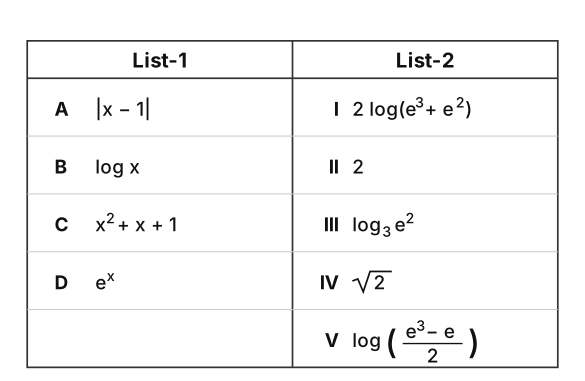
›Reveal solutionSolution
Apply f′(c)=2f(3)−f(1) to each function. You get c=2 (any c works for ∣x−1∣), c=log3e2, c=2 and c=log2e3−e — i.e. A–IV, B–III, C–II, D–V, option (D).
The concept first
Lagrange's Mean Value Theorem says something beautifully physical: if you travel from x=1 to x=3 along a smooth curve, then at some instant your instantaneous rate of change equals your average rate of change. Formally, if f is continuous on [a,b] and differentiable on (a,b), there exists c∈(a,b) with
f′(c)=b−af(b)−f(a).
So the entire job in each row is: compute the chord slope on the right, set the derivative equal to it, and solve for c.
One subtlety worth noticing: ∣x−1∣ is famously not differentiable at x=1 — but the kink is at the endpoint of [1,3], and the theorem only needs differentiability on the open interval (1,3). Inside, x>1 so ∣x−1∣=x−1, perfectly smooth.
Step-by-step
- A: f(x)=∣x−1∣ on [1,3]. Here f(x)=x−1, f(1)=0, f(3)=2.
chord slope=22−0=1,f′(x)=1 ∀x∈(1,3).
The equation f′(c)=1 is satisfied by every c in (1,3). The only List-2 value lying in (1,3) that is not already claimed by another (uniquely determined) function is 2≈1.414. → A – IV.
2. B: f(x)=logx (natural log) on [1,3]. f(1)=0, f(3)=log3.
f′(c)=c1=2log3−0=2log3 ⟹ c=log32.
Now log32=2⋅log31=2log3e=log3e2. Check: c≈1.09862≈1.82∈(1,3) ✓ → B – III.
3. C: f(x)=x2+x+1 on [1,3]. f(1)=3, f(3)=9+3+1=13.
f′(c)=2c+1=213−3=5 ⟹ 2c=4 ⟹ c=2∈(1,3) ✓
→ C – II.
4. D: f(x)=ex on [1,3]. f(1)=e, f(3)=e3.
f′(c)=ec=2e3−e ⟹ c=log(2e3−e).
Numerically 220.09−2.72≈8.68, so c≈log8.68≈2.16∈(1,3) ✓ → D – V.
5. Assemble: A–IV, B–III, C–II, D–V.
✓Final answerThe mean-value points are 2, log3e2, 2 and log2e3−e respectively, giving A–IV, B–III, C–II, D–V — option (D).
ANSWER: D
- TG EAPCET 2022Set eng-2022-07-20-AN1 markMCQQ.If l and m are respectively the order and the degree of the differential equation f(x)y′′+g(x)y′=x4y whose general solution is y=ax2+blogx, then f(m)+g(m)= (A) 2l (B) l (C) 3m (D) 1+m
›Reveal solutionSolution
The key idea is to find the differential equation from its given general solution, then identify its order l and degree m, and finally evaluate f(m)+g(m) — the answer is l.
We are told that the general solution of the differential equation
f(x)y′′+g(x)y′=x4y
is y=ax2+blogx, where a and b are arbitrary constants. The functions f(x) and g(x) are not given explicitly — they are to be determined from the fact that this y satisfies the equation for all a,b.
The problem asks for f(m)+g(m), where l is the order and m is the degree of this differential equation. So we first need to find the differential equation itself.
- Find the derivatives of the given solution.
y=ax2+blogx
Differentiate:
y′=2ax+xb
Differentiate again:
y′′=2a−x2b
-
Eliminate the arbitrary constants a and b.
We have three equations: y, y′, y′′ in terms of a and b. We need one equation relating y, y′, y′′ and x alone — that is the differential equation.
From y′′=2a−x2b, we can solve for a and b in terms of y′′ and something else. But a cleaner way:
From y′=2ax+xb, multiply by x:
xy′=2ax2+b
From y=ax2+blogx, we have ax2=y−blogx. Substitute into xy′:
xy′=2(y−blogx)+b=2y−2blogx+b
This still has b. Instead, let's use y′′ directly.
From y′′=2a−x2b, multiply by x2:
x2y′′=2ax2−b
But 2ax2=2(y−blogx) from y=ax2+blogx. So:
x2y′′=2y−2blogx−b
This still contains b. We need another relation to eliminate b.
From y′=2ax+xb, multiply by x:
xy′=2ax2+b
And 2ax2=2(y−blogx). So:
xy′=2y−2blogx+b
Now subtract the x2y′′ equation from this? Let's do it systematically.
We have:
xy′=2y−2blogx+b(1)
x2y′′=2y−2blogx−b(2)
Subtract (2) from (1):
xy′−x2y′′=(2y−2blogx+b)−(2y−2blogx−b)=2b
So b=21(xy′−x2y′′).
Now add (1) and (2):
xy′+x2y′′=(2y−2blogx+b)+(2y−2blogx−b)=4y−4blogx
Substitute b:
xy′+x2y′′=4y−4(21(xy′−x2y′′))logx
xy′+x2y′′=4y−2(xy′−x2y′′)logx
Bring terms together:
xy′+x2y′′+2(xy′−x2y′′)logx=4y
Factor:
xy′(1+2logx)+x2y′′(1−2logx)=4y
Divide through by x (assuming x=0):
y′(1+2logx)+xy′′(1−2logx)=x4y
This is the differential equation. Compare with the given form f(x)y′′+g(x)y′=x4y:
f(x)=x(1−2logx),g(x)=1+2logx
-
Identify order l and degree m.
The highest derivative is y′′, so order l=2.
The equation is polynomial in y′′ and y′ (no fractional powers, no transcendental functions of derivatives), and the highest power of y′′ is 1. So degree m=1.
Watch outDegree is defined only when the equation is polynomial in the derivatives. Here it is, so degree = 1. The presence of logx in the coefficients does not affect the degree — degree concerns only the dependent variable and its derivatives.
-
Compute f(m)+g(m).
Since m=1, evaluate f(1) and g(1):
f(1)=1⋅(1−2log1)=1⋅(1−0)=1
g(1)=1+2log1=1+0=1
So f(m)+g(m)=1+1=2.
And l=2, so f(m)+g(m)=l.
✓Final answerThe value is f(m)+g(m)=l, which corresponds to option (B).
🎓Unlock everything free for 14 days
- ✓Full step-by-step solutions
- ✓Concept-first explanations
- ✓Methods, shortcuts & mistakes
- ✓PYQ mapping + timed mock tests
Full access for 14 days. No credit card required.