Physics · Ch 13 — Atoms
Alpha-particle Scattering and Rutherford's Nuclear Model of Atom
Alpha-particle Scattering and Rutherford's Nuclear Model of Atom
The Geiger-Marsden Experiment
In 1911, at Rutherford's suggestion, Geiger and Marsden performed a landmark experiment. They directed a beam of 5.5 MeV alpha-particles from a radioactive source (Bi) at a very thin gold foil of thickness m. The alpha-particles were collimated into a narrow beam by passing them through lead bricks. A rotatable detector, consisting of a zinc sulphide screen and a microscope, was used to observe the scattered alpha-particles. When an alpha-particle struck the screen, it produced a brief flash of light (a scintillation). By counting these flashes at different angles, the distribution of scattered particles as a function of the scattering angle could be studied.
The key experimental findings were striking:
- Most alpha-particles passed straight through the foil with no deflection at all.
- Only about 0.14% of the incident alpha-particles were scattered by more than .
- About 1 in 8000 alpha-particles (roughly 0.0125%) were deflected by more than — some were even scattered backwards.
Rutherford reasoned that to deflect a fast, heavy alpha-particle backwards, it must experience an enormous repulsive force. Such a force could only arise if the positive charge and most of the mass of the atom were concentrated in an extremely tiny region at its centre. Only then could an incoming alpha-particle get very close to this concentrated positive charge and suffer a large deflection. This reasoning led to the discovery of the atomic nucleus.
Rutherford's Nuclear Model of the Atom
Based on the scattering evidence, Rutherford proposed the nuclear model of the atom:
In Rutherford's nuclear model, the entire positive charge and nearly all the mass of the atom are concentrated in a tiny central region called the nucleus. The electrons are located at some distance away from the nucleus and move in orbits around it, much like planets orbiting the Sun.
From the scattering data, Rutherford estimated the size of the nucleus to be between m and m. In contrast, the size of an atom was known from kinetic theory to be about m. This means the atom is roughly 10,000 to 100,000 times larger than its nucleus. Consequently, most of an atom is empty space.
This explains why most alpha-particles pass straight through the foil — they simply travel through the vast empty space. Only when an alpha-particle happens to come very close to a nucleus does the intense electric field there scatter it through a large angle. The atomic electrons, being extremely light compared to an alpha-particle, do not appreciably affect its path.
Assumptions for Analysing the Scattering
Since the gold foil is very thin, it is reasonable to assume that an alpha-particle suffers at most one scattering event during its passage through the foil. Therefore, we only need to compute the trajectory of an alpha-particle scattered by a single nucleus.
Key facts about the particles involved:
- An alpha-particle is the nucleus of a helium atom. It carries a positive charge of (where is the elementary charge) and has the mass of a helium atom.
- The gold nucleus has a charge of , where is the atomic number. For gold, .
- The gold nucleus is about 50 times heavier than an alpha-particle. It is therefore reasonable to assume that the nucleus remains stationary throughout the scattering process.
Under these assumptions, the trajectory of an alpha-particle can be computed using Newton's second law of motion and Coulomb's law for the electrostatic force of repulsion between the alpha-particle and the positively charged nucleus.
The Force Between Alpha-Particle and Nucleus
The magnitude of the electrostatic force of repulsion between an alpha-particle (charge ) and a nucleus (charge ) separated by a distance is given by Coulomb's law:
where is the permittivity of free space. The force is directed along the line joining the alpha-particle and the nucleus. As the alpha-particle approaches the nucleus and then recedes, both the magnitude and direction of this force change continuously.
Trajectory of the Scattered Alpha-Particle
The scattering problem is essentially a central force problem under an inverse-square repulsive force. The trajectory of the alpha-particle is a hyperbola, with the nucleus at one focus. The key parameter that determines the scattering angle is the impact parameter, — the perpendicular distance between the initial velocity direction of the alpha-particle and the centre of the nucleus.
›Proof
Derivation of the relationship between impact parameter and scattering angle
Consider an alpha-particle of mass , charge , and initial speed approaching a stationary nucleus of charge . Let be the impact parameter and be the scattering angle (the angle through which the alpha-particle is deflected from its original direction).
The trajectory is a hyperbola. Using conservation of energy and angular momentum, one can derive the relation:
This can be rearranged to give the impact parameter in terms of the scattering angle:
The derivation proceeds as follows:
-
Conservation of angular momentum: At infinity, the angular momentum is . At the point of closest approach (distance from the nucleus), the angular momentum is , where is the speed at closest approach. By conservation, .
-
Conservation of energy: At infinity, the total energy is . At closest approach, the total energy is . Equating:
-
Geometry of the hyperbola: The scattering angle is related to the angle between the asymptotes of the hyperbola by . The eccentricity of the hyperbola is . Using the standard equation of the hyperbola in polar coordinates with the nucleus at the focus, one obtains the relation between and given above.
The detailed algebraic manipulation involves eliminating and using the two conservation equations and the geometry of the hyperbola. …
Drawn by us to help you understand the concept clearly, and verified to make sure it's accurate. For exams, practice from your textbook's own diagram.
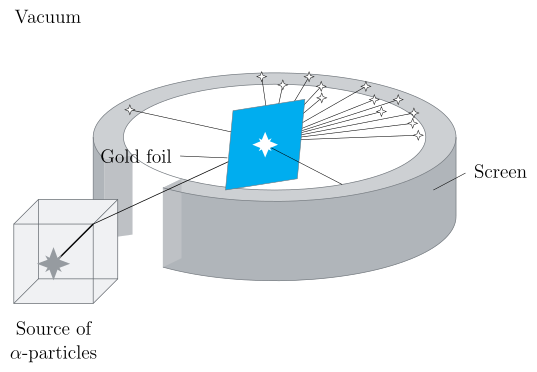
The figure shows the apparatus that Geiger and Marsden used under Rutherford’s guidance — the experiment that revealed the atomic nucleus. At the centre of the drawing is a thin gold foil, shown as a small tilted square. Around it, drawn in perspective, is a shallow cylindrical drum. The inner curved wall of this drum is coated with zinc sulphide — that is the screen. A lead-shielded box containing a radioactive source of -particles sits below and to the left, outside the drum. A narrow beam of -particles emerges from the box, travels in a straight line, and strikes the gold foil. On hitting the foil, the -particles scatter in all directions. Those that hit the zinc-sulphide screen produce tiny flashes of light — scintillations — which can be viewed and counted through a microscope. The entire setup is placed inside a vacuum chamber (not shown in the figure) so that the -particles do not lose energy by colliding with air molecules.
The physical idea the figure teaches is simple but revolutionary: most -particles pass straight through the foil with little or no deflection, a few are deflected through small angles, and an extremely small number — about 1 in 8000 — bounce back almost the way they came. This could not happen if the positive charge and mass of the atom were spread out uniformly (as in Thomson’s plum-pudding model). The only explanation is that the atom has a tiny, dense, positively charged nucleus at its centre, and the rest is mostly empty space.
The key result from this experiment is the Rutherford scattering formula, which gives the number of -particles scattered through an angle :
where:
- = number of incident -particles
- = number of atoms per unit volume in the foil
- = thickness of the foil
- = atomic number of the foil (gold, )
- = elementary charge
- = permittivity of free space
- = distance from foil to screen
- = kinetic energy of the incident -particles
- = scattering angle measured from the original direction …
Drawn by us to help you understand the concept clearly, and verified to make sure it's accurate. For exams, practice from your textbook's own diagram.
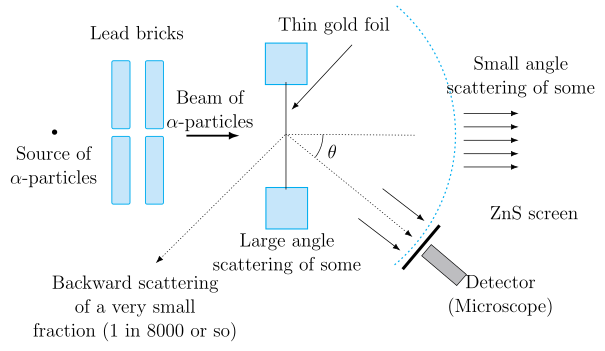
The Geiger-Marsden experiment, often called the gold-foil experiment, is the single most important experimental setup in the Atoms chapter because it forced a complete rewrite of atomic theory. Fig. 12.2 is a schematic of that setup, drawn as a 2D top-down view.
At the far left sits a radioactive source that emits -particles (helium nuclei, ). These particles are not naturally collimated — they fly in all directions. To get a narrow beam, the source is surrounded by lead bricks with a single narrow slit cut through them. Only -particles that happen to travel straight through the slit emerge as a well-defined beam. This beam travels from left to right and strikes a thin gold foil at the centre of the diagram. The foil is only a few thousand atoms thick — thin enough that most -particles pass through it without hitting a gold nucleus head-on.
What happens after the foil is the entire point of the figure. The scattered -particles are detected by a ZnS screen mounted on a rotatable arm. When an -particle hits the zinc sulphide, it produces a tiny flash of light — a scintillation — which is observed through a microscope. The detector can be moved along a circular arc centred on the foil, so the experimenter measures the number of scintillations per minute at each scattering angle .
The figure shows three distinct outcomes, drawn as trajectories leaving the foil:
- Small-angle scattering: Most -particles continue almost straight ahead, deflected by only a few degrees. These are the particles that passed through the empty space between atoms, experiencing only weak Coulomb repulsion from the distant positive charge of the gold nuclei.
- Large-angle scattering: A smaller number are deflected through angles like , , or . These particles came close enough to a gold nucleus to feel a strong electrostatic repulsion.
- Backward scattering: A very tiny fraction — about 1 in 8000 — are scattered backward, toward the lower-left of the diagram, through angles greater than and even close to . This was the shocking result. If the positive charge in an atom were spread out like a pudding (Thomson's model), an -particle could never be turned around; the maximum deflection would be tiny. Only a concentrated, massive positive nucleus could produce such a violent reversal.
The fact that 1 in 8000 -particles is back-scattered tells us that the nucleus occupies only about of the atom's volume. The atom is mostly empty space.
The textbook uses this figure to derive the key formula for the distance of closest approach, . At the moment an -particle is turned back (scattered through ), its entire initial kinetic energy has been converted into electrostatic potential energy at the point of closest approach to the nucleus:
Here:
- is the initial kinetic energy of the -particle (typically a few MeV).
- is the atomic number of the target nucleus (for gold, ).
- is the elementary charge ().
- is the charge of the -particle. …
Drawn by us to help you understand the concept clearly, and verified to make sure it's accurate. For exams, practice from your textbook's own diagram.
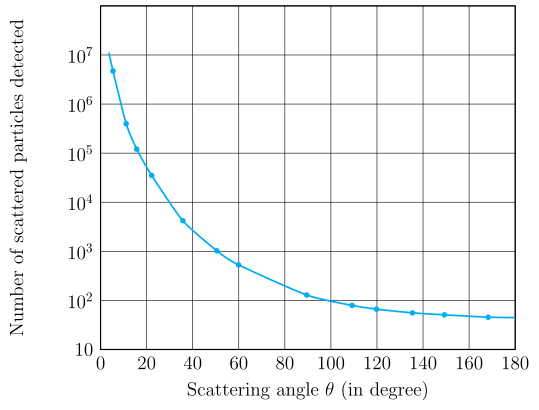
The graph in Fig. 12.3 is a log-linear plot. The vertical axis, labelled "Number of scattered particles detected", is logarithmic — it runs from at the bottom to at the top. The horizontal axis is linear, showing the scattering angle in degrees from to .
The experimental data points, shown as dots, trace a curve that starts extremely high near – at the smallest angles (close to ). As increases, the number of detected particles drops steeply. By the time reaches about , the count has fallen to roughly –. At the largest angles, near , the curve levels off at around — a factor of ten thousand lower than at small angles. The solid curve drawn through these points is Rutherford's theoretical prediction, and it matches the data remarkably well across the entire range.
Why a logarithmic vertical axis?
The count varies over five orders of magnitude — from to . A linear scale would squash the low-angle data into a single point and hide the structure at large angles. The log scale lets you see both the huge peak at small and the tiny tail at large on the same graph.
What this figure teaches. Before this experiment, the prevailing model was Thomson's "plum pudding" atom — a diffuse positive sphere with electrons embedded like raisins. If that model were correct, alpha particles would barely be deflected; the chance of a large-angle scatter would be negligible. Geiger and Marsden found the opposite: a tiny but real fraction of alpha particles bounced back at angles greater than . Rutherford later said it was "almost as incredible as if you fired a 15-inch shell at a piece of tissue paper and it came back and hit you."
The graph makes this point visually. The steep drop with angle tells you that most alpha particles pass through with little deflection (small , huge count), but a very small number suffer a near-head-on collision (large , tiny count). That pattern is exactly what you expect if the positive charge is concentrated in a tiny, massive nucleus — not spread out.
The key formula. The theoretical curve in the figure comes from Rutherford's scattering formula. For a thin foil of thickness , with atoms per unit volume, each containing a nucleus of atomic number , the number of alpha particles scattered into a detector at angle (subtending a small solid angle ) is:
where:
- = number of incident alpha particles
- = number density of target atoms (atoms per unit volume)
- = foil thickness
- = atomic number of the target nucleus
- = elementary charge
- = permittivity of free space
- = kinetic energy of the incident alpha particle
- = scattering angle
- = solid angle subtended by the detector
The crucial dependence is . At small , , so — a very steep drop as increases. At , , giving the minimum count. This inverse-fourth-power dependence is what produces the dramatic fall seen in the graph.
A common mistake …