Q.State Kirchhoff's laws for an electrical network. Using these laws, deduce the condition for balance in a Wheatstone Bridge.
You're viewing a preview — the full solution, concept, methods & PYQ mapping are locked.
Start your 14-day free trial to unlock the full solution →Kirchhoff's junction and loop rules, applied to the four arms of a Wheatstone bridge, give the balance condition P/Q = R/S at which the galvanometer shows zero deflection.
Kirchhoff's Laws:
-
Junction rule (Kirchhoff's Current Law, KCL): At any junction in an electrical circuit, the algebraic sum of all currents meeting at that junction is zero, i.e. the sum of currents entering a junction equals the sum of currents leaving it. This follows from conservation of charge — charge cannot accumulate indefinitely at a junction in steady state.
-
Loop rule (Kirchhoff's Voltage Law, KVL): Around any closed loop in a circuit, the algebraic sum of the changes in potential (the products of current and resistance, ) together with the EMFs in that loop is zero. This follows from conservation of energy — the electric potential is a single-valued function of position, so going around any closed loop must bring you back to the same potential.
Wheatstone bridge balance condition:
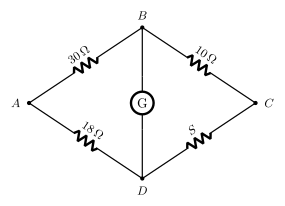
A Wheatstone bridge consists of four resistances arranged in a diamond (rhombus) shape: and form one pair of adjacent arms, and the other, with a galvanometer connected across the bridge's diagonal (between the junction of and the junction of ), and a battery connected across the other diagonal, driving current through the network.
Let the bridge be balanced, meaning no current flows through the galvanometer (). Let flow through then , and flow through then (since with , the current through equals the current through , and the current through equals the current through , by the junction rule).
Applying the loop rule to the loop containing , (with , so no drop across ) and :
…
Unlock everything free for 14 days
- Full step-by-step solutions
- Concept-first explanations
- Methods, shortcuts & mistakes
- PYQ mapping + timed mock tests
Full access for 14 days. No credit card required.