Q.State Kirchhoff's laws for an electrical network. Using these deduce the condition for balance in a Wheatstone bridge.
You're viewing a preview — the full solution, concept, methods & PYQ mapping are locked.
Start your 14-day free trial to unlock the full solution →Kirchhoff's junction rule (conservation of charge) and loop rule (conservation of energy) can be applied to a Wheatstone bridge to derive its balance condition, P/Q = R/S.
Kirchhoff's laws for an electrical network:
-
Junction (current) rule: At any junction in an electrical network, the algebraic sum of all currents meeting at that junction is zero: sum(I) = 0, with currents flowing into the junction taken as positive and those flowing out as negative. This follows from conservation of charge - charge cannot accumulate at a junction in steady state.
-
Loop (voltage) rule: The algebraic sum of the changes in potential (emfs and IR drops) around any closed loop in a network is zero: sum(emf) = sum(IR), following from conservation of energy - the net change in electric potential energy of a charge that returns to its starting point around a closed loop is zero.
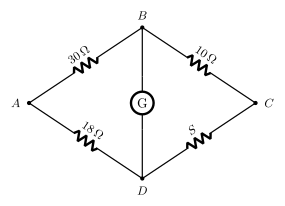
Wheatstone bridge balance condition: A Wheatstone bridge consists of four resistors P, Q, R, S arranged in a quadrilateral ABCD, with a battery connected between A and C, and a galvanometer connected between the junctions B and D (the bridge arm). Let the currents in P, Q, R, S be I1, I2, I3, I4 respectively, and let Ig be the current through the galvanometer.
At balance, no current flows through the galvanometer, i.e. Ig = 0. Applying the junction rule at B and D (with Ig = 0): the current through P equals the current through R, I1, and the current through Q equals the current through S, I2 (since no current diverts through the galvanometer branch).
Applying the loop rule to loop A-B-D-A (through P, galvanometer, S): with Ig = 0, I1 P = I2 S ... (i)
…
Unlock everything free for 14 days
- Full step-by-step solutions
- Concept-first explanations
- Methods, shortcuts & mistakes
- PYQ mapping + timed mock tests
Full access for 14 days. No credit card required.