Q.In the photoelectric effect, light (photons) is incident on a metal surface travelling along one direction, and photoelectrons are ejected from the surface moving off along a different direction (the incident light and the emitted electron do not travel along the same line). Since the incident photons carry momentum along the direction of the light while the emitted electrons move away in a different direction, how would you reconcile this photoemission with the principle of conservation of momentum? Note that the light (photons) and the emitted electrons have momenta pointing in different directions.
🔒You're viewing a preview — the full solution, concept, methods & PYQ mapping are locked.
🔒 Start your 14-day free trial to unlock the full solution →Concept understanding — Photoelectric Effect
The Photoelectric Effect: When Light Knocks Electrons Loose
Imagine you're throwing tennis balls at a wall covered in loose pebbles. If you throw hard enough, a pebble might get knocked off. That's the basic picture — but the photoelectric effect is the quantum version of this, and it completely shattered classical physics.
The Intuition
Light is made of tiny packets of energy called photons. Each photon carries a specific amount of energy, determined by its colour (frequency). When a photon hits a metal surface, it can transfer its energy to an electron inside the metal. If that energy is enough, the electron breaks free and flies out.
Think of electrons in a metal like people in a room with a high window. To escape, they need enough energy to reach the window sill. A photon is like a boost — but only if it gives enough energy in one shot. No amount of weak boosts (dim light) will work if each individual boost is too small.
The Precise Statement
Ephoton=hf=ϕ+Kmax
Where:
- Ephoton=hf is the energy of a photon (Planck's constant h=6.63×10⁻³⁴ J⋅s, f is frequency)
- ϕ is the work function — the minimum energy needed to remove an electron from that metal
- Kmax is the maximum kinetic energy of the ejected electron
What Classical Physics Got Wrong
Before Einstein (1905), physicists thought light was a continuous wave. They expected:
- Brighter light → more energy per electron → faster electrons
- Any colour would eventually eject electrons if you waited long enough
But experiments showed the opposite:
| Observation | Classical Prediction | Actual Result |
|---|---|---|
| Effect of intensity | Brighter light → faster electrons | Brighter light → more electrons, same speed |
| Threshold frequency | None — any light works eventually | Below a certain frequency, no electrons no matter how bright |
| Time delay | Electrons need time to absorb energy | Electrons appear instantly (within 10−9 s) |
The Key Insight
Einstein said: light behaves like a stream of particles (photons), each with energy hf. One photon interacts with one electron. If hf<ϕ, the electron cannot escape — period. If hf>ϕ, the excess energy becomes kinetic energy:
Kmax=hf−ϕ
This is why:
- Increasing intensity (more photons) ejects more electrons, but each electron still gets the same energy per photon — so their speed doesn't change.
- Below threshold frequency, even a trillion photons per second can't help — each one is too weak individually.
The photoelectric effect proved that light is quantized — it comes in discrete packets. This was the birth of quantum mechanics. Einstein won the 1921 Nobel Prize for this, not for relativity.
A Worked Example
Problem: A metal has work function ϕ=2.0 eV. Light of frequency f=6.0×10¹⁴ Hz shines on it. Find the maximum kinetic energy of ejected electrons. (h=4.14×10⁻¹⁵ eV⋅s)
Step 1: Photon energy
E=hf=(4.14×10⁻¹⁵)(6.0×10¹⁴)=2.48 eV …
Why this formula?
Photoelectric Effect: Why the Key Formulas Hold
The photoelectric effect is a cornerstone of quantum physics. It showed that light behaves as particles (photons) , not just waves. Let's build the reasoning step-by-step.
1. The Core Idea: Energy Conservation
When a photon hits a metal surface, it transfers all its energy to a single electron inside the metal.
- The photon's energy is E=hf, where h is Planck's constant and f is the frequency of light.
- The electron needs a minimum energy to escape the metal — this is called the work function, ϕ.
Why only one electron?
Einstein proposed that light is quantized into discrete packets (photons). A single photon cannot split its energy among multiple electrons — it interacts with one electron at a time.
2. The Photoelectric Equation
If the photon's energy is greater than the work function, the excess energy becomes the electron's kinetic energy after escape:
hf=ϕ+Kmax
Where:
- hf = energy of incident photon
- ϕ = work function (minimum energy to remove electron)
- Kmax = maximum kinetic energy of ejected electron
Why "maximum" kinetic energy?
- Electrons inside the metal have different binding energies.
- Some electrons are near the surface (loosely bound) → get maximum K.
- Others are deeper → lose energy in collisions before escaping → lower K.
3. The Stopping Potential Connection
We measure Kmax using a stopping potential Vs:
Kmax=eVs
Where e is the electron charge. This is because:
- An electric field opposing the electron's motion does work eVs to stop it.
- At the stopping potential, the electron's kinetic energy is exactly balanced by the electric potential energy.
Combining:
hf=ϕ+eVs
This is the Einstein photoelectric equation in its most testable form.
4. Why the Threshold Frequency Exists
From the equation:
hf=ϕ+eVs
If f is too low, hf<ϕ. Then:
- The photon cannot supply enough energy to overcome the work function.
- No electron is ejected, regardless of light intensity.
The threshold frequency f0 is when Kmax=0:
hf0=ϕ⇒f0=hϕ
Why intensity doesn't matter for ejection?
- Intensity = number of photons per second.
- Each photon still has energy hf. If hf<ϕ, even a billion photons won't eject an electron — each photon is individually too weak.
5. Why Kinetic Energy Depends on Frequency, Not Intensity
From Kmax=hf−ϕ:
- Frequency f directly determines Kmax.
- Intensity only affects the number of electrons ejected (more photons → more electrons), not their individual energy.
This was the key experimental contradiction with classical wave theory:
- Classical: Higher intensity = bigger wave amplitude = more energy to electrons.
- Reality: Higher frequency = more energy per electron; intensity only changes current.
6. Summary of Key Relationships …
The electron is not free — it is bound in the metal. The photon's momentum is shared with the whole (very massive) metal, which recoils with negligible energy, so momentum is still conserved even though the electron flies off in a different direction from the incident light.
Momentum conservation is not violated. Because the electron is bound, the photon is absorbed by the electron together with the rest of the metal. The heavy metal lattice recoils to balance the photon's momentum pph=chν, gaining negligible kinetic energy (2Mp2 with M enormous), while the electron carries away almost all of …
The emitted electron and the incident photon travel in different directions, yet momentum is still conserved because the electron is bound in the metal, not free. The photon's momentum is taken up by the whole metal lattice, which is so massive that it recoils with negligible kinetic energy. So there is no conflict with conservation of momentum.
Concept
In photoemission a bound electron (not a free one) absorbs a photon inside the metal. The correct system to which conservation laws apply is photon + electron + the rest of the metal, not the photon and a single free electron.
Why a free electron will not do
A truly free electron cannot absorb an entire photon and conserve both energy and momentum at the same time. That is precisely why photoemission requires the electron to be attached to a heavy body — the metal — which can soak up the recoil.
Why the momentum still balances
- The incident photon carries momentum pph=chν along the direction of the light.
- When the electron leaves along a different direction, the missing momentum is carried away by the entire metal (the lattice), which recoils.
- The metal's mass M is of order 1022 times the electron mass, so the kinetic energy it gains,
Erecoil=2Mp2,
is utterly negligible even though it carries a real momentum p. …
Method: Analyzing Momentum Conservation in Bound-Particle Absorption
When a "conservation law appears to be violated" question involves an electron leaving a solid in a different direction from the incoming photon, the fix is always to correctly identify the full system the conservation law applies to.
Steps
Step 1: Ask whether the particle absorbing the photon is truly free
A genuinely free electron cannot absorb a photon and simultaneously conserve both energy and momentum — the two conditions overdetermine a free particle's final velocity. So if a process like this is observed, the absorbing particle must NOT be free; it must be attached to something much more massive (here, the metal lattice).
Step 2: Enlarge the system to include the massive body
Apply conservation of momentum to the system photon + electron + the rest of the solid, not to photon + electron alone:
pphoton=pelectron+plattice
The direction mismatch is resolved because the massive lattice can recoil in whatever direction is needed to balance the photon's momentum vector. …
Showing the 12 most recent of 16 on this concept.
- TG EAPCET 2026Set eng-2026-05-11-AN1 markMCQQ.A potentiometer wire of length 10 m and resistance 9 Ω is connected to a cell of emf E and internal resistance 1 Ω. If V is the maximum potential difference that can be measured using the potentiometer, then the condition for the potentiometer to work is (A) E=V (B) 9E≥10V (C) E<V (D) 9V=10E
›Reveal solutionSolution
The key idea is that a potentiometer works only when the voltage across its entire wire (the maximum measurable voltage) is slightly greater than the voltage to be measured. Here, the maximum potential difference across the wire is 109E, so the condition for it to measure a voltage V is 9E≥10V, which corresponds to option (B).
Why this approach works
A potentiometer is a device for measuring an unknown potential difference without drawing current from the source being measured. It works by balancing the unknown voltage against a known potential difference taken from a uniform wire. For the potentiometer to function, the unknown voltage V must be less than or equal to the maximum potential difference that can be obtained across the entire length of the wire. If V exceeds that maximum, the balance point cannot be reached — the slider would have to go beyond the wire.
So the problem reduces to: What is the maximum voltage across the potentiometer wire? That depends on the driving cell's emf E, its internal resistance, and the wire's resistance.
Step-by-step reasoning
- Find the current in the main circuit The potentiometer wire (resistance 9Ω) is connected in series with the driving cell (emf E, internal resistance 1Ω). The total resistance in the circuit is
Rtotal=9+1=10Ω.
Hence the current supplied by the cell is
I=10E.
- Find the potential difference across the whole wire The wire has resistance 9Ω, so the voltage drop from one end to the other is
Vwire=I×9=10E×9=109E.
This is the maximum voltage that can be tapped from the wire (by using its full length).
- Condition for the potentiometer to work …
- TG EAPCET 2026Set ap-2026-05-05-FN1 markMCQQ.A potentiometer wire of length 4 m and resistance 20 Ω is connected in series to a resistor of resistance 28 Ω. If the emf of the cell is 5 V and its internal resistance is 2 Ω, then the maximum potential difference that the potentiometer can measure is (A) 4 V (B) 3 V (C) 2 V (D) 5 V
›Reveal solutionSolution
The maximum potential difference a potentiometer can measure is the potential drop across its entire wire. By calculating the total current in the primary circuit and then the potential drop across the potentiometer wire, we find this maximum measurable potential difference to be 2 V.
A potentiometer is a device used to measure an unknown electromotive force (EMF) or potential difference accurately. Its core principle relies on the concept of a uniform potential gradient along a wire.
The primary circuit of a potentiometer consists of a cell (driver cell), a rheostat (or a fixed series resistor), and the potentiometer wire itself, all connected in series. A constant current flows through this primary circuit, establishing a potential drop across the potentiometer wire. This potential drop is distributed uniformly along the length of the wire, meaning there's a constant potential difference per unit length, known as the potential gradient.
The maximum potential difference that a potentiometer can measure is limited by the total potential drop across its entire wire. If you try to measure a potential difference greater than this, you won't be able to find a null point on the wire. Therefore, to find the maximum measurable potential difference, we need to calculate the potential difference across the potentiometer wire when the primary circuit is operational.
Here's how to calculate it:
- Calculate the total resistance of the primary circuit. The primary circuit consists of the potentiometer wire, the external series resistor, and the internal resistance of the driving cell, all connected in series. Let Rp be the resistance of the potentiometer wire, Rext be the external series resistor, and r be the internal resistance of the cell. The total resistance Rtotal is:
Rtotal=Rp+Rext+r
Given $R_p = 20~\Omega$, $R_{ext} = 28~\Omega$, and $r = 2~\Omega$.Rtotal=20 Ω+28 Ω+2 Ω=50 Ω
- Calculate the current flowing through the primary circuit. The current I in the primary circuit is determined by the EMF of the driving cell (E) and the total resistance of the circuit. Using Ohm's Law:
I=RtotalE
Given $\mathcal{E} = 5~\mathrm{V}$.I=50 Ω5 V=0.1 A
- Calculate the potential difference across the potentiometer wire. …
- TG EAPCET 2026Set ap-2026-05-05-FN1 markMCQQ.When monochromatic photons incident on a photosensitive material of cut-off wavelength 496 nm, photoelectrons are emitted with a maximum velocity of 8×10⁵ ms−1. Then the energy of the incident photons is nearly (Mass of the electron =9×10⁻³¹ kg and charge of the electron =1.6×10⁻¹⁹ C) (A) 6.1 eV (B) 3.7 eV (C) 4.3 eV (D) 5.2 eV
›Reveal solutionSolution
Use the photoelectric equation: the incident photon energy equals the work function plus the maximum kinetic energy of the emitted electron. The work function is found from the cut-off wavelength. The result is about 4.3 eV, option (C).
The photoelectric effect is a clean example of energy conservation at the quantum level. A single photon gives all its energy to one electron. Part of that energy is used to overcome the binding force that holds the electron in the metal — that's the work function. The rest appears as the electron's kinetic energy. The cut-off wavelength tells you the minimum photon energy needed to just barely eject an electron (with zero kinetic energy), so it directly gives the work function.
Here, you're given the cut-off wavelength (496 nm) and the maximum speed of the emitted electrons (8×10⁵ m/s). The mass of the electron is also provided. The plan is straightforward: find the work function from the cut-off wavelength, find the maximum kinetic energy from the speed, and add them to get the incident photon energy. Then convert everything to electronvolts (eV) to match the options.
- Find the work function from the cut-off wavelength. The cut-off wavelength λ0=496 nm is the longest wavelength that can still cause emission. At this wavelength, the photon energy exactly equals the work function ϕ (since the electron gets zero kinetic energy).
ϕ=λ0hc
Use hc=1240 eV·nm (a very handy constant for such problems).
ϕ=496 nm1240 eV⋅nm=2.5 eV
- Find the maximum kinetic energy of the photoelectrons. The maximum speed v=8×10⁵ m/s. The kinetic energy is
Kmax=21mv2
with m=9×10⁻³¹ kg.
Kmax=21×(9×10−31)×(8×105)2
First compute v2=64×1010=6.4×10¹¹ m²/s².
Then …
- TG EAPCET 2025Set eng-2025-05-02-FN1 markMCQQ.As shown in the figure, a dielectric of constant K is placed between the plates of a parallel plate capacitor and is charged to a potential V using a battery. If the dielectric is pulled out after disconnecting the battery from the capacitor, the final potential difference across the plates of the capacitor is (A) (1+K1)2V (B) 2KV (C) (1+K1)2V (D) 2V(1+K1)
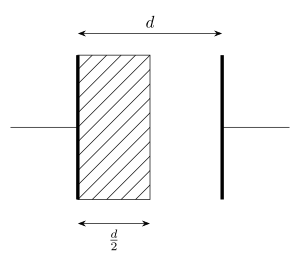
›Reveal solutionSolution
Charge is conserved once the battery is disconnected. With the dielectric slab shown occupying half the plate separation, the initial capacitance is a series combination of a dielectric-filled half-gap and a vacuum half-gap; once the dielectric is pulled out and the full gap is vacuum, working through Q=CiV=CfVf gives Vf=1+K12V, option (C).
Concept and intuition
The key idea is charge conservation after the battery is disconnected: the charge Q on the plates stays fixed no matter what happens to the dielectric afterward. Because the figure shows the dielectric slab filling only half the plate separation (not the whole gap), the capacitor must be modeled as two capacitors in series while it is being charged — one half-gap with the dielectric, one half-gap with vacuum. Once the dielectric is removed, the whole gap becomes vacuum and the capacitance drops to that of a plain parallel-plate capacitor of separation d; since Q is unchanged, V must rise to compensate for the smaller C.
Step-by-step solution
- Initial capacitance (dielectric fills half the gap, thickness d/2) Two capacitors in series, each with the full plate area A but half the separation:
C1=d/2Kε0A=d2Kε0A,C2=d/2ε0A=d2ε0A
Ci1=C11+C21=2ε0Ad(K1+1)⇒Ci=d2ε0A⋅K+1K
- Charge stored while connected to the battery
Q=CiV=d2ε0A⋅K+1K⋅V
- After disconnecting the battery and removing the dielectric The gap is now entirely vacuum, so
Cf=dε0A
Charge is unchanged (no battery connected), so Q=CfVf:
- TG EAPCET 2025Set eng-2025-05-02-FN1 markMCQQ.Photons of energy 4.5 eV are incident on a photosensitive material of work function 3 eV. The de Broglie wavelength associated with the photoelectrons emitted with maximum kinetic energy is nearly (A) 10 A˚ (B) 5 A˚ (C) 20 A˚ (D) 15 A˚
›Reveal solutionSolution
Use the photoelectric equation to find the maximum kinetic energy of the emitted electrons, then convert that energy to momentum and apply de Broglie’s relation to get the wavelength. The result is about 8.7 Å, so the closest option is 10 Å — option (A).
The problem combines two classic ideas: the photoelectric effect and the de Broglie wavelength of a particle.
The key insight: the maximum kinetic energy of the photoelectrons comes from the photon energy minus the work function. Once we know that kinetic energy, we can find the electron’s momentum, and then the de Broglie wavelength is simply λ=h/p.
- Find the maximum kinetic energy of the photoelectrons The photoelectric equation:
Kmax=hν−ϕ
Here hν=4.5 eV and ϕ=3 eV.
So
Kmax=4.5−3=1.5 eV.
- Convert kinetic energy to joules Since 1 eV=1.602×10⁻¹⁹ J,
Kmax=1.5×1.602×10−19=2.403×10⁻¹⁹ J.
- Find the momentum of the electron For a non‑relativistic electron (1.5 eV is tiny compared to its rest energy 511 keV),
p=2meKmax.
Electron mass me=9.109×10⁻³¹ kg.
p=2×9.109×10−31×2.403×10−19.
First compute the product inside:
2×9.109×10−31×2.403×10−19=4.378×10−49.
Then
p=4.378×10−49=6.617×10⁻²⁵ kg⋅m/s.
- Apply de Broglie’s relation
λ=ph,
with Planck’s constant h=6.626×10⁻³⁴ J⋅s.
- TG EAPCET 2024Set ap-2024-05-08-FN1 markMCQQ.If the wavelength of the incident radiation on a photosensitive metal surface is decreased from 3100 A˚ to 1550 A˚, the maximum kinetic energy of the emitted photoelectrons is tripled. The work function of the metal surface is (A) 3 eV (B) 4 eV (C) 2 eV (D) 6 eV
›Reveal solutionSolution
When the wavelength of incident light decreases, the photon energy increases, leading to higher kinetic energy of emitted photoelectrons. By applying Einstein's photoelectric equation for two different wavelengths and using the given relationship between kinetic energies, we find the work function of the metal. The work function is 2 eV.
The problem describes a scenario involving the photoelectric effect, where light incident on a metal surface causes electrons to be ejected. The core concept here is Einstein's photoelectric equation, which relates the energy of the incident photon, the work function of the metal, and the maximum kinetic energy of the emitted photoelectrons.
Concept and Intuition
When light shines on a metal surface, if the photons have sufficient energy, they can eject electrons from the metal. This phenomenon is called the photoelectric effect.
- Photon Energy (E): Light consists of discrete packets of energy called photons. The energy of a single photon is directly proportional to its frequency (ν) and inversely proportional to its wavelength (λ).
E=hν=λhc
where h is Planck's constant and c is the speed of light.
- Work Function (ϕ): This is the minimum energy required to remove an electron from the surface of a particular metal. It's a characteristic property of the metal. Electrons deeper inside the metal require more energy to escape, but the work function refers to the minimum energy for the most loosely bound electrons at the surface.
- Maximum Kinetic Energy (Kmax): When a photon strikes an electron, it transfers its energy. If this energy is greater than the work function, the electron is ejected. Any excess energy beyond the work function is converted into the kinetic energy of the emitted electron. Since the work function is the minimum energy to escape, the maximum kinetic energy is achieved by electrons that require only this minimum energy to escape.
Einstein's photoelectric equation elegantly combines these ideas:
Kmax=E−ϕ=λhc−ϕ
This equation tells us that the maximum kinetic energy of the emitted photoelectron is the energy of the incident photon minus the work function of the metal. If the photon energy is less than the work function, no photoemission occurs, regardless of the intensity of the light.
In this problem, we are given two different wavelengths of incident radiation and the corresponding relationship between the maximum kinetic energies. We can set up two equations based on Einstein's photoelectric equation and then solve them simultaneously to find the unknown work function.
Step-by-step Solution
-
Identify the given information and constants:
- Initial wavelength, λ1=3100 A˚
- Final wavelength, λ2=1550 A˚
- Relationship between maximum kinetic energies: Kmax,2=3Kmax,1
- We need to find the work function, ϕ.
- For calculations involving photon energy, it's convenient to use the product hc. Since the wavelengths are in Angstroms and the options for work function are in electron volts (eV), we use the value hc≈12400 eV⋅A˚.
-
Apply Einstein's photoelectric equation for the first case:
When the wavelength is λ1=3100 A˚, let the maximum kinetic energy be Kmax,1.
The photon energy is E1=λ1hc.
Using Einstein's equation: …
- Photon Energy (E): Light consists of discrete packets of energy called photons. The energy of a single photon is directly proportional to its frequency (ν) and inversely proportional to its wavelength (λ).
- TG EAPCET 2024Set ap-2024-05-07-FN1 markMCQQ.Two photons of energies 2.5eV and 5.5eV incident on a metal surface of work function 1.5eV. The ratio of the maximum speeds of the photoelectrons emitted from the metal surface is (A) 1:4 (B) 1:2 (C) 1:1 (D) 5:11
›Reveal solutionSolution
The maximum kinetic energy of a photoelectron is the photon energy minus the work function; since kinetic energy scales with speed squared, the ratio of maximum speeds is the square root of the ratio of the excess energies, giving 1:2.
The key concept here is the photoelectric effect: a photon’s energy is used first to overcome the work function (the minimum energy needed to free an electron), and any leftover energy becomes the electron’s kinetic energy. The maximum speed corresponds to the case where no energy is lost to internal collisions, so all excess energy goes into kinetic energy: Kmax=hf−ϕ. Since kinetic energy is 21mv2, the speed is proportional to the square root of the excess energy.
Let’s work through it step by step.
- Write the photoelectric equation For a photon of energy E, the maximum kinetic energy of an emitted electron is
Kmax=E−ϕ,
where ϕ=1.5eV is the work function.
- Compute the excess energies
- For the 2.5eV photon:
K1=2.5−1.5=1.0eV.
- For the 5.5eV photon:
K2=5.5−1.5=4.0eV.
- Relate kinetic energy to speed Since K=21mv2, we have v=m2K. The mass m of the electron is the same for both, so the ratio of maximum speeds is v2v1=K2K1. …
- TG EAPCET 2024Set eng-2024-05-10-AN1 markMCQQ.The work function of a photosensitive metal surface is 1.1 eV. Two light beams of energies 1.5 eV and 2 eV incident on the metal surface. The ratio of the maximum velocities of the emitted photoelectrons is (A) 3:4 (B) 1:1 (C) 2:3 (D) 4:9
›Reveal solutionSolution
The maximum kinetic energy of a photoelectron is the photon energy minus the work function, and since kinetic energy scales with velocity squared, the ratio of velocities is the square root of the ratio of the excess energies. The correct ratio is 2:3, so option (C).
The key concept here is the photoelectric effect: a photon gives all its energy to an electron, but the electron must first overcome the binding energy (work function ϕ) to escape. The leftover energy becomes kinetic energy. Since kinetic energy K=21mv2, the velocity v is proportional to K. So the ratio of velocities is the square root of the ratio of the kinetic energies, not the photon energies themselves.
Let’s work it through:
- Find the kinetic energy for each photon. For the first beam: photon energy E1=1.5 eV, work function ϕ=1.1 eV. Maximum kinetic energy:
K1=E1−ϕ=1.5−1.1=0.4 eV.
For the second beam: E2=2.0 eV, so
K2=2.0−1.1=0.9 eV.
- Relate kinetic energy to velocity. Since K=21mv2, we have v∝K. Therefore,
v2v1=K2K1.
- Plug in the numbers. …
- TG EAPCET 2023Set ap-2023-05-11-AN1 markMCQQ.An electric charge (q) moves along a metal tube with a variable cross-section as shown in the figure. It's velocity at the wider position A is Vo. Then the velocity of the charge when it approaches the neck of tube (position B) is (A) greater than Vo (B) equal to Vo (C) less than Vo (D) less than or equal to Vo
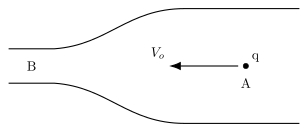
›Reveal solutionSolution
Inside a metallic tube the charge feels no force (a conductor screens the field), so it moves at constant speed — the velocity at the neck B equals Vo.
Concept: The tempting (wrong) analogy is fluid flow, where the equation of continuity (A1v1=A2v2) forces the speed to increase where the cross-section narrows. But a single charge is not an incompressible fluid; its motion is governed by Newton's laws, i.e. by the forces on it.
Reasoning:
- The tube is metal (a conductor). The electrostatic field inside the body of a conductor is zero, and a neutral conducting enclosure screens the interior. …
- TG EAPCET 2023Set eng-2023-05-14-FN1 markMCQQ.Metal detector works on the principle of (A) Ohm’s law (B) Coulomb’s law (C) Electromagnetic induction (D) Stefan’s law of radiation
›Reveal solutionSolution
A metal detector works by generating a changing magnetic field that induces currents in metal objects; this is the principle of electromagnetic induction, making option (C) correct.
The key concept here is electromagnetic induction — the production of an electric current in a conductor when it is exposed to a changing magnetic field. A metal detector doesn’t simply “sense” metal; it actively creates a magnetic field that changes over time. When this field encounters a metal object, it induces tiny electric currents (called eddy currents) in the metal. Those currents then create their own magnetic field, which the detector picks up. The other options are unrelated: Ohm’s law deals with voltage, current, and resistance in a circuit; Coulomb’s law describes electrostatic forces between charges; Stefan’s law is about thermal radiation.
Let’s break down why each option is or isn’t correct:
-
Ohm’s law (A) — This law states V=IR, relating voltage, current, and resistance. While a metal detector contains circuits that obey Ohm’s law, the operating principle of detection is not Ohm’s law. It doesn’t explain how the detector senses metal.
-
Coulomb’s law (B) — This law describes the force between stationary electric charges: F=kr2q1q2. Metal detectors do not rely on static electric charges; they rely on changing magnetic fields, so this is incorrect. …
-
- TG EAPCET 2023Set eng-2023-05-14-FN1 markMCQQ.At very high frequencies, the current (i) in the given circuit is [FIGURE] (A) 4 A (B) 0.4 A (C) 44 A (D) 4.4 A
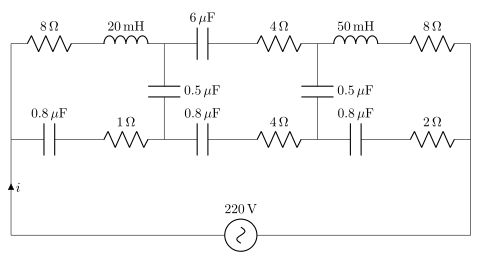
›Reveal solutionSolution
At ω→∞ capacitors short and inductors open. The ladder collapses to 1Ω+(4∥4)+2Ω=5Ω, giving i=220/5=44 A — option (C).
The concept first
A frightening-looking AC network becomes trivial once you use the two limiting behaviours of reactive elements:
XC=ωC1 ω→∞ 0(capacitor→short circuit)
XL=ωL ω→∞ ∞(inductor→open circuit)
Why? A capacitor opposes a change of voltage; at very high frequency the voltage barely has time to build up across it, so it offers almost no opposition — a wire. An inductor opposes a change of current; at very high frequency the back-emf is enormous, so essentially no current gets through — a break.
Once every capacitor is a wire and every inductor is a gap, all the reactances vanish, the impedance is purely resistive, and Ohm's law i=V/R finishes the job. (The values 6μF, 0.8μF, 0.5μF, 20 mH, 50 mH are deliberate red herrings — none of them matters in the limit.)
Step-by-step
1. Kill the inductors (open circuits).
- The upper row begins 8Ω→20mH→…. With the 20mH open, the 8Ω leads nowhere: it is a dead branch carrying zero current. Delete it.
- Similarly, near the right the 50mH opens, orphaning the last upper 8Ω (which only connects to the right terminal through that broken inductor). Delete it too.
2. Short every capacitor.
- The three 0.8μF capacitors in the lower row become wires, so the lower row reduces to just its resistors: 1Ω, then 4Ω, then 2Ω in series from the left terminal to the right terminal.
- The 6μF capacitor in the upper row becomes a wire, so the upper 4Ω is now directly connected between the two cross-link nodes.
- The two 0.5μF cross-links become wires, welding each upper node to the lower node beneath it. …
- TG EAPCET 2022Set ap-2022-07-31-FN1 markMCQQ.When the brakes are applied to two cars moving with initial velocities V and 2V and the cars stop at distances d1 and d2 respectively. Assuming the work done on the cars is the same, then the value of ratio d1d2 is (A) 1 (B) 2 (C) 0.5 (D) 4
›Reveal solutionSolution
The key idea is that the work done by the brakes equals the change in kinetic energy, and since the work is the same for both cars, the stopping distance is proportional to the square of the initial speed. The ratio d1d2 is 4, so the correct option is (D).
Concept and Intuition
When brakes are applied, the force of friction (assumed constant) does work to bring the car to rest. The work-energy theorem tells us that the net work done on an object equals its change in kinetic energy. Here, the work done by the brakes is the same for both cars, so the initial kinetic energy of each car is entirely dissipated by the same braking force over different distances. Since kinetic energy depends on the square of velocity, a car starting at twice the speed has four times the kinetic energy, and thus needs four times the stopping distance if the braking force is constant.
Step-by-step solution
-
Apply the work-energy theorem
For each car, the work done by the brakes (which is the net work, since other forces are balanced) equals the change in kinetic energy. The car starts with kinetic energy 21mv2 and ends at rest, so the work done is W=21mv2.
-
Express work in terms of force and distance
If the braking force F is constant (same for both cars, as the problem implies identical braking conditions), then the work done is also W=F⋅d, where d is the stopping distance. Thus:
Fd=21mv2
- Write equations for both cars For the first car (initial speed V, stopping distance d1):
Fd1=21mV2
For the second car (initial speed 2V, stopping distance d2):
-
🎓Unlock everything free for 14 days
- ✓Full step-by-step solutions
- ✓Concept-first explanations
- ✓Methods, shortcuts & mistakes
- ✓PYQ mapping + timed mock tests
Full access for 14 days. No credit card required.