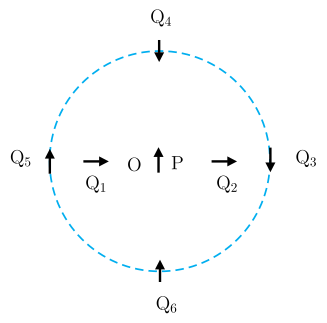
Q.Figure 5.4 shows a small magnetised needle P placed at a point O. The arrow shows the direction of its magnetic moment. The other arrows show different positions (and orientations of the magnetic moment) of another identical magnetised needle Q.
🔒You're viewing a preview — the full solution, concept, methods & PYQ mapping are locked.
🔒 Start your 14-day free trial to unlock the full solution →Concept understanding — Magnetic Poles
Magnetic Poles: The Intuition First
Imagine you have a bar magnet — the kind you might have stuck on your refrigerator. If you bring two of them close, something interesting happens. Sometimes they snap together with a satisfying click. Other times, they push each other away, refusing to touch no matter how hard you try.
That's not random. Every magnet has two special regions, one at each end, where the magnetic force is strongest. These are its magnetic poles.
The word "pole" comes from the Greek polos, meaning "pivot" or "axis" — the Earth itself has a North Pole and a South Pole, and it behaves like a giant magnet.
The Two Types of Poles
Every magnet has exactly two poles: a north pole and a south pole. You cannot have a magnet with only one pole — cut a bar magnet in half, and each half immediately becomes a complete magnet with its own north and south poles.
The rule of interaction is simple and memorable:
- Unlike poles attract: north pulls south, south pulls north.
- Like poles repel: north pushes north away; south pushes south away.
This is the fundamental behaviour. No exceptions.
The Precise Statement
Magnetic poles are the regions of a magnet where the external magnetic field is strongest. Every magnet has exactly two poles — a north pole and a south pole — that cannot be isolated. Like poles repel; unlike poles attract.
The key points to remember for exams:
- Poles always come in pairs — there is no magnetic monopole (a single isolated pole) in nature, despite decades of searching.
- The north pole is defined as the pole that points toward Earth's geographic north when the magnet is freely suspended.
- The south pole points toward Earth's geographic south.
A Common Confusion (Watch Out)
Earth's geographic North Pole is actually a magnetic south pole. Why? Because the north pole of a compass needle (which is a magnetic north pole) is attracted to it. And unlike poles attract. So the Earth's north pole behaves like a magnetic south pole. This often trips students up in exams.
Why This Matters …
Why this formula?
Magnetic Poles: Why the Key Formulas Hold
Let's build this from first principles — understanding why a magnetic pole behaves the way it does, not just memorizing the result.
1. What Is a Magnetic Pole?
A magnetic pole is a conceptual point where the magnetic field appears to originate or terminate. In reality, magnetic poles always come in north-south pairs (no isolated monopoles exist in nature), but we treat them as idealized sources for calculations.
- North pole: source of magnetic field lines (outward)
- South pole: sink of magnetic field lines (inward)
2. The Key Formula: Force Between Two Magnetic Poles
The force between two magnetic poles of strengths m1 and m2, separated by distance r, is:
F=4πμ0⋅r2m1m2
Why this form?
This is a Coulomb's law analog — and that's not a coincidence. Here's the reasoning:
-
Experimental observation: Magnetic poles attract/repel with a force that:
- Varies as 1/r2 (inverse square law)
- Is proportional to the product of pole strengths
- Depends on the medium (via μ0, the permeability of free space)
-
Mathematical analogy: The magnetic field B at distance r from a single pole m is:
B=4πμ0⋅r2m
This comes from Gauss's law for magnetism applied to a point source.
- Force derivation: The force on pole m2 in the field of pole m1 is:
F=m2⋅B1=m2⋅(4πμ0⋅r2m1)
Hence:
F=4πμ0⋅r2m1m2
Key insight: The 1/r2 dependence is not arbitrary — it follows from the geometry of 3D space (flux spreads over a sphere of area 4πr2).
3. The Magnetic Field of a Bar Magnet (Two Poles)
For a bar magnet of length 2l with poles +m and −m, the field at a point on the axis at distance x from the center is:
B=4πμ0⋅(x2−l2)22ml
Why this form?
-
Superposition principle: The total field is the vector sum of fields from the north pole (+m) and south pole (−m).
-
Field from north pole at distance (x−l):
BN=4πμ0⋅(x−l)2m(away from north)
- Field from south pole at distance (x+l):
BS=4πμ0⋅(x+l)2m(toward south)
- Net field (both along same direction on axis):
B=BN−BS=4πμ0m[(x−l)21−(x+l)21]
- Simplify using algebra:
(x−l)21−(x+l)21=(x2−l2)24xl
Therefore:
B=4πμ0⋅(x2−l2)24mxl
But for a bar magnet, the magnetic moment is M=m⋅(2l) (pole strength × separation). So 2ml=M, giving:
B=4πμ0⋅(x2−l2)22Mx
Key insight: The field is not simply 1/r2 because we have two poles — the net effect is a dipole field, which falls off as 1/r3 at large distances.
4. The Far-Field Approximation (Dipole Formula)
For x≫l (far from the magnet), x2−l2≈x2, so:
B≈4πμ0⋅x32M
Why 1/x3?
- A single pole gives 1/r2 …
Needle Q sits in the dipole field BP of the central needle P, whose moment points up. Its orientation energy is U=−mQ⋅BP=−mBcosθ. Equilibrium (τ=mQ×BP=0) needs mQ parallel (stable, U minimum) or antiparallel (unstable, U maximum) to the local field.
- On P's axis (Q4 top, Q6 bottom) the field points up (parallel to mP), magnitude Baxial=4πμ0r32m.
- On P's equator (Q1, Q2, Q3, Q5) the field points down (antiparallel to mP), magnitude Beq=4πμ0r3m. …
P's moment points up, so its field is upward on the axis (at Q4, Q6) and downward on the equator (at Q1, Q2, Q3, Q5). A needle is in equilibrium only when its moment is parallel (stable) or antiparallel (unstable) to the local field. (a) Q1 and Q2 are not in equilibrium. (b) Stable: Q3 and Q6; unstable: Q4 and Q5. (c) Q6 has the lowest potential energy.
Concept Understanding
Each needle is a magnetic dipole. Needle Q sits in the field BP of the central needle P, whose moment points up. The orientation energy is U=−mQ⋅BP=−mBcosθ, where θ is the angle between mQ and the local field.
- On P's axis (top point Q4, bottom point Q6) the dipole field is parallel to mP (points up), with magnitude Baxial=4πμ0r32m.
- On P's equator (Q1, Q2 near O, and Q3, Q5 on the circle) the field is antiparallel to mP (points down), with magnitude Beq=4πμ0r3m.
Zero torque (τ=mQ×BP=0) requires mQ parallel or antiparallel to the local field. Parallel (θ=0) is a potential-energy minimum, so stable; antiparallel (θ=180∘) is a maximum, so unstable.
Step-by-Step Solution
| Needle | Position | Local BP | mQ | θ | Verdict |
|---|---|---|---|---|---|
| Q1 | near O (equator) | down | right | 90∘ | torque =0 -> not in equilibrium |
| Q2 | near O (equator) | down | right | 90∘ | torque =0 -> not in equilibrium |
| Q3 | right (equator) | down | down | 0∘ | stable |
Method: Equilibrium of a Dipole in Another Dipole's Field
This method applies to any problem where several small magnetic (or electric) dipoles are placed at different points around a central dipole, and you must classify each one's equilibrium state.
Steps
Step 1: Identify the field pattern of the source dipole
A dipole's field has two characteristic symmetry zones you should recognise on sight:
- On the axial line (extension of the dipole axis): field is parallel to the dipole moment, magnitude
Baxial=4πμ0r32m
- On the equatorial line (perpendicular bisector through the centre): field is antiparallel to the dipole moment, magnitude
Beq=4πμ0r3m
For any other angular position, use the general dipole field expression instead of assuming one of these two special cases.
Step 2: Write the equilibrium condition
A dipole placed in a field B feels torque τ=m×B. Equilibrium (τ=0) requires m to be parallel or antiparallel to the local field at that point — never to the source dipole's own moment direction, and never to some average or global direction.
Step 3: Classify stable vs unstable using potential energy
U=−m⋅B=−mBcosθ …
- TG EAPCET 2023Set eng-2023-05-14-AN1 markMCQQ.A current ‘i’ is flowing through a wire of length ‘L’. If it is made into a circular loop of one turn, then its magnetic moment is (A) 4πL2i (B) 4πL2 (C) L2i4π (D) 4πL2i
›Reveal solutionSolution
The magnetic moment of a current loop is the product of current and area. For a wire of length L bent into a single circular turn, the radius is L/(2π), so the area is L2/(4π), giving a magnetic moment of 4πL2i. The correct option is (A).
Concept & Intuition
The magnetic moment of a planar current loop is defined as μ=iA, where i is the current and A is the area vector (magnitude = area, direction perpendicular to the loop). When you have a fixed length of wire, bending it into a circle maximizes the enclosed area for a single turn. The problem gives the wire length L and current i; we just need to find the radius of the circle that can be formed, compute its area, and multiply by the current.
Step-by-step reasoning
- Relate wire length to loop circumference The entire wire of length L is used to make one circular turn. Therefore, the circumference of the loop equals L.
2πr=L⇒r=2πL.
- Compute the area of the loop The area of a circle of radius r is πr2. Substituting r:
A=π(2πL)2=π⋅4π2L2=4πL2.
- Magnetic moment For a single-turn loop carrying current i, the magnetic moment is …
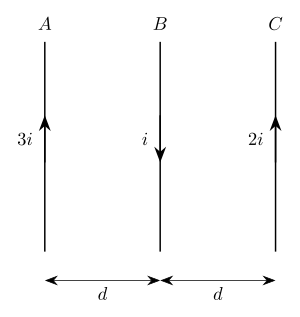
- TG EAPCET 2023Set eng-2023-05-14-FN1 markMCQQ.Three long, straight, parallel wires carrying different currents are arranged as shown in the diagram. In the given arrangement, let the net force per unit length on the wire ‘C’ be F. If the wire ‘B’ is removed without disturbing the other two wires, then the force per unit length on wire ‘A’ is (A) −F (B) 3F (C) 2F (D) −3F
›Reveal solutionSolution
With k=2πdμ0i2, the net force per unit length on C is F=−kx^ (towards A). After removing B, wire A feels only C's attraction, +3kx^, which is −3F — option (D).
The concept first
Two long parallel wires a distance d apart, carrying I1 and I2, exert on each other a force per unit length
LF=2πdμ0I1I2,
attractive if the currents are in the same direction, repulsive if opposite ("like currents attract" — the opposite of like charges, a classic memory trap).
Because forces are vectors, we must fix a sign convention. Put the wires on the x-axis in the order A, B, C from left to right, and call rightwards positive. Define the convenient unit
k=2πdμ0i2.
Given: IA=3i (up), IB=i (down), IC=2i (up); spacings AB=BC=d, so AC=2d.
Step-by-step
Part 1 — the net force per unit length on C (this defines F).
- Force from A on C. IA and IC are both up ⇒ parallel ⇒ attraction. C is pulled to the left (towards A). Separation 2d:
FA→C=2π(2d)μ0(3i)(2i)=26⋅2πdμ0i2=3k(leftwards)=−3k.
- Force from B on C. IB is down, IC is up ⇒ antiparallel ⇒ repulsion. C is pushed away from B, i.e. to the right. Separation d:
FB→C=2πdμ0(i)(2i)=2k(rightwards)=+2k.
- Add:
F=−3k+2k=−k(magnitude k, directed from C towards A).
Part 2 — the force per unit length on A once B is removed. …
- TG EAPCET 2022Set eng-2022-07-20-FN1 markMCQQ.Three parallel wires a, b and c carrying currents ia,ib and ic as shown in the figure are placed next to each other. The magnitude force on a length l of the wire a, if d2=2d1, ib=ia and ic=4ia is (A) 6πd1μ0ia2l (B) 2πd1μ0ia2l (C) 4πd1μ0ia2l (D) 3πd1μ0ia2l
›Reveal solutionSolution
Wire a is pulled toward b (parallel currents attract) and pushed away from c (anti-parallel currents repel); these forces oppose, so the net magnitude is Fac−Fab=6πd1μ0ia2l — option (A).
Setup. The wires sit in the order a — b — c. Given ib=ia, ic=4ia, spacing a–b =d1 and b–c =d2=2d1, so the a–c separation is d1+d2=3d1. The force per length between two parallel wires carrying I1,I2 a distance r apart is
F=2πrμ0I1I2l,
attractive for parallel currents, repulsive for anti-parallel.
Force from b (parallel to a, attractive, toward b).
Fab=2πd1μ0iaibl=2πd1μ0ia2l=6πd13μ0ia2l.
Force from c (anti-parallel to a, repulsive, away from c). …
- TG EAPCET 2021Set ap-2021-08-09-FN1 markMCQQ.The strength of earth’s magnetic field on the earth’s surface is of the order (A) 10−5 T (B) 10−15 T (C) 10−10 T (D) 10−20 T
›Reveal solutionSolution
The Earth’s magnetic field at the surface is roughly 0.3–0.6 × 10⁻⁴ T, so the order of magnitude is 10⁻⁵ T. The correct option is (A).
The key idea is to recall a familiar fact: a typical compass needle aligns with the Earth’s field, and that field is weak but measurable — about half a gauss. In SI units, 1 gauss = 10⁻⁴ T, so the surface field is around 0.5 × 10⁻⁴ T = 5 × 10⁻⁵ T. That’s squarely in the 10⁻⁵ T ballpark.
Let’s walk through the reasoning step by step.
-
Recall the typical strength
The Earth’s magnetic field at the surface is often given as 0.3 to 0.6 gauss. Since 1 gauss = 10⁻⁴ tesla, this converts to 3×10⁻⁵ T to 6×10⁻⁵ T.
-
Identify the order of magnitude
The order of magnitude is the power of ten when the number is written in scientific notation. Both 3×10⁻⁵ and 6×10⁻⁵ have the exponent –5. So the order is 10−5 T.
-
Compare with the options
- (A) 10−5 T → matches.
- (B) 10−15 T → that’s a trillion times weaker (typical of interstellar magnetic fields).
- (C) 10−10 T → still 100,000 times weaker (more like a laboratory shielded field).
- (D) 10−20 T → absurdly tiny (comparable to fields in deep space between galaxies).
-
Confirm with a sanity check …
-
- TG EAPCET 2021Set eng-2021-08-04-FN1 markMCQQ.A wire of length l carries a current I along the X-axis. The magnetic force acting on the wire is given by F=IB0l(k^−j^) T where B0 is a constant. The existing magnetic field B is (A) B0(i^) (B) B0(i^+j^−k^) (C) B0(i^+j^+k^) (D) B0(i^−j^−k^)
›Reveal solutionSolution
The magnetic force on a current-carrying wire is F=I(l×B). Given l=li^ and F=IB0l(k^−j^), comparing components shows B=B0(i^+j^+k^), which is option (C).
The core idea here is the Lorentz force on a current-carrying conductor: F=I(l×B), where l is a vector along the wire in the direction of the current. The problem gives you the force and the wire's orientation, so you can work backwards to find the magnetic field.
The wire lies along the X-axis, so l=li^. The force is given as F=IB0l(k^−j^). Notice the force has no i^ component — that's a crucial clue about which components of B can exist.
Let's solve it step by step.
- Write the cross product explicitly. Let B=Bxi^+Byj^+Bzk^. Then
l×B=(li^)×(Bxi^+Byj^+Bzk^)
Since i^×i^=0, i^×j^=k^, and i^×k^=−j^, we get
l×B=l(Byk^−Bzj^)
- Multiply by current to get force.
F=I(l×B)=Il(Byk^−Bzj^)
The problem states F=IB0l(k^−j^). Comparing the two expressions:
- Coefficient of k^: IlBy=IlB0⟹By=B0
- Coefficient of j^: −IlBz=−IlB0⟹Bz=B0
- What about Bx? …
- TG EAPCET 2021Set eng-2021-08-06-FN1 markMCQQ.Force acting on an electron moving with velocity V in a magnetic field B is (e is the charge of electron) (A) e(V×B) (B) e(V⋅B) (C) BeV (D) VeB
›Reveal solutionSolution
The magnetic force on a moving charge is given by the Lorentz force law: F=q(v×B). For an electron, q=−e, so the magnitude is e(V×B) but direction is opposite. The correct option is (A).
The question asks for the force acting on an electron moving with velocity V in a magnetic field B. This is a direct application of the Lorentz force law, which describes how charged particles behave in electromagnetic fields.
The key concept is that a magnetic field exerts a force only on a moving charge, and that force is always perpendicular to both the velocity and the magnetic field. This perpendicular nature is captured by the cross product — not the dot product or any division. The dot product would give a scalar (a number), not a vector force, and division of vectors is not a defined operation in physics.
For a particle with charge q, the magnetic force is F=q(v×B). For an electron, the charge is q=−e, where e is the elementary charge (a positive constant). So the force on an electron is F=−e(V×B). The magnitude is e∣V×B∣, and the direction is opposite to that of V×B.
Now let's examine each option:
-
Option (A): e(V×B)
This gives the correct magnitude and the correct cross-product form, but the sign is positive. Since the question asks for "force acting on an electron" and gives e as the charge of the electron (a positive constant), the actual force is −e(V×B). However, in many exam contexts, the magnitude or the expression for the magnitude is what's intended, and the negative sign is understood to come from the charge. Option (A) is the standard textbook expression for the magnitude of the magnetic force on an electron.
-
Option (B): e(V⋅B) …
-
🎓Unlock everything free for 14 days
- ✓Full step-by-step solutions
- ✓Concept-first explanations
- ✓Methods, shortcuts & mistakes
- ✓PYQ mapping + timed mock tests
Full access for 14 days. No credit card required.