Q.Name the pathological condition when uncontrolled cell division occurs.
🔒You're viewing a preview — the full solution, concept, methods & PYQ mapping are locked.
🔒 Start your 14-day free trial to unlock the full solution →Concept understanding — Cancer Cell Biology
Imagine a city where every cell is a citizen with a specific job. Skin cells form the outer wall, stomach cells digest food, nerve cells carry messages. Each citizen follows a strict rulebook: grow when needed, stop when the job is done, and eventually die to make room for younger replacements. This orderly cycle is what keeps the city healthy.
Now, what happens if one citizen suddenly stops listening to the rules? It starts growing uncontrollably, refuses to die, and begins crowding out its neighbours. Worse, it might break through the city walls and travel to a different district, setting up a new colony there. That rogue citizen is a cancer cell. Cancer cell biology is the study of how normal, well-behaved cells turn into these rebellious, destructive ones.
The core idea: a breakdown of cellular discipline
Every cell in your body contains a complete set of instructions — your DNA. Think of DNA as the city's master blueprint and rulebook. Inside that blueprint are specific genes that act like traffic lights: some tell the cell to grow (these are called proto-oncogenes), and others tell it to stop growing or to self-destruct when damaged (these are called tumour suppressor genes).
Cancer begins when these traffic lights break. A proto-oncogene might get stuck on green, so the cell grows non-stop. Or a tumour suppressor gene might get stuck on red, so the cell never gets the signal to stop or die. Usually, a single broken light isn't enough — the cell has backup systems. But over years, multiple lights break, and the cell loses all control.
Cancer is not one disease but a collection of diseases. All cancers share one fundamental property: uncontrolled cell division caused by accumulated damage to the DNA. The type of cancer depends on which original cell type went rogue (e.g., lung cells → lung cancer, skin cells → skin cancer).
How a normal cell becomes cancerous: a step-by-step intuition
-
Initiation — A cell's DNA gets damaged by something (a chemical in cigarette smoke, UV radiation from the sun, a random copying error during cell division). This damage is a mutation. One mutation alone rarely causes cancer, but it's the first crack in the rulebook.
-
Promotion — The damaged cell is now slightly more prone to grow. If it encounters more damaging agents (promoters), it accumulates more mutations. Each mutation pushes it further from normal behaviour.
-
Progression — After several mutations, the cell now divides rapidly, ignores signals to stop, and refuses to die. It forms a mass of cells called a tumour. Not all tumours are cancerous — benign tumours stay in one place and don't invade neighbours. Malignant tumours are the dangerous ones: they invade nearby tissues and can break off to travel through blood or lymph vessels.
-
Metastasis — This is the most dangerous step. A few cancer cells detach from the original tumour, travel through the bloodstream or lymphatic system, and settle in a distant organ (like the liver, lungs, or brain). There, they start a new tumour. This spread is what makes cancer so hard to treat.
Why does this matter for you?
You don't need to memorise gene names or pathways. What matters is understanding the logic behind prevention and treatment:
- Prevention works because most cancers take years to develop. Avoiding known DNA-damaging agents (tobacco, excessive sun, certain viruses like HPV) reduces the chance of those first mutations.
- Early detection works because a small, localised tumour can often be surgically removed before it metastasises. …
The normal cell cycle is under tight genetic control specifically so that growth, DNA copying and division proceed in a coordinated, regulated way.
- All the events of the cell cycle are described as being under genetic control, which is what ensures division proceeds correctly and each progeny cell receives an intact genome. …
The cell cycle is normally kept under tight genetic control, and when that regulation fails, the resulting uncontrolled division of cells is the condition known as cancer.
The chapter is clear that every event of the cell cycle — the coordinated growth of the cell, the precise, single-stage replication of its DNA, and the careful division of chromosomes to daughter nuclei — is under genetic control. This regulation exists specifically to ensure that division proceeds correctly and that each new cell produced receives an intact, complete genome.
This tight coupling of growth, DNA duplication and division is what keeps a body's cell population in check: cells divide roughly as often as needed for growth or to replace lost cells, and no more. …
Step 1 — Recall that the cell cycle's growth/replication/division events are normally under tight genetic control.
Step 2 — Identify the described failure mode: cells dividing without that normal regulation, i.e. unchecked, uncontrolled …
- Higher Secondary (+2 Stage) Examination 2025Set ANNUAL4 marksQ.(i) What is metastasis?(ii) Write the difference between a benign tumour and a malignant tumour.(iii) Write the names of two tests for the diagnosis and detection of cancer. OR(i) What is called immunity?(ii) Mention the names of two hallucinogenic drugs.(iii) Show the life cycle of the malaria parasite by means of a diagram. (Description not required.)
›Reveal solutionSolution
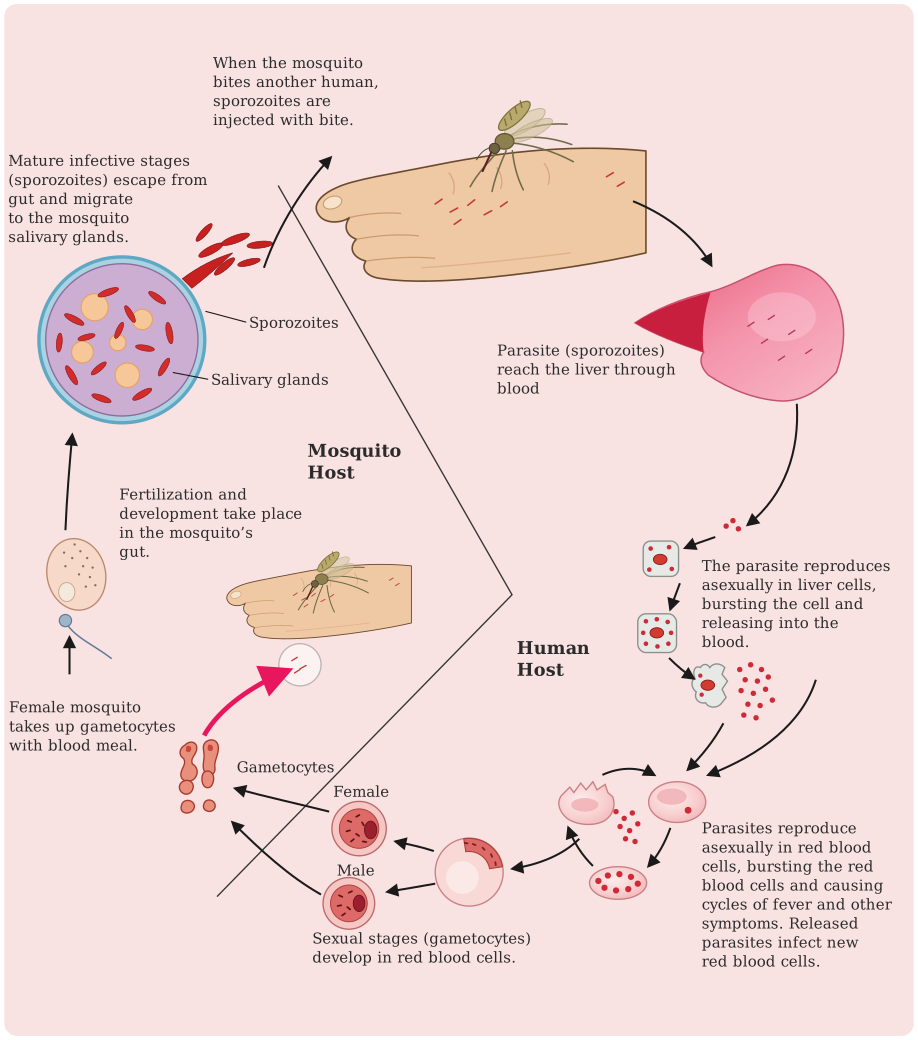
Figure — The internal-choice OR alternative explicitly says 'Show the life cycle of the malaria parasite by means of a Metastasis is how cancer spreads to distant organs, forming secondary tumours, and malignant tumours (unlike benign ones) invade and metastasise; several tests can diagnose cancer. (OR: immunity fights disease, some drugs cause hallucinations, and the malaria parasite has a complex life cycle alternating between humans and the Anopheles mosquito.)
- Metastasis: the phenomenon in which cancerous (malignant) cells break away from the primary tumour, travel through the blood or lymphatic system, and lodge in a new, distant part of the body, where they multiply and form a new, secondary tumour. This ability to invade and spread is the most dangerous property of cancer cells.
- Benign vs malignant tumour:
Benign tumour Malignant tumour Grows slowly, stays confined/localised, usually encapsulated Grows rapidly and uncontrollably Does not invade neighbouring tissue and does not metastasise Invades surrounding normal tissue and metastasises to distant organs Usually not life-threatening; removal is often curative Life-threatening, can cause organ failure/death (iii) Two tests for cancer diagnosis: biopsy and histopathological (microscopic) study of the suspected tissue; and imaging techniques such as radiography (X-rays), CT scan, MRI or PET scan (blood tests for specific tumour biomarkers are also used).
OR alternative:
- Immunity: the overall ability/capacity of the body to defend itself against foreign, disease-causing organisms (pathogens) and other harmful substances (antigens); it is broadly of two types, innate immunity (present from birth, non-specific) and acquired immunity (develops after exposure to a pathogen/antigen, pathogen-specific, with memory).
- Two hallucinogenic drugs: cannabinoid compounds obtained from the plant Cannabis sativa (marijuana/hashish/charas/ganja - acting on cannabinoid receptors in the brain), and atropine-type alkaloids from Atropa belladonna and Datura (LSD, lysergic acid diethylamide, is another commonly cited synthetic hallucinogen).
- Life cycle of the malaria parasite (Plasmodium) - shown as a labelled sequence in place of a hand-drawn figure, since only text can be submitted here:
- An infected female Anopheles mosquito bites a human and injects sporozoites into the blood.
- Sporozoites reach the liver, multiply inside liver cells, and release merozoites into the blood. …
- Higher Secondary (+2 Stage) Examination 2023Set ANNUAL4 marksQ.What do you understand by contact inhibition and metastasis? Write the name of one method used in cancer detection and the name of one treatment method for cancer. (marks 1x4)
›Reveal solutionSolution
Loss of contact inhibition allows cancer cells to divide uncontrollably, and metastasis lets them invade distant organs; biopsy/histopathology detects cancer, and radiotherapy (among other options) treats it.
Contact inhibition: This is the normal property of cells whereby, when a growing population of cells comes into physical contact with other cells (forming a monolayer/confluent sheet), their uncontrolled growth/division is inhibited/stopped. Cancer cells LOSE this property of contact inhibition, and hence continue to divide uncontrollably, forming a mass/tumour even when in contact with neighbouring cells.
Metastasis: This is the phenomenon in which cancer cells from the primary tumour invade the surrounding normal tissue, and then travel through the blood or lymphatic system to reach distant parts of the body, where they establish new (secondary) tumours. Metastasis is what makes cancer especially life-threatening, as it spreads the disease throughout the body.
…
🎓Unlock everything free for 14 days
- ✓Full step-by-step solutions
- ✓Concept-first explanations
- ✓Methods, shortcuts & mistakes
- ✓PYQ mapping + timed mock tests
Full access for 14 days. No credit card required.