Biology · Ch 13 — Plant Growth and Development
Plant Growth Generally is Indeterminate
Plant Growth Generally is Indeterminate
Plant growth is unique because plants retain the capacity for unlimited growth throughout their life. This remarkable ability is due to the presence of meristems at certain locations in the plant body. The cells of a meristem have the capacity both to divide and to self-perpetuate — that is, to keep producing new cells while also renewing themselves.
- When a meristematic cell divides, one product usually remains meristematic, while the other soon loses the capacity to divide; these cells then mature and make up the bulk of the plant body.
- Because new cells are continually being added to the plant body by the activity of the meristem, this pattern is called the open form of growth, and growth of this kind is described as indeterminate.
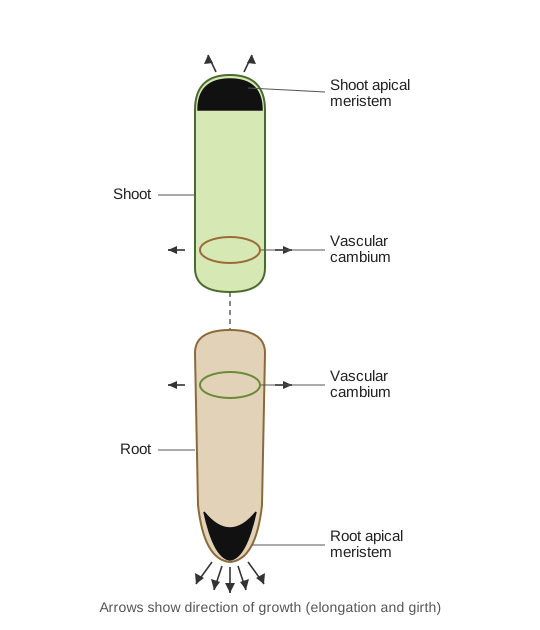
In earlier classes the root apical meristem and the shoot apical meristem were studied. These apical meristems are responsible for the primary growth of plants and principally bring about the elongation of the plant along its axis. …
Drawn by us to help you understand the concept clearly, and verified to make sure it's accurate. For exams, practice from your textbook's own diagram.
This diagram shows where the main meristems sit in a plant and the directions in which they drive growth. At the top of the shoot lies the shoot apical meristem, and at the tip of the root lies the root apical meristem; the arrows at these two ends point outward along the axis, indicating that these apical meristems bring about primary growth, the elongation of the plant in length. Running lengthwise within both the shoot and the root is the vascular cambium, a lateral meristem. The sideways-pointing arrows along the cambium show that it adds cells to increase the girth of the organ — this is secondary growth. By separating the apical meristems (which add length) from the lateral cambium (which adds thickness), the figure make …