Chemistry · Ch 2 — Structure of Atom
Aufbau Principle
Aufbau Principle
2.6.4a Aufbau Principle
The word aufbau is German for "building up." In chemistry, the aufbau principle describes how electrons are added to an atom's orbitals as we move from one element to the next. The principle states:
In the ground state of an atom, electrons fill orbitals in order of increasing energy.
This means an electron always occupies the lowest-energy orbital available. Only after that orbital is full does the next electron move into a higher-energy orbital. The entire process is governed by three rules working together: the aufbau principle itself, the Pauli exclusion principle, and Hund's rule of maximum multiplicity.
The Order of Orbital Energies
The energy of an orbital depends on the effective nuclear charge () that an electron experiences, and different types of orbitals (, , , ) are affected to different extents. Because of this, there is no single ordering of orbital energies that is perfectly correct for every atom. However, the following sequence is remarkably accurate for the placement of valence electrons in all atoms:
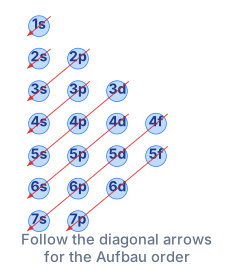
A useful way to remember this order is to draw the orbitals in rows by principal quantum number () and then follow the arrows from the top right to the bottom left.
Drawn by us to help you understand the concept clearly, and verified to make sure it's accurate. For exams, practice from your textbook's own diagram.
The figure is a mnemonic grid, not a graph. It arranges orbital labels (1s, 2s, 2p, 3s, 3p, 4s, 3d, and so on) in a table-like layout. The rows correspond to the principal quantum number , running from at the top down to at the bottom. The columns correspond to the azimuthal quantum number : the subshell () on the far left, then (), (), and () moving to the right. Each orbital label sits inside a light-blue circle placed at the intersection of its row and column.
What makes the diagram useful is a set of dashed diagonal arrows that run from the top-right corner down toward the bottom-left. Each arrow passes through several orbital circles in sequence. Following the arrows from the topmost one gives the order in which orbitals are filled with electrons in a ground-state atom: 1s, 2s, 2p, 3s, 3p, 4s, 3d, 4p, 5s, 4d, 5p, 6s, 4f, 5d, 6p, 7s, 5f, 6d, 7p. This sequence is the Aufbau order.
The physical idea the figure teaches is that orbital energy does not increase simply with . For example, the 4s orbital (, ) fills before the 3d orbital (, ) because 4s has a lower energy in neutral atoms. The diagonal arrows encode the rule: the energy of an orbital increases with the sum , and for orbitals with the same , the one with the smaller has lower energy. The figure lets you read off this ordering without calculating each time.
Here is the principal quantum number (shell number) and is the azimuthal quantum number (0 for , 1 for , 2 for , 3 for ). The rule is a guide, not a law — it works well for neutral atoms in their ground states, but exceptions occur when orbitals are very close in energy. …
…