Question of 78
Q.(i) What is cloning?
(ii) Mention two characteristics of a vector.
(iii) Draw a diagram of the E. coli cloning vector pBR322 and mark the Ori region and the EcoRI region.
OR
Write the main use, in biotechnology, of each of the following:
(a) Gene gun,
(b) Gel electrophoresis,
(c) Selectable marker,
(d) Ethidium bromide.
Tripura TbseHigher Secondary (+2 Stage) Examination 2025Subjective· 4mImportance★★★★★
0% · 0/78 Questions
You're viewing a preview — the full solution, concept, methods & PYQ mapping are locked.
Start your 14-day free trial to unlock the full solution →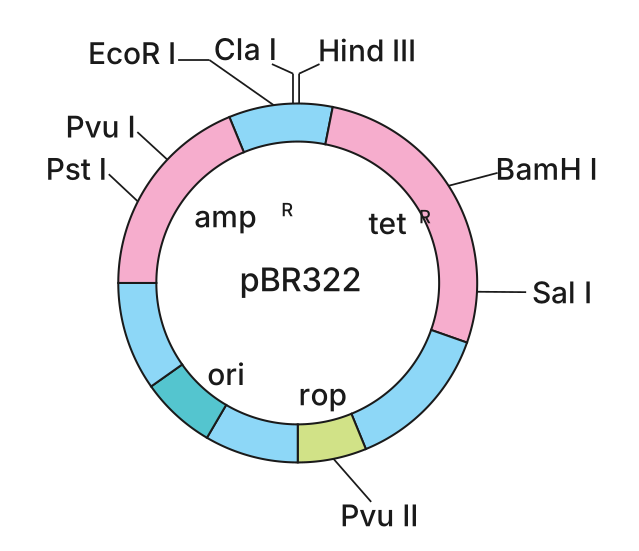
Cloning vectors like the plasmid pBR322 need an origin of replication and selectable markers to carry and multiply a gene of interest; several other tools (gene gun, gel electrophoresis, markers, ethidium bromide) support the broader cloning workflow.
- Cloning: the process of producing multiple identical copies of any DNA fragment/gene (or, in the wider sense, an entire cell/organism) by an asexual, non-sexual method - in genetic engineering, 'molecular cloning' specifically means inserting a gene of interest into a self-replicating vector (like a plasmid) and allowing it to be copied many times inside a host cell.
- Two characteristics a good cloning vector must have:
- An origin of replication (ori) - a specific DNA sequence from which replication starts, allowing the vector (and any DNA linked to it) to replicate autonomously inside the host cell.
- A selectable marker - usually an antibiotic-resistance gene (e.g. ampicillin or tetracycline resistance) that helps identify and select the host cells that have taken up the vector (transformants) from those that have not. (A vector should also ideally have a small size and few, unique recognition sites for restriction enzymes, for convenient cloning.)
(iii) The E. coli cloning vector pBR322 (described in place of a hand-drawn diagram): pBR322 is a small, circular double-stranded plasmid, about 4361 base pairs long, engineered for use as a cloning vector. Its main labelled features are:
- The ori (origin of replication) region, from which the plasmid replicates inside E. coli.
- Two antibiotic-resistance selectable marker genes: ampR (ampicillin resistance) and tetR (tetracycline resistance), located at different points around the circular map.
- Several unique restriction sites for enzymes including EcoRI, BamHI, HindIII, PstI, PvuII and SalI - some of these sites lie within the ampR gene (e.g. PstI) or within the tetR gene (e.g. BamHI, HindIII, SalI), so inserting foreign DNA at such a site inactivates that particular marker gene; this 'insertional inactivation' is used to identify which host cells have actually taken up the recombinant plasmid, by testing for loss of the corresponding antibiotic resistance. The unique EcoRI site, used to open the map at position 0, lies outside the ampR gene.
OR alternative - main biotechnology use of each: …
Unlock everything free for 14 days
- Full step-by-step solutions
- Concept-first explanations
- Methods, shortcuts & mistakes
- PYQ mapping + timed mock tests
Full access for 14 days. No credit card required.