Question 42 of 42
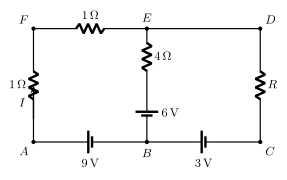
Q.Using Kirchhoff's rules, calculate the potential difference between B and D in the circuit diagram as shown in the figure.
Tripura TbseCBSE Class XII Board 2018Subjective· 3mImportance★★★★★
100% · 42/42 Questions
You're viewing a preview — the full solution, concept, methods & PYQ mapping are locked.
Start your 14-day free trial to unlock the full solution →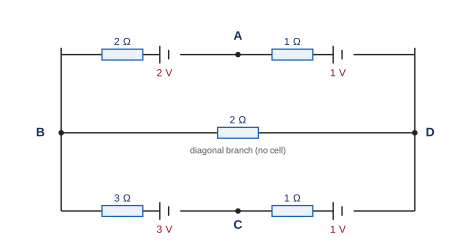
Reduce to three parallel branches between B and D; using the numerator is zero, so .
Concept. Corner A connects only to B (via AB) and D (via AD), and corner C connects only to B (via BC) and D (via DC). So A and C are simple pass-through nodes, and the circuit is three branches in parallel between nodes B and D:
- Branch via A: , cells V and V.
- Branch via C: , cells V and V.
- Diagonal: , no cell.
Kirchhoff's rules. Let . With each cell taken to drive current around the loop ABCD in the same sense, the net emf aiding the DB direction is V in the A-branch and V in the C-branch. Each branch current (taken DB) is . KCL at node D (no external connection) gives : …
Unlock everything free for 14 days
- Full step-by-step solutions
- Concept-first explanations
- Methods, shortcuts & mistakes
- PYQ mapping + timed mock tests
Full access for 14 days. No credit card required.