Question of 42
Q.(i) State Kirchhoff's junction rule and loop rule. Which physical quantities' conservation do these two rules validate?
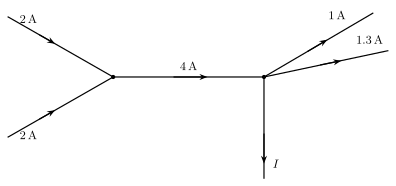
(ii) In the circuit diagram below, if the potential at point C is 10V, what is the potential at point D?
OR
How can the emfs of two cells be compared with the help of a potentiometer? Draw the circuit diagram.
Tripura TbseHigher Secondary (+2 Stage) Examination 2024Subjective· 3mImportance★★★★★
0% · 0/42 Questions
You're viewing a preview — the full solution, concept, methods & PYQ mapping are locked.
Start your 14-day free trial to unlock the full solution →Kirchhoff's junction rule is charge conservation at a node; the loop rule is energy conservation around a closed path. Applying the junction rule at C gives 3A flowing into the 3Ω branch, so V and V.
(i) Kirchhoff's rules:
- Junction rule (Kirchhoff's Current Law): At any junction in a circuit, the algebraic sum of currents meeting at that junction is zero — i.e. the total current flowing INTO a junction equals the total current flowing OUT of it. This follows from the conservation of electric charge (charge cannot accumulate at a junction in steady state).
- Loop rule (Kirchhoff's Voltage Law): The algebraic sum of the changes in potential (emfs and IR drops) around any closed loop in a circuit is zero. This follows from the conservation of energy (the electric potential is a single-valued function of position, so going around any closed loop must return you to the same potential). …
Unlock everything free for 14 days
- Full step-by-step solutions
- Concept-first explanations
- Methods, shortcuts & mistakes
- PYQ mapping + timed mock tests
Full access for 14 days. No credit card required.