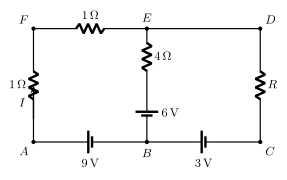
Q.Using Kirchhoff's laws, determine the values of I and R in the given circuit. (Assume that no current flows through the 4Ω resistor.)
You're viewing a preview — the full solution, concept, methods & PYQ mapping are locked.
Start your 14-day free trial to unlock the full solution →Since the 4(ohm) branch carries no current, the whole outer loop F-E(D)-C-B-A-F behaves as a single-current series loop; combine its KVL equation with the zero-current branch's potential-balance condition (V_E - V_B = 6V, the full 6V-cell EMF with no IR drop across the 4-ohm resistor) to solve simultaneously for I and R.
Since E and D are joined by a plain connecting wire, they are at the same potential (). Because no current flows through the 4(ohm)/6V branch connecting E to B, that branch draws no current from the rest of the circuit -- the main current I simply circulates around the single outer loop F to E(D) to C to B to A and back to F.
Step 1 -- the zero-current branch. With no current through the 4(ohm) resistor, there is no IR drop across it, so the potential difference between E and B is due entirely to the 6V cell in that branch:
Step 2 -- the same potential difference via the main loop. Going from E through R (between D/E and C) and then through the 3V cell to reach B (reading the cells' polarities as oriented in the printed figure): …
Unlock everything free for 14 days
- Full step-by-step solutions
- Concept-first explanations
- Methods, shortcuts & mistakes
- PYQ mapping + timed mock tests
Full access for 14 days. No credit card required.