Biology · Ch 3 — Plant Kingdom
Pteridophytes
Pteridophytes
Pteridophytes are a group of plants that includes the horsetails and the ferns. They have several practical uses: they are employed for medicinal purposes, act as soil-binders that hold the soil together, and are frequently grown as ornamental plants.
A major evolutionary step
Pteridophytes hold an important place in plant evolution because they are the first land plants to possess vascular tissues, namely the xylem and the phloem, which conduct water and food through the plant body. They generally grow in cool, damp, shady places, although some can thrive in sandy-soil conditions.
The dominant sporophyte
In bryophytes the dominant phase of the life cycle is the gametophyte, but in pteridophytes the situation is reversed. Here the main plant body is the sporophyte, and it is far more advanced, being differentiated into true roots, a true stem and true leaves. All of these organs contain well-developed vascular tissues.
- The leaves may be small, called microphylls, as seen in Selaginella, or large, called macrophylls, as seen in ferns.
- The sporophytes bear sporangia, and these sporangia are supported by leaf-like appendages known as sporophylls.
- In some plants the sporophylls cluster together to form compact structures called strobili or cones, as in Selaginella and Equisetum.
Within the sporangia, spore mother cells undergo meiosis to produce spores.
The gametophyte: the prothallus
When a spore germinates, it grows into a gametophyte that is inconspicuous and small but multicellular, mostly photosynthetic, and thalloid in form. This gametophyte is called a prothallus. It requires cool, damp, shady places to survive. Because of this narrow, specific requirement, together with the need for water during fertilisation, living pteridophytes cannot spread widely and are confined to limited geographical regions.
The prothallus bears the male and female sex organs, the antheridia and archegonia respectively. Water is needed to carry the antherozoids, the male gametes released from the antheridia, to the mouth of the archegonium. When a male gamete fuses with the egg inside the archegonium, a zygote is formed. This zygote then develops into a multicellular, well-differentiated sporophyte, which is the dominant phase of the pteridophyte life cycle.
Homospory and heterospory
Most pteridophytes produce only one kind of spore, and such plants are described as homosporous. A few genera, such as Selaginella and Salvinia, produce two different kinds of spores: large megaspores and small microspores. Plants of this type are called heterosporous.
- The megaspores germinate into female gametophytes.
- The microspores germinate into male gametophytes. …
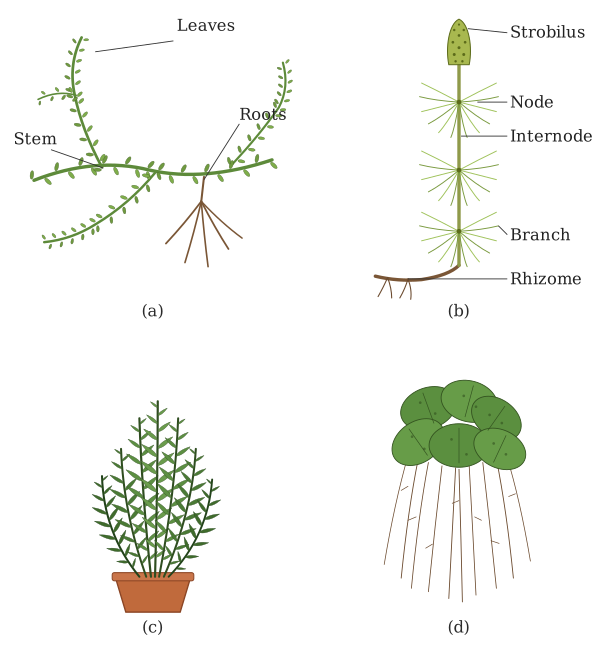
Drawn by us to help you understand the concept clearly, and verified to make sure it's accurate. For exams, practice from your textbook's own diagram.
This plate shows examples of pteridophytes, the first plants to have proper vascular tissue for conducting water and food. (a) Selaginella is a small plant whose parts are marked out as leaves, stem and roots.
(b) Equisetum, the horsetail, is drawn as a jointed, ribbed stem in which each part is labelled — the node where a joint occurs, the internode between two nodes, a side branch arising at a node, and the underground rhizome from which the whole shoot grows — with a cone-like strobilus capping the tip.
(c) The fern is shown simply as a whole potted plant with its characteristic large, divided, feathery fronds; this particular photograph is a plain habit shot and does not show any close-up of the spore-bearing sori that real ferns carry on the underside of their fronds. …