Chemistry · Ch 4 — Chemical Bonding and Molecular Structure
Types of H-Bonds
Types of H-Bonds
4.9.2 Types of H-Bonds
A hydrogen bond is a special type of dipole-dipole attraction. It forms when a hydrogen atom is sandwiched between two highly electronegative atoms — specifically fluorine (F), oxygen (O), or nitrogen (N). The hydrogen atom is covalently bonded to one electronegative atom (the donor) and is attracted to another electronegative atom (the acceptor). This attraction is what we call a hydrogen bond.
Hydrogen bonds are classified into two distinct types based on where the participating atoms are located.
(1) Intermolecular Hydrogen Bond
This bond forms between two different molecules. The molecules can be of the same compound or of different compounds.
Intermolecular hydrogen bonding is the reason water has such a high boiling point compared to other hydrides of group 16 elements. It takes a lot of energy to break these bonds between water molecules.
Examples:
- Hydrogen fluoride (HF): The hydrogen of one HF molecule is attracted to the fluorine of a neighbouring HF molecule.
- Water (H₂O): The hydrogen of one water molecule is attracted to the oxygen of another water molecule.
- Alcohols (e.g., ethanol, C₂H₅OH): Similar to water, the hydrogen of the –OH group in one alcohol molecule bonds with the oxygen of another.
In all these cases, the hydrogen bond acts as a bridge between separate molecules, linking them together into larger associated clusters.
(2) Intramolecular Hydrogen Bond
This bond forms within a single molecule. It occurs when a hydrogen atom is already bonded to a highly electronegative atom (F, O, or N) in a molecule, and that same molecule also contains another highly electronegative atom (F, O, or N) positioned nearby. The hydrogen atom is then attracted to this second electronegative atom, forming a bond inside the same molecule.
A common mistake is to think intramolecular hydrogen bonding is a covalent bond. It is not. It is still an electrostatic attraction, just like intermolecular hydrogen bonding. The key difference is that the attraction is within the same molecule, not between different molecules.
Example: …
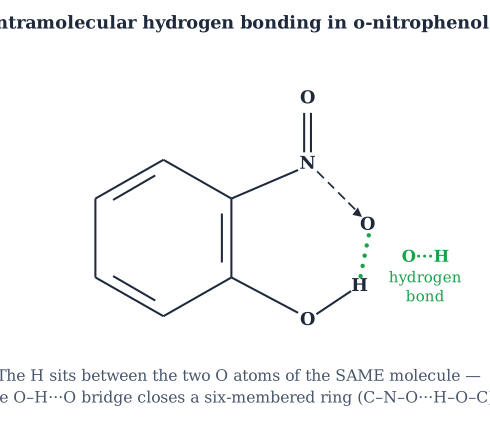
Drawn by us to help you understand the concept clearly, and verified to make sure it's accurate. For exams, practice from your textbook's own diagram.
Fig. 4.22 is a structural diagram of a single o-nitrophenol molecule. It shows the benzene ring with an –OH group and a –NO₂ group attached to adjacent carbon atoms (the ortho position). A dashed line is drawn from the hydrogen of the –OH group to one of the oxygen atoms of the –NO₂ group. This dashed line represents the intramolecular hydrogen bond. The atoms involved — O–H···O — together with the atoms connecting them form a six-membered ring: the two benzene carbons bearing the –OH and –NO₂ groups, the nitrogen, the two oxygens and the hydrogen. The figure makes it clear that the hydrogen atom is simultaneously bonded covalently to its own oxygen and, through a weaker electrostatic attraction, to the nearby oxygen of the nitro group.
The physical idea is simple but powerful. A hydrogen bond forms when a hydrogen atom is sandwiched between two highly electronegative atoms (F, O, or N). In o-nitrophenol, both the –OH oxygen and the –NO₂ oxygen are highly electronegative, and the molecule’s geometry brings them close enough that the hydrogen can interact with both. Because this happens within the same molecule, it is called an intramolecular hydrogen bond. The dashed line is not a covalent bond — it is a strong dipole-dipole attraction, typically about 10–40 kJ/mol, much weaker than a covalent bond but stronger than ordinary van der Waals forces.
The key distinction the figure teaches: in an intermolecular H-bond, the hydrogen links two separate molecules (e.g., between two water molecules). In an intramolecular H-bond, the hydrogen links two atoms within the same molecule, forming a ring — in o-nitrophenol the hydrogen sits between the two oxygen atoms.
No formula is developed directly from this figure in the NCERT text. The figure is purely illustrative. However, the concept of hydrogen bonding is often quantified by the bond energy. For an intramolecular H-bond like the one shown, the stabilization energy can be estimated from the difference in properties (e.g., boiling point, IR frequency shift) between the ortho isomer and its meta or para counterparts, which cannot form such a ring. The general condition for any hydrogen bond is:
…