Chemistry · Ch 4 — Chemical Bonding and Molecular Structure
Types of Molecular Orbitals
Types of Molecular Orbitals
Classifying Molecular Orbitals by Symmetry
The molecular orbitals of diatomic molecules are designated by their symmetry about the internuclear (bond) axis: sigma (), pi () and delta ().
Sigma () Molecular Orbitals — Symmetrical About the Bond Axis
A molecular orbital looks the same from every angle as you rotate the molecule about the bond axis — it is cylindrically symmetrical.
- Two atomic orbitals combine to give the (bonding) and (antibonding) pair.
- Taking the internuclear axis as the z-direction, two orbitals meet head-on along that axis, and their linear combination again produces two sigma orbitals: and .
The bonding member concentrates electron density between the nuclei; the antibonding member has a node there (Section 4.7.1).
Pi () Molecular Orbitals — Not Symmetrical About the Bond Axis
Molecular orbitals built from or atomic orbitals are not symmetrical about the bond axis, because their parent orbitals have positive lobes above and negative lobes below the molecular plane. These combine sidewise:
- with gives (bonding) and (antibonding); likewise gives and .
- A bonding MO carries its electron density above and below the internuclear axis (a nodal plane contains the axis itself).
- A antibonding MO has, in addition, a node between the nuclei.
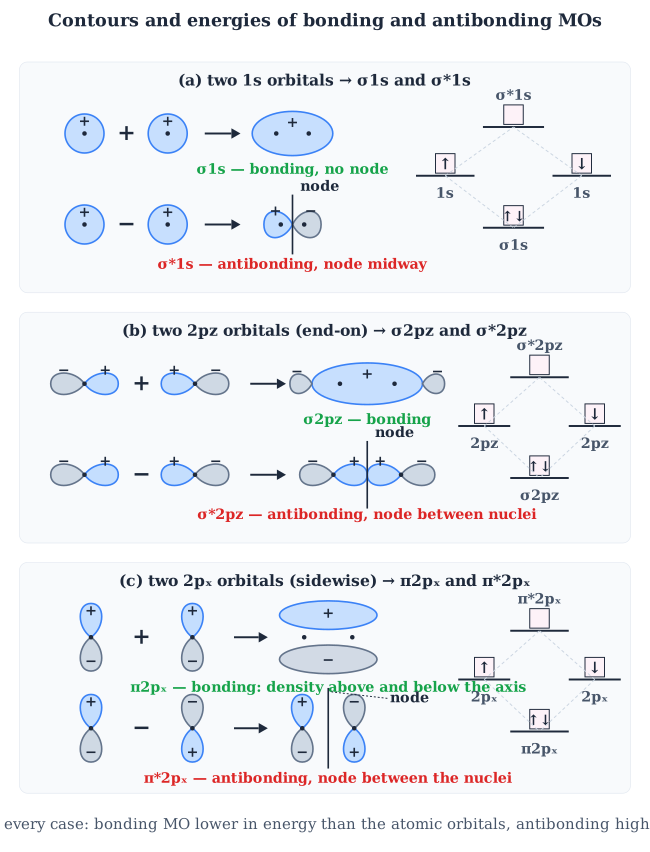
Drawn by us to help you understand the concept clearly, and verified to make sure it's accurate. For exams, practice from your textbook's own diagram.
Figure 4.20 is the visual foundation for molecular orbital (MO) theory in the chapter. It shows three separate panels, one for each type of atomic orbital combination, and each panel has two parts: a contour diagram on the left and an energy-level diagram on the right.
What each panel teaches
Panel (a) shows two 1s atomic orbitals combining. The contour diagram on the left depicts the electron density: for the bonding MO (σ1s), the contours from the two atoms overlap constructively between the nuclei, concentrating electron density in the internuclear region. For the antibonding MO (σ1s), a nodal plane appears exactly midway between the nuclei, where the wavefunctions cancel. The energy-level diagram on the right places σ1s lower than the original 1s atomic level, and σ1s higher by the same amount — the classic splitting pattern.
Panel (b) does the same for 2pz orbitals approaching end-on (along the internuclear axis). The bonding combination (σ2pz) shows a single region of high electron density along the axis, with no node between the nuclei. The antibonding combination (σ*2pz) has a nodal plane perpendicular to the axis, cutting through the midpoint. The energy splitting is larger than for 1s because 2p orbitals extend further and overlap more strongly.
Panel (c) treats 2px orbitals overlapping sideways (perpendicular to the internuclear axis). Here the bonding MO (π2px) has electron density above and below the axis, with a nodal plane along the axis itself. The antibonding MO (π*2px) has an additional nodal plane between the nuclei. The energy splitting for π orbitals is smaller than for σ orbitals because sideways overlap is weaker than end-on overlap.
The physical idea
The figure drives home a single core principle: when atomic orbitals combine, they always produce two molecular orbitals — one lower in energy (bonding) and one higher (antibonding). The number of nodes in the wavefunction increases by one when going from bonding to antibonding. The type of overlap (σ or π) determines both the shape of the contours and the magnitude of the energy splitting.
The key formula the textbook develops with this figure
The textbook uses this figure to introduce the relationship between bond order and electron count. For a diatomic molecule, the bond order is:
where is the number of electrons in bonding molecular orbitals and is the number of electrons in antibonding molecular orbitals. A bond order of 1 corresponds to a single bond, 2 to a double bond, and so on. A bond order of zero means the molecule is unstable. …