Mathematics · Ch 3 — Trigonometric Functions
Degree Measure
Degree Measure
The Idea of Degree Measure
An angle is formed by rotating a ray (the initial side) to a new position (the terminal side). The size of the angle depends on how much rotation has occurred. The most familiar unit for measuring this rotation is the degree.
One degree (written as ) is defined as exactly of a complete revolution. In other words, if you rotate the initial side all the way around so it lands back on itself, you have turned through .
Why ? This number was chosen by ancient mathematicians (likely the Babylonians) because it is divisible by many integers — 2, 3, 4, 5, 6, 8, 9, 10, 12, 15, 18, 20, 24, 30, 36, 40, 45, 60, 72, 90, 120, and 180 — making it convenient for dividing a circle into equal parts.
Subdividing a Degree: Minutes and Seconds
For measurements that require more precision than a whole degree, we use two finer subdivisions:
- One sixtieth of a degree is called a minute, written as .
- One sixtieth of a minute is called a second, written as .
This gives the following conversion relations:
So, for example, an angle of means 30 degrees, 15 minutes, and 45 seconds. This system is called sexagesimal (base-60) and is still used in navigation, astronomy, and surveying.
A common mistake is to treat minutes and seconds as decimal fractions of a degree. They are not. is , not . Always convert carefully: .
Examples of Angles in Degree Measure
The textbook illustrates several angles measured in degrees, both positive and negative. The sign convention is:
- A positive angle results from a counter-clockwise rotation from the initial side to the terminal side.
- A negative angle results from a clockwise rotation.
Some standard angles you will encounter frequently are:
- — one full revolution (counter-clockwise).
- — a half revolution (a straight line).
- — three-quarters of a revolution.
- — one full revolution () plus an extra (so the terminal side is the same as for ).
- — a clockwise rotation of (terminal side is the same as for ). …
Drawn by us to help you understand the concept clearly, and verified to make sure it's accurate. For exams, practice from your textbook's own diagram.
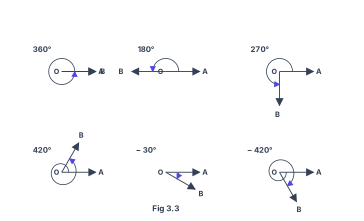
Fig. 3.3 is a visual definition of what an angle is in geometry — not just a static corner, but a directed rotation. The figure shows six separate ray diagrams, each with the same starting point: a vertex labelled O, an initial side OA drawn horizontally to the right, and a terminal side OB that has been rotated away from OA. A curved arrow (or spiral) between OA and OB marks the rotation, and the size of that rotation is written next to the diagram.
The six diagrams are arranged in a 3×2 grid. They show angles of , , , , , and . The first three are the most familiar: shows a full circle — the terminal side OB lands exactly back on OA, and the rotation arc is a complete loop. is a half-turn, so OB points directly left. is three-quarters of a turn, so OB points straight down. These three establish the idea that a positive angle means an anticlockwise rotation from OA.
The next three diagrams extend the idea. is larger than — the rotation arc is drawn as a spiral that goes around once and then continues for another . This shows that an angle can be more than one full revolution; the terminal side OB ends up in the same position as it would for , but the rotation itself is larger. The last two diagrams introduce negative angles: shows a small clockwise arc from OA to OB, so OB lies below the horizontal. is a clockwise rotation of more than one full turn — the spiral goes clockwise once around and then another , ending at the same place as .
The key physical idea is that an angle is not just a shape — it is a directed amount of turn. The same final position of OB can come from many different rotations (e.g., , , , etc.). This is the foundation for the concept of coterminal angles.
The textbook uses this figure to ground the definition of degree measure given in the surrounding text. One degree () is defined as of a full revolution. So a angle is exactly one full revolution, is half a revolution, and so on. The figure makes this concrete: you can see the fraction of the circle swept out.
The central formula that emerges from this figure — and the one you will use constantly — is the relationship between an angle measured in degrees and the number of revolutions:
For a positive angle, the number of revolutions is positive (anticlockwise). For a negative angle, it is negative (clockwise). So means one full anticlockwise revolution plus another . Similarly, means one full clockwise revolution plus another clockwise. …