Mathematics · Ch 3 — Trigonometric Functions
Radian Measure
Radian Measure
The Idea of a Radian
Degrees are not the only way to measure an angle. There is a more natural unit, called the radian, that is based directly on the geometry of a circle. The definition is simple and powerful.
Take a circle of radius 1 unit — this is called a unit circle. Now consider an arc of that circle whose length is exactly 1 unit. The angle that this arc subtends at the centre of the circle is defined to be 1 radian.
The word "radian" comes from "radius". An angle of 1 radian is the angle you get when you wrap one radius-length of arc around the circumference.
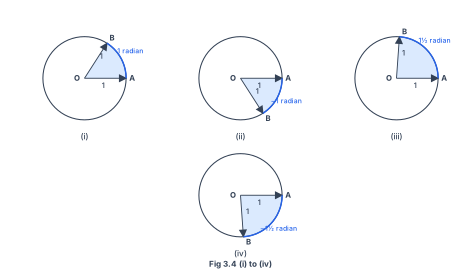
The textbook shows this with a series of figures (Fig 3.4). In each figure, OA is the initial side (starting position) and OB is the terminal side (ending position). The figures illustrate angles of:
- 1 radian
- –1 radian (measured clockwise)
- radians
- – radians
The negative sign simply indicates the direction of rotation — clockwise instead of anticlockwise.
Relating Radians to a Full Revolution
We know that the circumference of a circle of radius 1 unit is (since circumference ). One complete revolution of the initial side sweeps out the entire circumference. Therefore, one full revolution subtends an angle of radians.
This is the fundamental link between radians and the circle: radians = one full turn.
The General Case: A Circle of Any Radius
The definition extends naturally to a circle of any radius . In such a circle, an arc of length (equal to the radius) will subtend an angle of 1 radian at the centre. This is the core geometric fact.
The key idea: the angle in radians is simply the ratio of the arc length to the radius. This ratio is dimensionless — it is a pure number.
The Central Formula:
Since equal arcs subtend equal angles at the centre, we can scale this up. If an arc of length gives an angle of 1 radian, then an arc of length will give an angle whose measure is radians.
Thus, if in a circle of radius , an arc of length subtends an angle of radians at the centre, we have the fundamental relation:
…
Drawn by us to help you understand the concept clearly, and verified to make sure it's accurate. For exams, practice from your textbook's own diagram.
The figure shows four separate unit circles, each drawn with centre and a horizontal radius of length 1 unit pointing to the right. In every circle, a second radius of length 1 unit is drawn at a specific angle from . The arc of the circle between and is highlighted in blue, and the sector (the pie-slice region bounded by , , and that arc) is shaded light blue. Each arc is labelled with its length — “1 radian”, “–1 radian”, “ radian”, or “ radian” — and the corresponding angle at the centre is given the same numerical measure.
The four panels teach one core idea: the radian measure of an angle is the length of the arc it cuts off on a unit circle. In panel (i), the arc from to has length exactly 1 unit, so the angle is 1 radian. In panel (ii), the terminal side is rotated clockwise from ; the arc length is still 1 unit, but the direction gives a negative measure, –1 radian. Panels (iii) and (iv) show arcs of length units, giving angles of radian and radian respectively. The sign convention is simple: anticlockwise rotation gives a positive angle, clockwise gives a negative one.
The unit circle has radius , so its circumference is . One full anticlockwise revolution therefore corresponds to an arc of length , which is why a complete rotation equals radians. This is the bridge between radian measure and the familiar degree measure: .
The textbook uses this figure to develop the fundamental relation between arc length, radius, and angle. On a circle of radius , an arc of length subtends an angle of 1 radian at the centre. By proportionality, an arc of length subtends an angle radians given by
Here is the angle in radians (positive for anticlockwise, negative for clockwise), is the length of the intercepted arc, and is the radius of the circle. This formula is the direct generalisation of what the figure shows for : when , and are numerically equal, which is exactly why the arc length is the radian measure on a unit circle. …