Mathematics · Ch 3 — Trigonometric Functions
Relation Between Radian and Real Numbers
Relation Between Radian and Real Numbers
The Core Idea: Radians Are Lengths on the Unit Circle
The connection between radian measure and real numbers is not a theorem to be memorised — it is a definition that makes trigonometry work as a function of real numbers. The textbook builds this idea by starting with the unit circle (radius = 1).
Take a unit circle with centre . Pick any point on the circle. The ray is the initial side of an angle. Now, if you travel along the circle from to another point , the length of the arc is exactly the radian measure of the angle (since radius = 1, arc length = angle in radians). So far, this is just the definition of a radian.
The leap comes when we attach a real number line to the circle.
The Tangent Line as a Number Line
Draw the line that is tangent to the circle at point . Call this line , where lies on one side of and on the other. Now assign:
- The point itself represents the real number 0.
- The segment (in one direction) represents positive real numbers.
- The segment (in the opposite direction) represents negative real numbers.
This is just a standard number line, but it is tangent to the circle at .
Wrapping the Line onto the Circle
Here is the key geometric operation. Imagine the line (the positive side) is flexible like a rope. You lift it off the tangent and wrap it around the circle in the anticlockwise direction, starting at . As you wrap, each point on the line lands on a unique point on the circle. The distance you have travelled along the line (the real number ) becomes the length of the arc from to that point on the circle — which is exactly the radian measure of the angle swept.
Similarly, you wrap the negative side around the circle in the clockwise direction. Each negative real number corresponds to an arc of length in the clockwise direction, giving a negative radian measure.
This wrapping process is one-to-one: every real number lands on exactly one point of the circle, and every point on the circle is hit by infinitely many real numbers (because you can go around multiple times). But for the first wrap (from to anticlockwise, and to clockwise), the correspondence is a perfect bijection between real numbers in and points on the circle.
The Consequence: Radians and Real Numbers Are Identical
Because of this wrapping, the textbook states the central conclusion:
Radian measures and real numbers can be considered as one and the same.
This is not a metaphor. When you see in calculus or physics, the "2" is a real number, but it is also the radian measure of an angle of 2 radians. There is no conversion factor needed — the number is the angle. This is why radian measure is called "natural": it makes trigonometric functions functions of real numbers, not of some separate angular unit.
This identification only works because we used the unit circle (radius = 1). If the radius were , the arc length would be , and the direct equality between the real number and the angle would break. Always check that the circle is unit radius when making this identification.
A Common Misunderstanding
Students often ask: "If radians are real numbers, why do we write radians instead of just ?" The answer is that is a real number (approximately 3.14159...). Saying " radians" is just a reminder that we are interpreting that real number as an angle measure. In advanced mathematics, the word "radians" is often dropped entirely — means the sine of radians. …
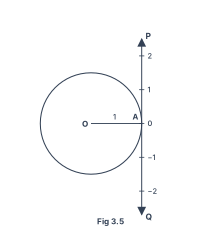
Drawn by us to help you understand the concept clearly, and verified to make sure it's accurate. For exams, practice from your textbook's own diagram.
The figure shows a unit circle — a circle of radius exactly 1, centred at O. The point A is on the circle, directly to the right of O, so OA is a horizontal radius of length 1. At A, a vertical line is drawn tangent to the circle. This tangent line is labelled PAQ: P is above A, Q is below A, and the line extends in both directions with double arrowheads, indicating it is a real-number line.
On this tangent line, A itself is marked as 0. Moving upward from A, the points are labelled 1, 2, and so on up to P. Moving downward from A, the points are labelled −1, −2, and so on down to Q. So the tangent line PAQ is a copy of the real-number line, with A as the origin.
The physical idea is this: the length of an arc of the unit circle equals the radian measure of the angle that arc subtends at the centre. Now imagine you take the positive half of the tangent line (AP) and wrap it anticlockwise around the circle. The point at distance 1 from A on the tangent lands exactly at the point on the circle where the arc length from A is 1 — which is the radian angle 1. Similarly, the point at distance 2 lands where the arc length is 2, and so on. Wrapping the negative half (AQ) clockwise does the same for negative numbers.
This gives a one-to-one correspondence: every real number on the tangent line corresponds to a unique point on the unit circle reached by travelling an arc length from A (anticlockwise if , clockwise if ). And that arc length is exactly the radian measure of the angle.
The central result is that radian measure and real numbers are identified with each other. For the unit circle, the radian measure of an angle is numerically equal to the length of the intercepted arc, and that arc length is the same as the real number assigned to the point on the tangent line after wrapping.
The key formula that emerges from this figure is the definition of the trigonometric functions on the unit circle. For any real number , let be the point on the unit circle reached by travelling units of arc length from A. Then:
…