Biology · Ch 5 — Molecular Basis of Inheritance
Transcription Unit
Transcription Unit
The Core Idea: What Defines a Transcription Unit
A transcription unit is not just any stretch of DNA that gets copied into RNA. It is a precisely defined segment, and its boundaries are set by three specific DNA regions that work together to ensure accurate transcription. Think of it as a complete "gene cassette" — the machinery of transcription recognises these boundaries, not the entire chromosome.
The Three Essential Regions of a Transcription Unit
Every transcription unit in DNA is defined by three regions, arranged in a fixed order:
- A Promoter – the start signal.
- The Structural Gene – the actual DNA that gets transcribed into RNA.
- A Terminator – the stop signal.
The promoter and terminator flank the structural gene — the promoter lies at one end, the terminator at the other. The structural gene sits between them.
The Two DNA Strands: Template vs. Coding
A critical convention governs how we name the two strands of the structural gene. Because the two strands of DNA run in opposite directions (one is 5-prime to 3-prime, the other 3-prime to 5-prime), and because RNA polymerase can only synthesise RNA in the 5-prime to 3-prime direction, the strand that actually serves as the template for RNA synthesis is the one with polarity 3-prime to 5-prime. This is called the template strand.
The other strand, which has polarity 5-prime to 3-prime, has a sequence identical to the RNA that will be produced — except that thymine (T) in DNA is replaced by uracil (U) in RNA. This strand is displaced during transcription and does not itself code for anything. Yet, oddly, it is called the coding strand.
All reference points when defining a transcription unit — such as where the promoter or terminator is located — are made with respect to the coding strand, not the template strand.
A Hypothetical Sequence to See the Pattern
The textbook gives a concrete example to make this clear. Consider a short stretch of a transcription unit:
- Template strand: 3-prime - ATGCATGCATGCATGCATGCATGC - 5-prime
- Coding strand: 5-prime - TACGTACGTACGTACGTACGTACG - 3-prime
The RNA transcribed from this DNA will be complementary to the template strand and identical (with U instead of T) to the coding strand. So the RNA sequence would be:
5-prime - UACGUACGUACGUACGUACGUACG - 3-prime
Notice that the RNA is written in the 5-prime to 3-prime direction, matching the polarity of the coding strand.
Promoter and Terminator: Location and Function
The promoter is located towards the 5-prime-end of the coding strand — this is called the upstream side of the structural gene. Its job is to provide a binding site for RNA polymerase. Crucially, the presence of a promoter in a transcription unit is what defines which strand is the template and which is the coding strand. If you were to switch the positions of the promoter and the terminator, the definitions of template and coding strands would reverse.
The terminator is located towards the 3-prime-end of the coding strand — the downstream side. It defines where the process of transcription ends.
Additional Regulatory Sequences …
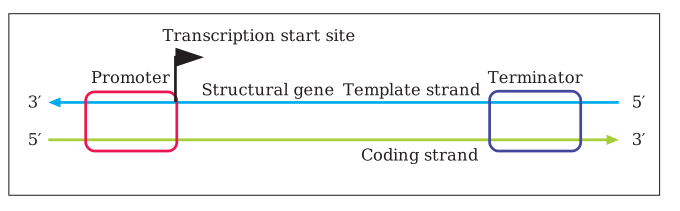
Drawn by us to help you understand the concept clearly, and verified to make sure it's accurate. For exams, practice from your textbook's own diagram.
The figure shows a linear stretch of double-stranded DNA, drawn as two parallel horizontal lines. The top strand is labelled the coding strand (polarity $5' \rightarrow 3'$), and the bottom strand is labelled the template strand (polarity $3' \rightarrow 5'$). The entire segment is divided into three distinct regions from left to right.
On the left end is the promoter region. It is positioned upstream of the structural gene, meaning it lies towards the $5'$ end of the coding strand. The promoter is not transcribed; it is a binding site for RNA polymerase. The figure makes clear that the promoter defines which strand will serve as the template — the strand that runs $3' \rightarrow 5'$ relative to the promoter's location.
To the right of the promoter is the structural gene — the actual DNA sequence that gets transcribed into RNA. Within this region, the two strands are explicitly labelled: the bottom strand is the template strand ($3' \rightarrow 5'$), and the top strand is the coding strand ($5' \rightarrow 3'$). A small arrow or directional indicator along the template strand shows that RNA polymerase moves along it in the $3' \rightarrow 5'$ direction, synthesising RNA in the $5' \rightarrow 3'$ direction. The coding strand, meanwhile, is shown displaced or not used as a template; its sequence matches the RNA transcript (except thymine replaced by uracil).
On the right end is the terminator region. It is located downstream of the structural gene, towards the $3'$ end of the coding strand. The terminator signals the end of transcription — RNA polymerase detaches here, and the RNA transcript is released. …