Q.What is the principle of transformer? Explain the working of step-up transformer by drawing circuit diagram.
🔒You're viewing a preview — the full solution, concept, methods & PYQ mapping are locked.
🔒 Start your 14-day free trial to unlock the full solution →Concept understanding — Transformer Principle
Transformer Principle: From Intuition to Precision
Imagine you have a water pipe with a narrow section and a wide section. Water flows through the narrow part fast but with low pressure; through the wide part it flows slow but with high pressure. The total amount of water (flow × pressure) stays the same. A transformer does something similar — but for electricity.
A transformer takes AC power at one voltage and current, and delivers nearly the same power at a different voltage and current. If voltage goes up, current must come down, and vice versa. The total power (voltage × current) is almost unchanged — minus a tiny loss.
The Core Idea: Mutual Induction
Two coils of wire are placed near each other, usually wound around a common iron core. When AC flows through the first coil (the primary), it creates a changing magnetic field. That changing field passes through the second coil (the secondary) and induces a voltage across it. This is mutual induction — a changing current in one coil induces a voltage in a neighbouring coil.
The iron core is crucial: it guides the magnetic field from one coil to the other with very little leakage, making the transfer efficient.
A transformer works only with AC. A steady DC current produces a constant magnetic field, which induces nothing in the secondary coil. Change is essential.
The Precise Statement
For an ideal transformer (no energy losses), the relationship between primary and secondary voltages and currents is:
VpVs=NpNsandIpIs=NsNp
where:
- Vp, Vs = primary and secondary voltages
- Ip, Is = primary and secondary currents
- Np, Ns = number of turns in primary and secondary coils
VpIp=VsIs
Power in equals power out (ideal case).
What This Means
If the secondary has more turns than the primary (Ns>Np), the secondary voltage is higher — this is a step-up transformer. Current in the secondary is correspondingly lower.
If the secondary has fewer turns (Ns<Np), the secondary voltage is lower — a step-down transformer. Current in the secondary is higher.
A step-up transformer raises voltage but lowers current. It does not create energy. The product V×I stays constant (ignoring losses). Many beginners think a step-up transformer "amplifies" power — it does not.
Why the Turns Ratio Works
The voltage induced in each turn of a coil is the same (because the same changing magnetic flux links every turn). So the total induced voltage is proportional to the number of turns:
Vp∝Np,Vs∝Ns
Dividing gives the ratio. For current, conservation of power forces the inverse relationship.
A Real Transformer: Small Losses …
A transformer transfers AC energy between two coils wound on a common soft-iron core by mutual induction, and the ratio of secondary to primary turns fixes the ratio of the voltages. …
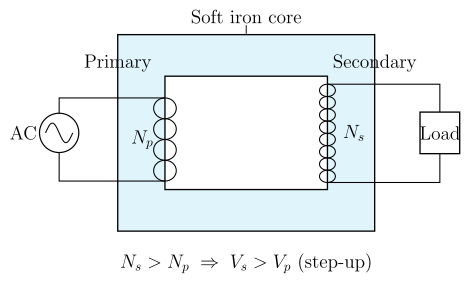
Transformer = mutual induction between two coils on a common soft-iron core; the turns ratio sets the voltage ratio. A step-up transformer has more secondary turns, so it raises the voltage.
Principle. A transformer transfers AC electrical energy from one circuit to another by mutual induction. Alternating current in the primary coil sets up a continuously changing magnetic flux; a laminated soft-iron core confines this flux so that (ideally) all of it links the secondary coil, inducing an alternating emf in it.
Working of a step-up transformer.
- Primary (Np turns) is connected to the AC input; secondary (Ns turns) delivers the output, with Ns>Np.
- The alternating primary current makes the core flux ϕ change with time. The emf induced per turn, −dtdϕ, is the same for both coils, so VpVs=NpNs=k (>1 for step-up).
- Since Ns>Np, the output voltage Vs>Vp — the voltage is stepped up. …
Showing the 12 most recent of 17 on this concept.
- CBSE 2026Set ANNUAL1 markMCQQ.An ideal transformer has 500 turns in the primary and 5000 turns in the secondary. If the primary be connected to a 6 V battery, then the secondary voltage is(a) 0(b) 0.6 V(c) 60 V(d) 6 V
›Reveal solutionSolution
A transformer needs a changing current/flux to work. A DC battery gives a constant current, so once steady state is reached the secondary voltage is 0.
A transformer works on the principle of mutual induction: the emf induced in the secondary is
es=−Mdtdip
…
- CBSE 2026Set ANNUAL1 markQ.Why cannot a transformer be used to step up direct current (D.C.)?
›Reveal solutionSolution
No changing flux, no induced EMF — a transformer needs AC to work at all.
A transformer operates on the principle of mutual induction: a time-varying current in the primary coil produces a time-varying magnetic flux in the core, which links the secondary coil and induces an EMF in it, given by ε2=−N2dtdΦ. With a constant DC current in the primary, the flux in the core, once established, remains steady (constant) — its rate of change dΦ/dt is zero in the steady state. Since the induced EMF depends entirely on this rate of change, no EMF (and hence no stepped-up voltage) is induced in the secondary for steady DC, so a t …
- CBSE 2025Set X11 markMCQQ.Transformer cores are usually laminated. This is to reduce energy loss due to(a) flux leakage(b) winding resistance(c) eddy currents(d) hysteresis
›Reveal solutionSolution
(c) eddy currents. The changing flux in the core induces circulating (eddy) currents in the solid metal, which dissipate energy as heat (∝ resistance path). Laminating the core with thin i …
- CBSE 2025Set ANNUAL1 markMCQQ.Which quantity is increased in a step-up transformer ?(a) current(b) voltage(c) power(d) frequency
›Reveal solutionSolution
A step-up transformer increases voltage (and correspondingly decreases current), since power and frequency stay the same.
For an ideal transformer,
VpVs=NpNs …
- CBSE 2025Set ANNUAL1 markQ.On which principle does transformer work?
›Reveal solutionSolution
A transformer transfers energy from primary to secondary coil through mutual induction of a changing magnetic flux.
A transformer consists of two coils (primary and secondary) wound on a common laminated soft-iron core. When an alternating current is passed through the primary coil, it produces a continuously changing magnetic flux in the core. Since the secondary coil is linked to the same core, this changing flux also links the secondary coil.
By Faraday's law of electromagnetic induction, a changing flux linked with the secondary coil induces an alternating emf in it — this is mutual induction, i.e., induction of emf in one coil due to a changing current in a nearby (magnetically coupled) coil.
…
- CBSE 2025Set ANNUAL1 markQ.Why is electric power transmission from power stations to sub-stations near consumers done at high voltages ?
›Reveal solutionSolution
For a fixed power to be delivered, P=VI, so raising the transmission voltage lowers the current; since resistive line loss goes as I2R, a lower current means far less energy is wasted as heat.
Electrical power transmitted is P=VI. For a given power P to be delivered by the transmission line, increasing the transmission voltage V proportionally decreases the current I=P/V.
The power dissipated as heat in the transmission line's resistance R is
Ploss=I2R
…
- CBSE 2024Set 55/2/11 markMCQQ.Which of the following quantity/quantities remains same in primary and secondary coils of an ideal transformer ? Current, Voltage, Power, Magnetic flux (A) Current only (B) Voltage only (C) Power only (D) Magnetic flux and Power both
›Reveal solutionSolution
In an ideal transformer, the magnetic flux linking both coils is the same (by Faraday’s law), and power is conserved (no losses). Current and voltage change with the turns ratio. So the correct choice is (D) Magnetic flux and Power both.
The core idea
An ideal transformer is a perfect magnetic circuit with no energy losses — no resistance in the windings, no hysteresis, no eddy currents, and perfect coupling (all flux from the primary passes through the secondary).
Two fundamental principles govern it:
- Faraday’s law of induction — the same changing magnetic flux Φ links every turn of both coils.
- Conservation of energy — in the absence of losses, the power delivered to the primary must equal the power extracted from the secondary.
From these, everything else follows.
Step-by-step reasoning
- Magnetic flux is the same in both coils In an ideal transformer, the core is assumed to have zero reluctance and no flux leakage. The alternating current in the primary creates a time-varying magnetic flux Φ(t) that is entirely confined to the core. Since both coils are wound on the same core, every turn of the secondary is linked by exactly the same flux as every turn of the primary. By Faraday’s law, the induced emf in each coil is proportional to the number of turns:
Ep=−NpdtdΦ,Es=−NsdtdΦ
The flux Φ itself is identical — only the induced voltages differ because Np=Ns.
- Voltage changes with the turns ratio From the above,
VpVs=NpNs
So voltage is not the same in primary and secondary unless Np=Ns (which is not generally true).
- Current changes inversely with the turns ratio For an ideal transformer, the magnetising current is negligible, and the primary current adjusts to balance the secondary load. Power conservation gives:
VpIp=VsIs⇒IpIs=NsNp
So current is also not the same.
- Power is conserved …
- CBSE 2024Set IMPROVEMENT1 markMCQQ.In actual transformer, reason of energy losses is —(a) Flux Leakage(b) Eddy Currents(c) Resistance of the windings(d) All of above
›Reveal solutionSolution
A real transformer loses energy through flux leakage, eddy currents, AND winding resistance — all three act together.
An ideal transformer has no losses, but an actual transformer loses energy due to: (1) Flux leakage — not all of the flux produced by the primary links the secondary. (2) Eddy currents induced in the iron core, which dissipate energy as heat (reduced, but not eliminated, by lamination). (3) Resistance of the copper windin …
- CBSE 2024Set ANNUAL1 markMCQQ.The core in transformers and other electromagnetic devices is laminated, so as to(a) increase the magnetic field(b) increase the magnetic flux(c) reduce the magnetism in the core(d) reduce the eddy current losses in the core
›Reveal solutionSolution
A changing magnetic flux through any conducting core induces circulating "eddy" currents in the body of the core itself; these currents dissipate energy as heat (I2R) without doing any useful work. Laminating the core cuts this loss.
Why the core is laminated
In a transformer (or any a.c. electromagnetic device), the iron core carries a time-varying flux Φ(t). By Faraday's law this changing flux induces an e.m.f. not only in the windings but also within the bulk of the iron itself, driving circulating eddy currents inside the core.
- If the core were a single solid block, these eddy currents could flow in large loops of large cross-sectional area, and the power dissipated by eddy currents scales as Peddy∝Bmax2f2t2 where t is the thickness of the conducting slab carrying the loop. …
- CBSE 2022Set HE2171 markMCQQ.The transformer is based on the principle:(i) Self Induction(ii) Mutual Induction(iii) Electromagnetic waves(iv) None of the above
›Reveal solutionSolution
A transformer works on the principle of mutual induction between its primary and secondary windings.
A transformer consists of two coils (primary and secondary) wound on a common laminated iron core. When an alternating current flows in the primary, it produces a continuously changing magnetic flux in the core; this changing flux links the secondary coil as well and, by Faraday's law, induces an alternating emf in it. This transfer of energy from one coil to another purely through a …
- CBSE 2022Set TERM21 markMCQQ.Transformer is based upon the principle of:(a) Self-induction(b) Mutual induction(c) Eddy current(d) Angular momentum
›Reveal solutionSolution
A transformer transfers energy between its primary and secondary coils purely through mutual electromagnetic induction.
A transformer consists of two coils (primary and secondary) wound on a common laminated iron core. An alternating current in the primary coil produces a changing magnetic flux in the core; this changing flux links the secondary coil and, by Faraday's law, induces an emf in it. This transfer of energy fro …
- CBSE 2022Set ANNUAL1 markMCQQ.A step-down transformer reduces the supply voltage from 220 V to 11 V and increases the current from 6 A to 100 A. Then its efficiency is :(a) 0.12(b) 1.2(c) 0.9(d) 0.83
›Reveal solutionSolution
Dividing output power (11 V×100 A) by input power (220 V×6 A) gives a transformer efficiency of about 0.83.
Working
Efficiency of a transformer is defined as
η=Input powerOutput power
Input (primary) power:
Pin=VpIp=220×6=1320 W
…
🎓Unlock everything free for 14 days
- ✓Full step-by-step solutions
- ✓Concept-first explanations
- ✓Methods, shortcuts & mistakes
- ✓PYQ mapping + timed mock tests
Full access for 14 days. No credit card required.