Biology · Ch 5 — Morphology of Flowering Plants
Gynoecium
Gynoecium
The gynoecium is the female reproductive part of the flower and is made up of one or more carpels. A carpel consists of three parts, namely the stigma, style and ovary. The ovary is the enlarged basal part, on which lies the elongated tube, the style. The style connects the ovary to the stigma, which is usually at the tip of the style and is the receptive surface for pollen grains. Each ovary bears one or more ovules attached to a flattened, cushion-like placenta. When more than one carpel is present, they may be free — called apocarpous, as in lotus and rose — or fused — called syncarpous, as in mustard and tomato. After fertilisation, the ovules develop into seeds and the ovary matures into a fruit.
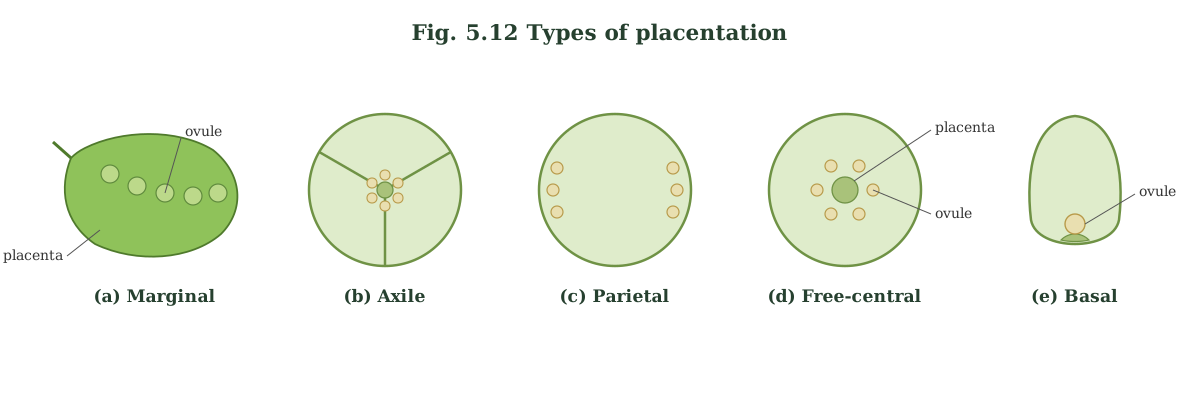
Placentation: The arrangement of ovules within the ovary is known as placentation. The main types are:
- Marginal — the placenta forms a ridge along the ventral suture of the ovary and the ovules are borne on this ridge in two rows, as in pea.
- Axile — the placenta is axial and the ovules are attached to it in a multilocular ovary, as in china rose, tomato and lemon.
- Parietal — the ovules develop on the inner wall of the ovary or on its peripheral part; the ovary is one-chambered but becomes two-chambered due to the formation of a false septum, as in mustard and Argemone. …
Drawn by us to help you understand the concept clearly, and verified to make sure it's accurate. For exams, practice from your textbook's own diagram.
Placentation describes where inside the ovary the ovules are attached to the placenta, and the figure shows five arrangements. In marginal placentation the ovules line up in a row along one inner margin of a single-chambered ovary, as in pea. In axile placentation the ovary is divided into chambers and the ovules attach to a central axis, as in china rose, tomato and lemon. In parietal placentation the ovules develop on the inner wall of a one-chambered ovary, as in mustard. In free-central placentation the ovules are borne on a central column in an ovary with no dividing walls, as in Di …