Biology · Ch 5 — Morphology of Flowering Plants
Phyllotaxy
Phyllotaxy
Phyllotaxy is the pattern of arrangement of leaves on the stem or branch. It describes how the leaves are positioned at the nodes as one moves along the axis, and it is usually of three types — alternate, opposite and whorled.
- Alternate phyllotaxy — a single leaf arises at each node, and the successive leaves are placed in an alternate manner along the stem rather than directly above one another. This arrangement is seen in plants such as china rose, mustard and sun flower.
- Opposite phyllotaxy — a pair of leaves arises at each node and the two leaves lie opposite to each other, one on either side of the stem at the same level. This type is found in Calotropis and guava plants.
- Whorled phyllotaxy — when more than two leaves arise at a node and are arranged in a circle, they form a whorl, and the phyllotaxy is called whorled. This condition is seen in Alstonia. …
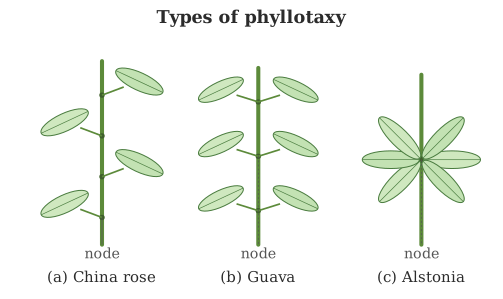
Drawn by us to help you understand the concept clearly, and verified to make sure it's accurate. For exams, practice from your textbook's own diagram.
Phyllotaxy is the pattern in which leaves are arranged on the stem or branch, and the figure shows its three basic types. In alternate phyllotaxy, a single leaf grows at each node and successive leaves are placed on opposite sides, as in china rose, mustard and sunflower. In opposite phyllotaxy, two leaves arise at each node, one on each side facing each other, as in guava and Calotropis. In whorled phyllotaxy, three or more leaves come out at the same node and form a ring or whorl around the stem, as in Als …