Physics · Ch 9 — Mechanical Properties of Fluids
Pascal's Law
Pascal's Law
The Meaning of Pressure
Pressure is defined as the normal force acting per unit area. When you press a sharp needle against your skin, the force is concentrated over a very small area, producing a large pressure that pierces the skin. The same force applied through a blunt object — like the back of a spoon — spreads over a much larger area, so the pressure is far smaller and the skin remains intact.
This idea explains why an elephant stepping on a man's chest would be disastrous: the enormous weight of the elephant, concentrated on the relatively small area of its foot, produces a pressure far beyond what the ribs can withstand. A circus performer, however, can lie on a bed of nails because the total force of the performer's weight is distributed over hundreds of nail points — each nail carries only a tiny fraction of the weight, so the pressure at any single point is harmless.
The key distinction is between force and pressure. A large force can produce a small pressure if it acts over a large area; a small force can produce a huge pressure if it acts over a tiny area.
Pascal's Law — The Fundamental Principle
Pascal's law governs how pressure behaves in a fluid at rest. It states:
where is the pressure at a depth below the free surface of a fluid of density , is the atmospheric pressure at the free surface, and is the acceleration due to gravity.
But the deeper meaning of Pascal's law is this: pressure applied to an enclosed fluid is transmitted undiminished to every portion of the fluid and to the walls of the containing vessel.
This is not an obvious fact. If you push on a solid object, the force is transmitted along the direction you push. But in a fluid, the molecules are free to move, so a push in one direction gets redistributed equally in all directions. The result is that the pressure increase is the same everywhere.
Derivation of the Pressure Variation with Depth
Consider a fluid at rest in a container. Take a small cylindrical element of the fluid, with cross-sectional area and height , whose top face is at the free surface and whose bottom face is at depth .
The forces acting on this fluid element are:
- The force due to atmospheric pressure acting downward on the top face:
- The force due to the fluid pressure acting upward on the bottom face:
- The weight of the fluid element acting downward:
Since the fluid is at rest, the net force on the element must be zero. Taking upward as positive:
Dividing through by :
Therefore:
This is the fundamental equation for pressure in a static fluid. It shows that pressure increases linearly with depth.
This formula assumes the fluid is incompressible (constant density ). For gases, where density changes significantly with pressure, the formula is more complicated. For liquids like water, the assumption of constant density is excellent for most practical depths.
Properties Derived from Pascal's Law
The textbook lists three key properties that follow directly from Pascal's law. Each one is proved below.
Property 1: Pressure is the same at all points at the same horizontal level in a fluid at rest
Proof: Consider two points A and B at the same depth below the free surface of a fluid at rest. From the pressure-depth relation:
Since the right-hand sides are identical, . The pressure depends only on depth, not on horizontal position.
This property is the reason why a liquid finds its own level in communicating vessels. If you connect two containers at their bases, the liquid will rise to the same height in both, regardless of their shapes.
Property 2: Pressure at a point in a fluid at rest is the same in all directions
Proof: Consider a tiny wedge-shaped element of fluid at rest, with dimensions , , and (where is the depth into the page). The wedge has a sloping face of length at an angle to the horizontal.
The forces on this element are:
- On the vertical face (area ): force acting horizontally
- On the horizontal face (area ): force acting vertically
- On the sloping face (area ): force acting perpendicular to the face
- The weight of the element:
Since the fluid is at rest, the net force in any direction must be zero.
Horizontal equilibrium: The horizontal component of the force on the sloping face must balance the force on the vertical face:
But , so:
Therefore .
Vertical equilibrium: The vertical component of the force on the sloping face plus the weight must balance the force on the horizontal face:
But , so:
Now take the limit as the wedge shrinks to a point (). The weight term, which contains the product , becomes negligible compared to the other terms (which contain only two of the dimensions). In this limit:
Since and , we have . The pressure is the same in all directions at a point.
The weight term vanishes in the limit because it is proportional to the volume (three small dimensions multiplied together), while the pressure forces are proportional to areas (only two small dimensions). For a sufficiently small element, the weight is negligible compared to the surface forces. …
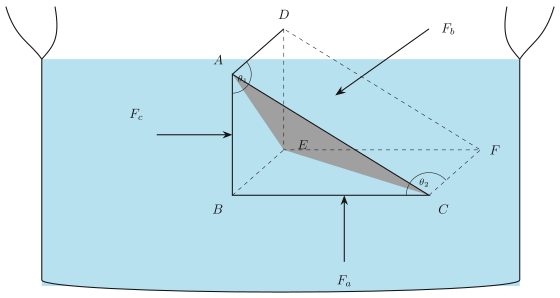
Drawn by us to help you understand the concept clearly, and verified to make sure it's accurate. For exams, practice from your textbook's own diagram.
The figure shows a right-angled triangular prism of fluid, labelled ABC-DEF, taken from deep inside a larger body of fluid at rest. The prism is oriented so that its rectangular face BCFE is vertical, its rectangular face ADFC is horizontal, and its rectangular face ABED is inclined. The three mutually perpendicular edges are: the vertical edge CF, the horizontal edge AC, and the edge BC that runs into the page. The two acute angles of the triangular cross-section are marked — one at vertex A (between the horizontal base and the inclined face) and the other at vertex C (between the vertical side and the inclined face).
Three forces are drawn acting on the prism, each normal (perpendicular) to the face it touches. On the horizontal bottom face ADFC, a force points vertically upward. On the vertical side face BCFE, a force points horizontally to the left. On the inclined face ABED, a force points perpendicularly into that face, at an angle above the horizontal. Because the fluid is at rest, every fluid element is in equilibrium — the vector sum of these three forces must be zero.
The physical idea is simple but profound: in a static fluid, pressure at a point is the same in all directions. The prism is a tool to prove this. By resolving into horizontal and vertical components and applying equilibrium conditions, the textbook shows that the pressure on each face is identical.
Here is the force on the horizontal face, the force on the vertical face, and the force on the inclined face. The angle is the acute angle between the inclined face and the horizontal.
Now, pressure is force per unit area. Let , , and be the areas of the horizontal, vertical, and inclined faces respectively. From the geometry of the prism, and . Substituting these into the force equations gives:
So the pressure is the same on every face. Since the orientation of the prism is arbitrary, this result holds for any direction — proving Pascal's law: pressure at a point in a static fluid acts equally in all directions. …