Physics · Ch 9 — Mechanical Properties of Fluids
Pressure
Pressure
Pressure in Fluids
The idea of pressure explains why a sharp needle pierces skin while a blunt spoon does not, even when pushed with the same force. The needle concentrates the force onto a tiny area, while the spoon spreads it over a much larger area. Similarly, an elephant's foot — despite its large area — still exerts enormous pressure on the ground because of the animal's huge weight. If that foot stepped on a person's chest, the pressure would be enough to crack ribs.
Pressure is not just about how much force you apply — it is about how that force is distributed over a surface.
Definition of Pressure
Pressure is defined as the normal force acting per unit area. "Normal" means the force is perpendicular to the surface — any component of force parallel to the surface does not contribute to pressure.
where is the component of force perpendicular to the surface, and is the area over which the force is distributed.
The SI unit of pressure is the pascal (Pa). One pascal equals one newton per square metre:
Other common units include the atmosphere (atm), bar, and torr (mm of Hg). For reference, standard atmospheric pressure at sea level is Pa.
Pressure is a scalar quantity, not a vector. Even though force is a vector, pressure has no direction — it acts equally in all directions at a point within a fluid. The "direction" we sometimes speak of (e.g., "downward pressure") actually refers to the force that results from the pressure acting on a surface of a particular orientation.
Why Pressure is a Scalar
This point often confuses students. Force is a vector — it has magnitude and direction. Pressure is defined as force per unit area, so why isn't it a vector?
The reason is subtle but important. When we say , the force is always taken as the component perpendicular to the area . But the area itself has an orientation — it is a vector quantity (its direction is the outward normal to the surface). Pressure, however, is the ratio of the magnitudes of two vectors (force and area) taken in the same direction. The result is a scalar.
More fundamentally, within a fluid at rest, the pressure at a point is the same in all directions. This is Pascal's law, which we will see shortly. A quantity that has the same value regardless of the orientation of measurement is a scalar.
Properties of Fluid Pressure
The textbook lists several key properties of pressure in fluids. Each one is derived from the fundamental definition and the behaviour of fluids at rest.
Property 1: Pressure Increases with Depth
In a static fluid, the pressure at a point depends only on the depth of that point below the free surface, not on the shape of the container.
Consider a small cylindrical element of fluid of cross-sectional area and height , with its top face at the free surface (where pressure is atmospheric pressure ) and its bottom face at depth . The fluid has uniform density .
The forces acting on this fluid element are:
- The weight of the fluid inside the cylinder: , acting downward
- The force due to pressure at the top: , acting downward
- The force due to pressure at the bottom: , acting upward (where is the pressure at depth )
Since the fluid is at rest, the net vertical force must be zero:
Dividing through by :
This is the fundamental equation for pressure variation with depth in a static incompressible fluid.
The pressure difference between two points in a fluid depends only on the vertical separation between them, not on the horizontal distance. Two points at the same depth in the same fluid have the same pressure, regardless of the shape of the container.
Property 2: Pressure is the Same at All Points on the Same Horizontal Level
This follows directly from the previous result. If two points are at the same depth below the free surface, then:
Therefore . This holds true even if the container has an irregular shape, as long as the fluid is continuous and at rest.
This property is the basis for devices like the hydraulic press and the manometer. It also explains why water seeks its own level in connected vessels.
Property 3: Pressure Acts Equally in All Directions (Pascal's Law)
This is perhaps the most important property of fluid pressure. At any point in a static fluid, the pressure is the same in every direction.
To prove this, consider a tiny wedge-shaped element of fluid at rest. The wedge has dimensions such that its sloping face has area , and the two perpendicular faces have areas and respectively (where is the angle of the sloping face). The fluid is at rest, so the net force on the wedge must be zero in both the and directions.
Let , , and be the pressures acting on the faces perpendicular to the -axis, -axis, and the sloping face respectively. The forces are:
- On the -face:
- On the -face:
- On the sloping face:
Resolving forces in the -direction:
Resolving forces in the -direction:
Since is arbitrary, this shows that the pressure is the same in all directions at a point. This is Pascal's law.
Pascal's law: Pressure applied to an enclosed fluid is transmitted undiminished to every portion of the fluid and to the walls of the containing vessel.
Property 4: Pressure is Independent of the Shape of the Container …
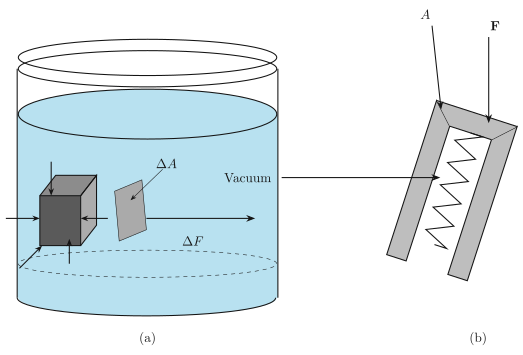
Drawn by us to help you understand the concept clearly, and verified to make sure it's accurate. For exams, practice from your textbook's own diagram.
Figure 9.1 in the NCERT textbook is a two-panel illustration that introduces the most fundamental idea in fluid mechanics: pressure acts perpendicular to any surface it touches.
Panel (a) shows a beaker of liquid with a cube fully submerged inside it. Arrows are drawn on every face of the cube — top, bottom, left, right, front, back — and also on the inner walls of the beaker. Every single arrow points inward, toward the surface it touches, and each arrow is drawn at a right angle (normal) to that surface. This is the key visual message: a fluid at rest exerts a force that is always perpendicular to the surface it contacts, whether that surface is the container wall or the surface of an object inside the fluid. There is no component of force parallel to the surface — if there were, the fluid would flow sideways, which it does not when at rest.
Panel (b) is a schematic of an idealised pressure-measuring device. It shows an evacuated chamber (labelled "Vacuum") with a piston on one side. Behind the piston is a calibrated spring. The piston has a small area on its face. A force is applied to the piston from outside (presumably by the fluid whose pressure is being measured). The spring compresses until the spring force balances . Because the chamber is evacuated, there is no opposing pressure from inside — the only force opposing the external push comes from the spring. The label "A" likely marks the piston's face area. The device directly measures the force needed to keep the piston stationary, and from that you calculate pressure.
The physical idea taught by this figure is that pressure is the normal force per unit area. The direction is always perpendicular to the surface, and the magnitude is the same in all directions at a given depth in a static fluid.
The textbook uses this figure to develop the defining formula for pressure:
where:
- is the pressure exerted by the fluid,
- is the magnitude of the normal force acting on a surface,
- is the area of that surface.
For the idealised device in panel (b), the pressure is , where is the force read from the spring and is the area of the piston face. The "Vacuum" label ensures that the only force on the inner side of the piston is from the spring, so the measured corresponds purely to the external fluid pressure times the area. …
| Fluid | ρ (kg m⁻³) |
|---|---|
| Water | 1.00 × 10³ |
| Sea water | 1.03 × 10³ |
| Mercury | 13.6 × 10³ |
| Ethyl alcohol | 0.806 × 10³ |
| Whole blood | 1.06 × 10³ |
| Air | 1.29 |
| Oxygen | 1.43 |
| Hydrogen | 9.0 × 10⁻² |
| Interstellar space | ≈ 10⁻²⁰ |