Q.State Rutherford's model of the atom and write its two drawbacks.
You're viewing a preview — the full solution, concept, methods & PYQ mapping are locked.
Start your 14-day free trial to unlock the full solution →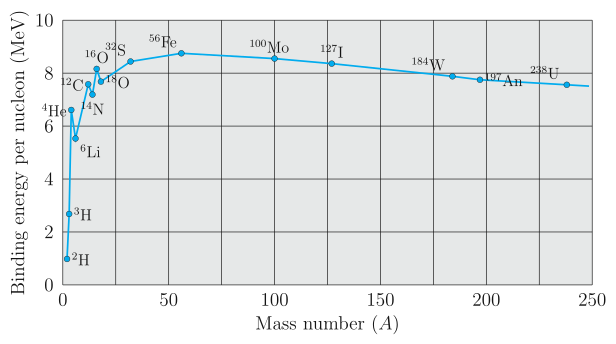
Rutherford's planetary model located the atom's mass and positive charge in a tiny nucleus, but classical physics predicts it should collapse — which it doesn't.
Rutherford's model of the atom (based on his -particle scattering experiment): almost the entire mass of the atom, and all of its positive charge, is concentrated in a tiny central region called the nucleus. The electrons revolve around this nucleus in various orbits, much like planets orbiting the Sun, held in orbit by the electrostatic force of attraction between the nucleus and the electrons. Most of the atom's volume is empty space.
Two drawbacks:
- Stability of the atom: According to classical electromagnetic theory, an accelerating (revolving) charge must continuously radiate energy. An orbiting electron, being an accelerated charge, should therefore continuously lose energy, causing its orbit to shrink, and it should spiral into the nucleus within a fraction of a second. This predicts that atoms should be unstable — contrary to the observed stability of matter.
- Line spectra: Since the model predicts the electron should spiral inward continuously (with the radiation frequency continuously changing as it does so), it predicts a continuous emission spectrum. It cannot explain why atoms actually emit line spectra — light only at certain sharp, discrete wavelengths.
OR — Binding energy per nucleon curve.
The curve of binding energy per nucleon () versus mass number has these two main features: …
Unlock everything free for 14 days
- Full step-by-step solutions
- Concept-first explanations
- Methods, shortcuts & mistakes
- PYQ mapping + timed mock tests
Full access for 14 days. No credit card required.