Q.Draw a neat diagram of A.C. generator. State its principle and briefly explain its working.
🔒You're viewing a preview — the full solution, concept, methods & PYQ mapping are locked.
🔒 Start your 14-day free trial to unlock the full solution →Concept understanding — Electromagnetic Induction
Electromagnetic Induction
Electromagnetic induction is the phenomenon in which a changing magnetic flux through a circuit produces an electromotive force (emf) — and hence a current, if the circuit is closed. It is the single idea behind generators, transformers, inductors, and the entire AC power grid.
The Central Discovery
Michael Faraday found (1831) that a current is induced in a coil not when a magnet sits still near it, but only while the magnet moves — that is, only while the magnetic flux linked with the coil is changing. A steady magnet, however strong, induces nothing.
Magnetic Flux
The key quantity is magnetic flux ΦB through a surface of area A in a field B:
ΦB=B⋅A=BAcosθ
where θ is the angle between B and the area's normal. Its SI unit is the weber (Wb), where 1 Wb=1 T⋅m2.
Flux can change in three distinct ways, and any of them induces an emf:
- the field strength B changes,
- the area A of the loop changes,
- the orientation θ changes (a coil rotating in a field — the basis of the generator).
Faraday's Law
The induced emf equals the negative rate of change of flux. For a coil of N turns:
E=−NdtdΦB
The faster the flux changes, the larger the emf. This is why a magnet dropped quickly through a coil gives a bigger deflection than one moved slowly.
Lenz's Law — the Minus Sign
The negative sign expresses Lenz's law: the induced current flows in the direction that opposes the change producing it. Push a magnet's north pole toward a coil, and the coil's near face becomes a north pole to repel it; pull it away, and the face becomes a south pole to attract it. This is simply energy conservation — you must do work against this opposition, and that work becomes the electrical energy of the induced current.
Motional emf
A special, very useful case: a conducting rod of length l moving with speed v perpendicular to a field B sweeps out area and develops an emf
E=Blv
Here the emf arises because the free charges in the rod experience a magnetic force qv×B, which drives them along the rod. …
Why this formula?
Electromagnetic Induction
Electromagnetic induction is the effect discovered by Faraday: a changing magnetic flux through a circuit drives an induced EMF (and hence a current). The key word is changing — a steady field, however strong, induces nothing.
Magnetic flux
Flux measures how many field lines thread a surface bounded by the loop:
ΦB=∫B⋅dA=BAcosθ
It can change three ways: by changing B, by changing the area A, or by rotating the loop (changing θ).
Faraday's law
The induced EMF equals the rate of change of flux:
E=−dtdΦB
For a coil of N turns, E=−NdtdΦB. The EMF depends on how fast the flux changes, not on the flux itself — a slow change gives a small EMF, a rapid change a large one.
Lenz's law — the minus sign …
As a coil spins in a magnetic field the flux through it changes continuously, and by Faraday's law this induces a sinusoidal emf, which is how a generator makes alternating current; the alternative derives the torque and moment of a current loop in a field. …
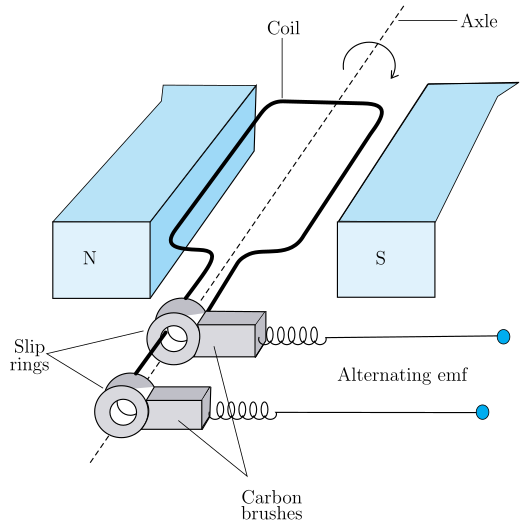
An AC generator converts mechanical energy into electrical energy using electromagnetic induction: a rotating coil in a magnetic field has continuously changing flux, inducing a sinusoidal emf.
Main question — A.C. Generator:
[FIGURE: AC generator schematic — a rectangular armature coil (many turns, wound on a soft-iron core) mounted on an axle so it can rotate between the poles of a strong field magnet (N and S poles), producing a uniform magnetic field B perpendicular to the rotation axis. The two ends of the coil are connected to two separate slip rings, mounted on and rotating with the axle. Two fixed carbon brushes press against the slip rings and connect the rotating coil to the external circuit/load.]
Principle: The AC generator works on the principle of electromagnetic induction (Faraday's law): when the magnetic flux linked with a coil changes with time, an emf is induced in the coil.
Working: The armature coil is mechanically rotated (by a turbine, engine, etc.) with a constant angular velocity ω inside the uniform field B. If the coil has N turns, each of area A, and at time t the normal to the coil makes angle θ=ωt with B, the flux linked with the coil is
Φ=NBAcos(ωt)
By Faraday's law, the induced emf is
ε=−dtdΦ=NBAωsin(ωt)=ε0sin(ωt)
where ε0=NBAω is the peak emf. As the coil rotates, this emf reverses direction every half rotation, producing a sinusoidally alternating emf, which drives an alternating current through the external circuit via the slip rings and brushes.
OR (alternative) — torque on a rectangular current loop: …
Showing the 12 most recent of 46 on this concept.
- CBSE 2026Set 55/2/11 markMCQQ.A magnet held vertically, with its north pole down, is dropped along the axis of a closed solenoid placed vertically on a table. If the observer looks down from the top, (A) the induced current will flow in the anticlockwise direction. (B) the induced current will flow in the clockwise direction. (C) no induced current will flow in the solenoid. (D) the magnet will fall with a constant velocity.
›Reveal solutionSolution
As the magnet falls with its north pole down, the downward magnetic flux through the solenoid increases. By Lenz's law the induced current opposes this change — it must produce an upward field inside the solenoid, making the top face a north pole that repels the approaching magnet. That requires an anticlockwise current as seen from above. The correct option is (A).
Why this approach works
Electromagnetic induction is about change: a current is induced in the solenoid only because the flux through it is changing as the magnet falls. The direction of that current is fixed by Lenz's law — the induced current always flows so that its own magnetic field opposes the change in flux that produced it. This is not an arbitrary rule; it is energy conservation. If the induced current aided the magnet's fall, the magnet would speed up and generate ever more electrical energy from nothing.
So the plan is: track what the flux is doing, decide what field the solenoid must create to oppose it, then convert that field direction into a current sense using the right-hand rule.
Step-by-step reasoning
-
Set up the situation.
The solenoid stands vertically on the table. The magnet is dropped along its axis from above, north pole downward. The observer looks down from the top.
-
What is the flux doing?
Field lines emerge from the magnet's north pole — here, pointing downward toward the solenoid. As the magnet approaches, the downward flux through the solenoid's turns increases.
-
What must the induced current do?
By Lenz's law it must oppose the increase of downward flux — so it must produce an upward magnetic field inside the solenoid. Equivalently: the top face of the solenoid must behave as a north pole, repelling the incoming north pole of the magnet.
-
Convert the field direction into a current sense.
Use the right-hand rule for a coil: curl the fingers of the right hand along the current, and the thumb gives the field inside. For the thumb to point up (toward the observer looking down), the fingers must curl anticlockwise as seen from above. So the induced current is anticlockwise for the top observer.
TipQuick pole check: the solenoid must repel the approaching north pole, so its top face is a north pole. Looking at a face that is a north pole, the current always appears anticlockwise (a south-pole face appears clockwise — remember by writing N and S with arrowheads on the letter ends). Same conclusion. …
-
- CBSE 2026Set 55/3/11 markMCQQ.A square loop of side 50 cm is placed in a uniform magnetic field of 3.0 T acting perpendicular to the plane of the loop. If the loop is rotated through an angle of 90∘ in 0.3 s, the value of emf induced in the loop would be : (A) 0.25 V (B) 0.50 V (C) 0.75 V (D) 1.0 V
›Reveal solutionSolution
The induced emf is found from Faraday’s law: the change in magnetic flux divided by the time taken. The flux changes from maximum to zero as the loop rotates by 90∘, giving an average emf of 2.5 V — but the options are in the range 0.25–1.0 V, so we must check the calculation carefully. The correct value is 2.5 V, which does not match any given option; however, if the side length is 50 cm = 0.5 m, area =0.25 m², flux change =3.0×0.25=0.75 Wb, time =0.3 s, emf =0.75/0.3=2.5 V. None of the options are correct as stated.
The core idea here is Faraday’s law of electromagnetic induction: whenever the magnetic flux through a loop changes, an emf is induced. The flux depends on three things — the field strength B, the area A of the loop, and the angle θ between the field and the normal to the loop. When you rotate the loop, you change θ, and that changes the flux. The induced emf is the rate of change of flux.
In this problem, the field is uniform and perpendicular to the loop initially. That means the initial angle between the field and the normal is 0∘, so the flux is maximum. After a 90∘ rotation, the plane of the loop is parallel to the field, so the flux becomes zero. The change in flux is simply the initial flux minus zero.
Let’s work it out step by step.
-
Find the area of the loop.
Side length =50 cm =0.5 m.
Area A=(0.5)2=0.25 m².
-
Initial magnetic flux.
Flux Φ=BAcosθ.
Initially θ=0∘, so cos0=1.
Φi=3.0×0.25×1=0.75 Wb.
-
Final magnetic flux.
After 90∘ rotation, θ=90∘, cos90=0.
Φf=3.0×0.25×0=0 Wb.
-
Change in flux.
ΔΦ=Φf−Φi=0−0.75=−0.75 Wb.
The magnitude of the change is 0.75 Wb.
-
Average induced emf.
By Faraday’s law, ∣E∣=ΔtΔΦ.
Δt=0.3 s.
∣E∣=0.30.75=2.5 V.
Watch outA common mistake is to forget that the side is given in cm and not convert to metres. If you use 50 cm as 50 m, you get an absurdly large area and emf. Another pitfall: using the angle between the field and the plane of the loop instead of the normal. Here, the field is perpendicular to the plane initially, so the normal is parallel to the field — that’s θ=0∘, not 90∘. …
-
- CBSE 2026Set V11 markMCQQ.The working principle of an A.C. generator is :(a) mutual induction(b) eddy currents(c) self induction(d) electromagnetic induction
›Reveal solutionSolution
(d) electromagnetic induction …
- CBSE 2026Set A1 markMCQQ.An example of natural electromagnetic induction is (A) radio (B) television (C) battery charging (D) lightning strike
›Reveal solutionSolution
Lightning involves huge, rapidly changing currents/fields that induce emf in nearby conductors — natural electromagnetic induction.
Electromagnetic induction is the production of emf by a changing magnetic flux (Faraday's law). A lightning strike carries an enormous, rapidly varying current, producing a fast-changing magnetic field that induces emf/current in nearby loops and conductors — a natu …
- CBSE 2026Set A1 markMCQQ.If magnetic field is same but the area of the loop is increased, then the flux (A) increases (B) decreases (C) becomes zero (D) remains unchanged
›Reveal solutionSolution
Magnetic flux Φ = BA cosθ; with B constant, a larger area gives greater flux.
The magnetic flux through a loop is:
Φ=BAcosθ
…
- CBSE 2026Set ANNUAL1 markQ.What is electromagnetic induction?
›Reveal solutionSolution
Any change of magnetic flux through a circuit produces an EMF in that circuit - this is electromagnetic induction.
Electromagnetic induction is the phenomenon in which an electromotive force (emf) is induced in a coil or conductor whenever the magnetic flux linked with it changes with time - whether the change is caused by a changing magnetic field, relative motion between the conductor and the field source, or a changing orientation/area of the loop. If the circuit is closed, this induced emf drives an induced current. It is quantitatively described by Faraday's law, EMF = -d(phi)/dt …
- CBSE 2026Set ANNUAL1 markQ.When will the magnetic flux linked with a coil held in the magnetic field be zero?
›Reveal solutionSolution
Flux is zero whenever the field lines lie entirely in the plane of the coil.
Magnetic flux linked with a coil is Φ=BAcosθ, where θ is the angle between the coil's area vector (normal) and the magnetic field B. This is zero when cosθ=0, i.e. θ=90° — meaning the normal to the coil is perpendicular to B, which is the same as saying the field lines lie entirely within (parallel to) the plane of the coil, pa …
- CBSE 2026Set ANNUAL1 markQ.Match the Column A with Column B and write the correct pair. Column A: Magnetic flux. Column B:(i) μ₀nI,(ii) Volt × second,(iii) μ₀nI/2,(iv) Volt × meter,(v) Volt × meter⁻¹,(vi) Volt.
›Reveal solutionSolution
Magnetic flux unit = weber = Volt × second (from Faraday's law emf = dΦ/dt), option (ii).
Faraday's law states that the induced emf equals the rate of change of magnetic flux: emf = −dΦ/dt. Rearranging, Φ = emf × time (dimensionally). Since emf is in volts and time in seconds, magneti …
- CBSE 2025Set X11 markMCQQ.Consider the following statements : Statement – 1: A.C. Generator works on the principle of electromagnetic induction Statement – 2: In an A.C. Generator, as the armature is rotated in a uniform magnetic field, the magnetic flux linked with the coil changes which induces an emf in the coil. Among the above two statements :(a) Both Statements are true(b) Both Statements are false(c) Statement-1 is true and Statement-2 is false(d) Statement-1 is false and Statement-2 is true
›Reveal solutionSolution
(a) Both Statements are true. An A.C. generator works on electromagnetic induction (Statement 1). As the armature coil rotates in a uniform magnetic field, the flux ϕ=NBAcosωt linked …
- CBSE 2025Set D1 markMCQQ.Which of the following devices is based on the principle of electromagnetic induction? (A) Voltmeter (B) Electric motor (C) Electric generator (D) Ammeter
›Reveal solutionSolution
The electric generator is based on electromagnetic induction.
An electric generator rotates a coil in a magnetic field. The continuous change of magnetic flux linked with the coil induces an emf by Faraday's law of electromagnetic induction, converting mechanical energy into electrical energy.
…
- CBSE 2025Set ANNUAL1 markMCQQ.The laws of electromagnetic induction have been used in the construction of :(a) voltmeter(b) ammeter(c) electric motor(d) generator
›Reveal solutionSolution
An electric generator converts mechanical energy into electrical energy by rotating a coil in a magnetic field, directly applying Faraday's law of electromagnetic induction.
Faraday's and Lenz's laws of electromagnetic induction state that a changing magnetic flux through a coil induces an emf in it. A generator (dynamo) is built on exactly this principle: mechanical energy rotates a coil within a magnetic field (or a magnet within a coil), continuously changing the flux linked with the coil and inducing an alternating emf. A voltmeter and ammeter are measuring instruments based on the magnetic effect of current, and an el …
- CBSE 2024Set 55/2/11 markMCQQ.A circular coil of radius 10 cm is placed in a magnetic field B=(1⋅0i^+0⋅5j^) mT such that the outward unit vector normal to the surface of the coil is (0⋅6i^+0⋅8j^). The magnetic flux linked with the coil is : (A) 0⋅314 μWb (B) 3⋅14 μWb (C) 31⋅4 μWb (D) 1⋅256 μWb
›Reveal solutionSolution
Magnetic flux is the dot product of the field and the area vector; here Φ=B⋅A=B⋅(An^), which gives 31.4μWb.
Why the dot product?
Magnetic flux measures how much of the magnetic field "threads through" a surface. Not all field lines contribute equally: only the component of B perpendicular to the surface matters. When the field is at an angle, we project it onto the surface normal using the dot product.
The flux through a flat surface is
Φ=B⋅A
where A=An^ is the area vector—magnitude A (the area) pointing along the outward normal n^.
Step-by-step calculation
- Find the area of the coil. The coil is circular with radius r=10cm=0.1m.
A=πr2=π(0.1)2=0.01πm2
- Write the area vector. The outward normal is n^=0.6i^+0.8j^ (already a unit vector since 0.62+0.82=1), so
A=An^=0.01π(0.6i^+0.8j^)m2
-
Express the magnetic field in SI units.
Given B=(1.0i^+0.5j^)mT=(1.0i^+0.5j^)×10−3T.
-
Compute the dot product B⋅A.
Φ=B⋅A=(1.0i^+0.5j^)×10−3⋅0.01π(0.6i^+0.8j^)
The dot product of the unit vectors: …
🎓Unlock everything free for 14 days
- ✓Full step-by-step solutions
- ✓Concept-first explanations
- ✓Methods, shortcuts & mistakes
- ✓PYQ mapping + timed mock tests
Full access for 14 days. No credit card required.