Q.A mobile phone lies along the principal axis of a concave mirror, as shown in Fig. 9.7. Show by suitable diagram, the formation of its image. Explain why the magnification is not uniform. Will the distortion of image depend on the location of the phone with respect to the mirror?
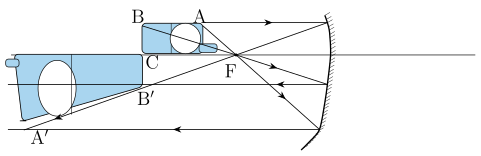
A phone lying along the principal axis has its two ends at different object distances from the mirror, and since magnification depends on , the two ends get magnified by different amounts - the image is stretched/compressed non-uniformly along its length. How severe this distortion is depends on where the phone sits relative to the focus.
Setting up the diagram
Draw a concave mirror with pole , principal axis, focus , and centre of curvature marked on the axis. Unlike the usual textbook object (a small arrow standing perpendicular to the axis, where every point is at the same distance from the mirror), here the "object" - the phone - lies along the axis itself. Label its near end (closer to the mirror, at object distance ) and its far end (farther away, at object distance ), with in magnitude.
Locating the image of each end
Use the mirror formula (magnitudes, concave mirror) separately for each end, since each is effectively a point object on the axis:
- Near end : solve for using . If lies between the pole and the focus (), comes out negative - a virtual image, behind the mirror.
- Far end : solve for using . If lies beyond the focus, is positive - a real image, in front of the mirror.
Draw and at these two computed image positions on the axis; the image of the phone is the segment .
Why the magnification is not uniform
For a point on the axis, the lateral magnification is . Because is different for and , the resulting (and hence ) is different for each - so the image length is not simply a uniformly-scaled copy of the real length . (Any dimension of the phone that lies genuinely perpendicular to the axis, at a single value of , would still image with one single magnification - it's specifically the along-the-axis extent that gets distorted, because that's the direction along which itself varies.)
Since , in general - this unevenness in magnification along the length of the phone is exactly what produces the distorted image (nose-and-ears-style stretching, the same effect that distorts a selfie taken at close range with a tilted phone).
Does the distortion depend on where the phone is placed?
Yes.
| Phone position | What happens |
|---|---|
| Both ends well beyond (far from the mirror) | (their difference is a small fraction of the distance) - magnifications are nearly equal, distortion is small. |
| Both ends between and (very close to the mirror) | Both images virtual, but at noticeably different magnifications - moderate distortion. |
| One end inside , the other beyond | One image virtual, the other real - the image is discontinuous at the point where the corresponding object point crosses , giving extreme, even "broken" distortion. |
So moving the phone closer to the mirror (especially straddling the focus) makes the distortion worse; moving it far away makes the distortion shrink toward zero.
Because the phone lies along the axis, its two ends sit at different object distances and therefore get imaged with different magnifications (, depending on ) - producing a non-uniformly stretched image. The amount of distortion depends on the phone's location: it is worst when part of the phone lies inside the focal length and part outside, and it shrinks toward zero the farther the phone is placed from the mirror.
Unlock everything free for 14 days
- Full step-by-step solutions
- Concept-first explanations
- Methods, shortcuts & mistakes
- PYQ mapping + timed mock tests
Full access for 14 days. No credit card required.