Physical Education · Ch 6 — Test and Measurement in Sports
Measurement of Cardio-Vascular Fitness - Harvard Step Test
Measurement of Cardio-Vascular Fitness - Harvard Step Test
Measurement of Cardio-Vascular Fitness - Harvard Step Test
Cardio-vascular (aerobic) fitness tells us how well the heart, lungs and circulatory system can supply oxygen to the working muscles during sustained activity. One of the simplest, most widely used field tests for it is the Harvard Step Test, developed by Brouha in 1943 to measure physical fitness for work and the ability to recover after work. The test was originally designed for young men of college age, and in Brouha's original validation study 2,200 males were tested. (The textbook also notes the Rockport Test as an alternative way to find a physical fitness index, but the Harvard Step Test is the one detailed here.) This is a core topic in the CBSE Class 12 Physical Education unit on Test and Measurement, and a recurring theme in NCERT/CBSE syllabus questions and answers.
- Purpose: to determine aerobic fitness.
- Objective: to perform the step test continuously, without a break, for 5 minutes or until exhausted.
- Equipment: a bench or wooden block 20 inches high, a stopwatch, and a metronome.
Procedure
On the command "Go" the student steps up and down, on and off the wooden block or bench, at a rate of 30 steps per minute for 5 minutes. On the command "up" (or the first sound of the metronome) one foot is placed on the bench; on the second "up" (or the second metronome sound) both feet are placed fully on the bench with the body erect and the legs and back straightened. The student then steps down. After exactly five minutes, on the signal "stop", the participant immediately sits down on the bench. If a student cannot maintain the pace, he or she is considered exhausted and the test is ended before the full five minutes are over. The tester notes the duration of the exercise in seconds.
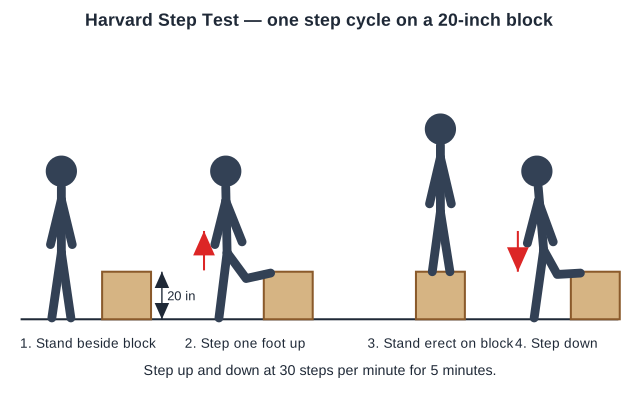
Drawn by us to help you understand the concept clearly, and verified to make sure it's accurate. For exams, practice from your textbook's own diagram.
A four-stage line-drawing sequence of a person performing the Harvard step test on a 20-inch wooden block or bench. Stage 1: the person stands beside the block. Stage 2: one foot is placed up on the block. Stage 3: both feet are on the block with the body fully erect, legs and back straight. Stage 4: the person steps back down to the floor. Small arrows show the up-and-down direction, illustrating …
Pulse Count
After the test the student stays seated, and the tester takes the heart beats between 1 and 1.5 minutes after exercise. The quicker the heart rate settles, the fitter the person is judged to be.
Scoring - the Physical Fitness Index (PFI)
The Fitness Index score is worked out with the following equation:
Fitness Index score = (Duration of the Exercise in Seconds x 100) / (5.5 x Pulse count of 1-1.5 min after Exercise)
The score is then compared against standard norms:
| Fitness Index score | Rating |
|---|---|
| Up to 49 | Poor |
| 50 - 80 | Average |
| 81 or above | Good |
Norms reference: Dr. D. K. Kansal (2008), Textbook of Applied Measurement, Evaluation and Sports Selection.
Worked example 1. A student completes the full 5 minutes (duration = 5 x 60 = 300 seconds) and the pulse count taken between 1 and 1.5 minutes is 60 beats. …