Physical Education · Ch 6 — Test and Measurement in Sports
Minute Walk Test (Six Minute Walk Test)
Minute Walk Test (Six Minute Walk Test)
Minute Walk Test (Six Minute Walk Test)
- Purpose: to determine aerobic endurance.
- Objective: to walk the maximum distance in 6 minutes.
- Equipment: a walking area with parallel lines 20 yards apart, connected by 5-yard cross-lines to make rectangles; a stopwatch; and a cone.
Procedure
On the command "Go" the participant begins walking and continues continuously on the marked track for 6 minutes, covering as much distance as possible without running.
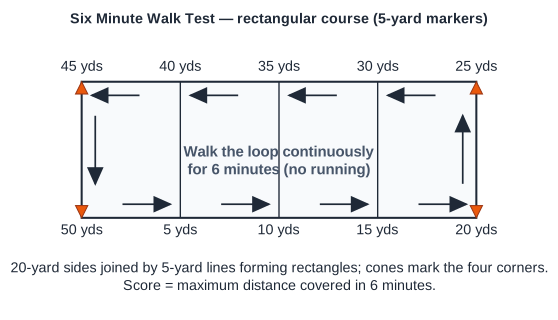
Drawn by us to help you understand the concept clearly, and verified to make sure it's accurate. For exams, practice from your textbook's own diagram.
A diagram of the marked rectangular walking course for the six-minute walk test. The perimeter is divided by cones every 5 yards. Along the bottom edge, markers read 50 yds (start), then 5, 10, 15 and 20 yds (left to right); along the top edge they read 25, 30, 35, 40 and 45 yds (right to left). Directional arrows show the participant walking a continuous loop around the rectangle - across the bottom, up one side, back across …
Scoring
The maximum distance covered in 6 minutes is recorded as the score (compared later against the normal score ranges in section 6.4.7).
The heading in the textbook drops the "6" and reads only "Minute Walk Test" - this is the standard Six Minute Walk Test of the Rikli and Jones battery.
Why It Matters (Physiological Rationale)
Six minutes of continuous walking is long enough to rely mainly on the aerobic (oxygen-based) energy system, so the distance covered reflects the combined efficiency of the heart, lungs, circulation and leg-muscle endurance — essentially a low-impact, field-based substitute for a treadmill cardiovascular-fitness test, chosen because it is safe and achievable for older adults who should not be asked to run or sprint.
Benefits of Regular Testing
- Gives a practical measure of aerobic endurance without needing a track, a laboratory, or specialised equipment.
- Because it is self-paced walking rather than running, it is safe for participants across a wide range of starting fitness and health.
- Used widely beyond fitness testing; the same Six-Minute Walk Test protocol is a standard clinical tool in cardiac and pulmonary rehabilitation to track recovery over time.
Common Mistakes & Precautions
- Allowing the participant to run or jog; the instruction is specifically to walk, as fast as comfortably possible, not to run.
- Not permitting brief rest if the participant becomes breathless; resting briefly and then continuing is allowed and should be noted, rather than forcing continuous effort against medical advice.
- Testing someone with chest pain, uncontrolled high blood pressure, or a known heart condition without medical clearance first, since this is a sustained-exertion test. …