Q.(i) Draw the graph of half-life period (t1/2) versus initial concentration of reactant ([A]0) for a zero order reaction. Give reasons in favour of your answer. (2 marks)
🔒You're viewing a preview — the full solution, concept, methods & PYQ mapping are locked.
🔒 Start your 14-day free trial to unlock the full solution →Concept understanding — Arrhenius Equation
The Arrhenius Equation Plot: Why Temperature Changes Reaction Speed
You already know that heating things up makes reactions go faster. A cold chai takes forever to dissolve sugar; hot chai does it in seconds. But how much faster? And is there a pattern that holds for every reaction?
That pattern is the Arrhenius equation, and plotting it in a clever way reveals something fundamental about how molecules need to collide to react.
The core idea: an energy barrier
Imagine a ball sitting in a valley. To get to the next valley, it must first be pushed up over a hill. That hill is the activation energy (Ea) — the minimum energy two molecules need to have when they collide, for the reaction to happen.
At a low temperature, most molecules move slowly. Only a tiny fraction have enough energy to climb that hill. Raise the temperature, and suddenly many more molecules have the required energy. The fraction of molecules with energy ≥Ea is given by the Boltzmann distribution:
fraction=e−Ea/RT
where R is the gas constant and T is the absolute temperature (in Kelvin). This exponential is the heart of the story.
The Arrhenius equation (precise statement)
The rate constant k of a reaction depends on temperature as:
k=Ae−Ea/RT
- k = rate constant (how fast the reaction proceeds)
- A = pre-exponential factor (frequency of collisions, times a steric factor — how often molecules hit in the right orientation)
- Ea = activation energy (J/mol or kJ/mol)
- R = 8.314 J/(mol·K)
- T = temperature in Kelvin
k is not the reaction rate itself — it's the proportionality constant in the rate law. But for a fixed concentration, a larger k means a faster reaction.
Why plot it? The linear trick
The equation k=Ae−Ea/RT is exponential in 1/T. That's hard to eyeball. But take the natural logarithm of both sides:
lnk=lnA−REa⋅T1
This is the equation of a straight line:
y=c+mx
where:
- y=lnk
- x=1/T
- slope m=−Ea/R
- intercept c=lnA
So if you measure k at several temperatures and plot lnk versus 1/T, you get a straight line — provided the reaction follows Arrhenius behaviour (most do, over moderate temperature ranges).
Always use Kelvin for T. Celsius will give you a curved mess because 1/T is not linear in Celsius.
What the plot tells you
From the slope, you get Ea:
Ea=−(slope)×R
A steep negative slope means a large Ea — the reaction is very sensitive to temperature. A shallow slope means a small Ea — temperature doesn't affect it much.
From the intercept, you get A:
A=eintercept
This tells you about the collision frequency and orientation factor. A high A means molecules are colliding often and in the right geometry.
A typical Arrhenius plot looks like this
| T (K) | k (s⁻¹) | 1/T (K⁻¹) | lnk |
|---|---|---|---|
| 300 | 0.0012 | 0.00333 | -6.72 |
| 310 | 0.0028 | 0.00323 | -5.88 |
| 320 | 0.0061 | 0.00313 | -5.10 |
| 330 | 0.0125 | 0.00303 | -4.38 |
Plot lnk (y-axis) vs 1/T (x-axis). The points fall on a straight line. Draw the best-fit line, measure its slope, and compute Ea. …
Why this formula?
Arrhenius Equation: Why It Holds
The Arrhenius equation is not a guess — it emerges from a deep physical picture of how molecules react. Let's build that picture step by step.
1. The Core Question
Why does reaction rate increase dramatically with temperature?
For many reactions, a 10 °C rise can double or triple the rate. This cannot be explained by simple kinetic energy arguments alone — the relationship is exponential.
2. The Key Insight: An Energy Barrier
Before molecules can react, they must collide — but not all collisions lead to products.
There is a minimum energy threshold called activation energy (Ea). Only collisions with energy ≥ Ea can break old bonds and form new ones.
Think of it like pushing a boulder over a hill:
- The hilltop is the transition state (activated complex).
- Ea is the height of that hill from the reactant valley.
3. The Boltzmann Factor — The "Why" of Exponential Dependence
At temperature T, the fraction of molecules with energy ≥ Ea is given by the Boltzmann distribution:
Fraction=e−Ea/(RT)
where:
- R = universal gas constant (8.314 J mol⁻¹ K⁻¹)
- T = absolute temperature (Kelvin)
Why this form?
- The Boltzmann distribution tells us that the probability of a molecule having energy E is proportional to e−E/(kBT).
- For 1 mole of molecules, kB (Boltzmann constant) becomes R via R=NAkB.
- So the fraction with energy ≥ Ea is the integral of that distribution from Ea to ∞, which yields e−Ea/(RT).
Key takeaway: This exponential factor is not arbitrary — it comes directly from statistical mechanics.
4. The Pre-Exponential Factor (A)
Even if a collision has enough energy, it must also:
- Have the correct orientation (steric factor)
- Occur with sufficient collision frequency
These are bundled into the pre-exponential factor A (also called the frequency factor):
A=(collision frequency)×(orientation factor)
For simple gas-phase reactions, collision frequency can be calculated from kinetic molecular theory — it's on the order of 1010 L mol⁻¹ s⁻¹.
5. Putting It Together: The Arrhenius Equation
The rate constant k is proportional to:
- The number of effective collisions per second (given by A)
- The fraction of collisions with sufficient energy (given by e−Ea/(RT))
Thus:
k=Ae−Ea/(RT)
This is the Arrhenius equation.
6. Why It Works — The Physical Logic
| Component | Physical meaning | Why it's there |
|---|---|---|
| A | Maximum possible rate if every collision worked | Accounts for collision frequency & geometry |
A zero-order reaction's half-life scales directly with how much reactant you start with, unlike a first-order reaction's, and separately the Arrhenius equation lets the activation energy be extracted from how much faster this reaction runs at the higher of the two given temperatures. …
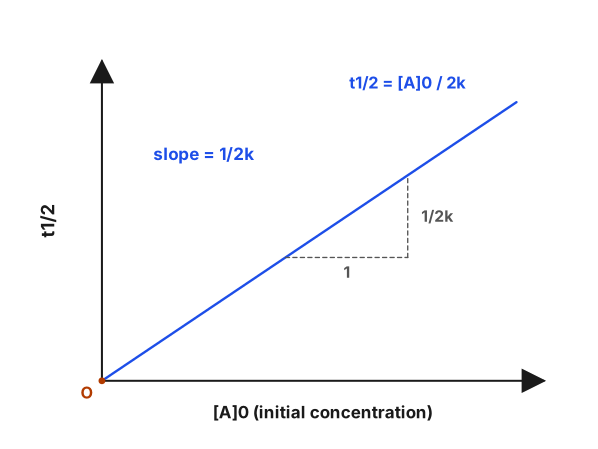
A zero-order reaction's half-life scales linearly with initial concentration; applying the Arrhenius two-temperature equation to the given rate ratio gives the activation energy.
(i) t1/2 vs [A]0 for a zero-order reaction: For a zero-order reaction, rate =k (constant), and the integrated law is [A]=[A]0−kt. At t=t1/2, [A]=[A]0/2:
2[A]0=[A]0−kt1/2⇒t1/2=2k[A]0
So t1/2 is directly proportional to [A]0 — the graph is a straight line passing through the origin with slope 2k1 (unlike a first-order reaction, where t1/2 is independent of [A]0).
(ii) Activation energy: Given k2/k1=10 at T2=400 K vs T1=200 K, using the two-point Arrhenius equation:
…
- CBSE 2024Set 56/3/11 markMCQQ.When a catalyst increases the rate of a chemical reaction, then the rate constant (k) : (A) remains constant (B) decreases (C) increases (D) may increase or decrease depending on the order of the reaction
›Reveal solutionSolution
A catalyst lowers the activation energy, which directly increases the rate constant k through the Arrhenius equation. The answer is (C).
The rate constant k is not just a number we measure—it encodes how the molecular-scale energy barrier controls reaction speed. To see why a catalyst must increase k, we need the Arrhenius equation.
k=Ae−Ea/RT
where A is the pre-exponential factor, Ea is the activation energy, R is the gas constant, and T is temperature.
This equation tells us that k depends exponentially on the activation energy. A catalyst works by providing an alternative reaction pathway with a lower Ea—it doesn't change the thermodynamics (reactants and products stay the same), but it reduces the energy hill molecules must climb to react.
Step-by-step reasoning
-
What a catalyst does at the molecular level
A catalyst participates in the reaction mechanism but is regenerated at the end. It creates intermediate steps with lower energy barriers than the uncatalyzed path. The net effect: Ea (catalyst) <Ea (no catalyst).
-
Impact on the exponential term
When Ea decreases, the exponent −Ea/RT becomes less negative (closer to zero). Since ex is an increasing function, e−Ea/RT becomes larger.
-
The pre-exponential factor A
This factor relates to collision frequency and orientation. A catalyst typically doesn't change A significantly—the main effect is on Ea.
-
Independence from reaction order
The rate constant k appears in the rate law (e.g., rate=k[A]n), but its value is determined by the Arrhenius equation, not by the order n. The order tells us how concentration affects rate; the activation energy tells us the intrinsic speed at given concentrations. A catalyst lowers Ea regardless of whether the reaction is zeroth, first, second, or any other order.
-
Quantitative example
Suppose Ea=100kJ/mol without catalyst and Ea=50kJ/mol with catalyst at T=300K (with R=8.314J/(mol⋅K)): …
-
- CBSE 2020Set 56/1/11 markQ.Will the rate constant of the reaction depend upon T if the Eact (activation energy) of the reaction is zero?
›Reveal solutionSolution
When activation energy is zero, the Arrhenius equation reduces to k=A, making the rate constant independent of temperature.
Why activation energy matters
The Arrhenius equation connects temperature to the rate constant through the activation energy—the minimum energy barrier reactants must overcome to transform into products. The equation captures a fundamental idea: higher temperatures give molecules more kinetic energy, increasing the fraction that can surmount the barrier.
k=Ae−Ea/RT
where k is the rate constant, A is the pre-exponential factor, Ea is the activation energy, R is the gas constant, and T is absolute temperature.
The exponential term e−Ea/RT embodies the temperature dependence. When Ea is large, even small temperature changes dramatically alter k. But what happens when there's no barrier at all?
The special case: Ea=0
- Substitute zero activation energy into the Arrhenius equation:
k=Ae−0/RT=Ae0=A⋅1=A
-
Interpret the result:
The rate constant collapses to just the pre-exponential factor A. This factor represents the frequency of collisions with proper orientation—it depends on molecular properties and collision geometry, but crucially, it has no temperature dependence built into the exponential term.
-
Physical meaning:
A zero activation energy means every collision between properly oriented molecules leads to reaction, regardless of their kinetic energy. There's no energy threshold to cross. Temperature might still affect collision frequency slightly through changes in molecular speed, but the dominant exponential temperature dependence vanishes. …
- CBSE 2019Set ANNUAL1 markMCQQ.Arrhenius equation is(a) k = -Ae^(-Ea/RT)(b) k = Ae^(Ea/RT)(c) k = Ae^(-Ea/RT)(d) k = -Ae^(Ea/RT)
›Reveal solutionSolution
The Arrhenius equation relating the rate constant to temperature is k=Ae−Ea/RT.
The Arrhenius equation expresses how the rate constant k of a reaction varies with absolute temperature T:
k=Ae−Ea/RT
where:
- A = the Arrhenius (pre-exponential/frequency) factor, related to the frequency of collisions with proper orientation
- Ea = activation energy of the reaction
- R = universal gas constant
- T = absolute temperature …
- CBSE 2017Set ANNUAL1 markQ.Explain Arrhenius equation.
›Reveal solutionSolution
The Arrhenius equation shows that a rate constant increases exponentially with temperature because more molecules acquire energy equal to or greater than the activation energy.
The Arrhenius equation is:
k=Ae−Ea/RT
where:
- k = rate constant of the reaction
- A = pre-exponential (frequency) factor, related to the frequency of collisions with proper orientation
- Ea = activation energy of the reaction
- R = universal gas constant
- T = absolute temperature (K)
The equation shows that as temperature T increases, the exponential term e−Ea/RT increases (since −Ea/RT becomes less negative), so a larger fraction of reactant molecules possess energy equal to or greater than Ea, and the rate constant k increases — explaining why reaction rates generally rise sharply with temperature.
Taking the natural log of both sides gives the linear form: …
🎓Unlock everything free for 14 days
- ✓Full step-by-step solutions
- ✓Concept-first explanations
- ✓Methods, shortcuts & mistakes
- ✓PYQ mapping + timed mock tests
Full access for 14 days. No credit card required.