Q.Derive the expressions for the electric field intensity and potential at any point along the axial line of an electric dipole. [2+1] OR An electric dipole of dipole moment p⃗ placed in a uniform electric field of intensity E⃗. Show that the torque (τ⃗) acting on the dipole is given by τ⃗ = p⃗ × E⃗. Hence, define electric dipole moment. [2+1]
You're viewing a preview — the full solution, concept, methods & PYQ mapping are locked.
Start your 14-day free trial to unlock the full solution →Superposing the fields/potentials of the +q and −q point charges of a dipole along its own axis gives the standard axial-field and axial-potential expressions, both varying as inverse powers of distance and directly with dipole moment.
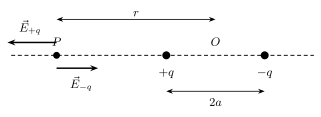
Consider an electric dipole consisting of charges and separated by distance , with dipole moment . Let be a point on the axial line (the line through both charges) at distance from the centre O, on the side of .
Electric field at P:
Distance of P from : ; from : .
Field due to (pointing away from , i.e. along the axis):
(directed away from dipole)
Field due to (pointing towards , i.e. opposite direction):
(directed towards dipole)
Since and are along the same line but opposite senses, and (P is closer to ), the net field points along 's direction, with magnitude:
Since :
For a point far away (), is negligible compared to :
directed along the dipole moment direction.
Potential at P:
Potential is scalar, so simply add algebraically: …
Unlock everything free for 14 days
- Full step-by-step solutions
- Concept-first explanations
- Methods, shortcuts & mistakes
- PYQ mapping + timed mock tests
Full access for 14 days. No credit card required.