Botany · Ch 7 — Molecular Basis of Inheritance
The Experimental Proof
The Experimental Proof
The central question in molecular biology after Watson and Crick proposed their model was: how does DNA copy itself? The model predicted a semiconservative mechanism — each new DNA molecule would keep one original strand and build one new strand. But a model is just a hypothesis until it is tested.
The definitive experimental proof came in 1958 from Matthew Meselson and Franklin Stahl, working with the bacterium Escherichia coli. Their experiment is a classic of elegant design, and it settled the matter beyond doubt.
The Meselson-Stahl Experiment
The key to their approach was to label DNA with a "heavy" isotope of nitrogen and then track what happened to that label as the bacteria replicated.
Step 1: Making "heavy" DNA. They grew E. coli for many generations in a medium where the only nitrogen source was ammonium chloride containing the heavy isotope nitrogen-15. Because nitrogen is a core component of DNA bases, all the newly synthesised DNA incorporated this heavier isotope. This "heavy" DNA has a greater density than normal DNA (which contains the common isotope nitrogen-14).
nitrogen-15 is not radioactive. It is a stable, heavy isotope. The separation of heavy DNA from normal DNA is based purely on differences in density, not radioactivity.
Step 2: The shift to "light" medium. The researchers then transferred the bacteria (now with fully nitrogen-15-labelled DNA) into a fresh medium containing only the normal, light nitrogen-14 ammonium chloride. As the bacteria grew and divided, they would use this light nitrogen to build any new DNA strands.
Step 3: Analysing the DNA by density. At specific time intervals, they took samples of the bacterial culture, extracted the double-stranded DNA, and spun it in a cesium chloride (CsCl) density gradient. In this ultracentrifuge, DNA molecules migrate to a position in the gradient that matches their own density. Heavier DNA sinks further down the tube than lighter DNA.
The Results and Their Meaning
The results from samples taken at different generations of growth were clear and decisive.
| Generation (Time) | DNA Density Observed | Interpretation |
|---|---|---|
| 0 generations (0 min, just after transfer) | All heavy (one band at the bottom) | The starting DNA is entirely nitrogen-15-labelled. |
| 1 generation (20 min) | All hybrid (one band at an intermediate position) | Each DNA molecule has one heavy (nitrogen-15) strand and one light (nitrogen-14) strand. This is exactly what semiconservative replication predicts. |
| 2 generations (40 min) | Half hybrid, half light (two bands of equal intensity) | The hybrid molecules from the first generation each act as a template. One daughter from each is a new hybrid; the other is entirely light (both strands made from nitrogen-14). |
| 3 generations (60 min) | One-quarter hybrid, three-quarters light | The pattern continues. The proportion of hybrid DNA halves with each generation. |
| 4 generations (80 min) | One-eighth hybrid, seven-eighths light | Continuing the same halving pattern, only 1/8 of the DNA is still hybrid by the fourth generation, and 7/8 is fully light — this is the ratio the textbook's own in-text question about 80 minutes is asking students to work out. |
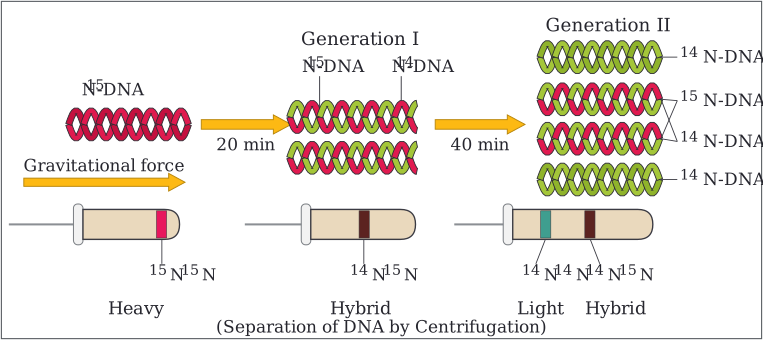
Drawn by us to help you understand the concept clearly, and verified to make sure it's accurate. For exams, practice from your textbook's own diagram.
The figure is a schematic of the experimental results from Meselson and Stahl’s 1958 experiment. It is not a photograph of a gel or a tube, but a diagram that summarises the key outcome of the CsCl density-gradient centrifugation.
The figure is organised as a vertical flow, reading from top to bottom. At the top, there is a single horizontal band labelled “Heavy DNA” — this represents the DNA extracted from E. coli that had been grown for many generations in a medium containing only $^{15}\text{N}$ (the heavy isotope of nitrogen). This DNA is uniformly dense because both strands of the double helix contain $^{15}\text{N}$.
Below that, after a downward arrow indicating the transfer of cells into a $^{14}\text{N}$ medium, the figure shows two bands side by side at the first generation (20 minutes after the shift). One band is labelled “Hybrid DNA” — this is the only band present at this time point. It has an intermediate density, exactly halfway between heavy and light DNA, because each double helix contains one old $^{15}\text{N}$ strand and one newly synthesised $^{14}\text{N}$ strand.
Further down, at the second generation (40 minutes after the shift), the figure shows two bands of equal intensity: one “Hybrid DNA” and one “Light DNA”. The light DNA band is at the position where DNA containing only $^{14}\text{N}$ would sediment. The equal amounts of hybrid and light DNA at this generation are the critical evidence for semiconservative replication — if replication were conservative, you would see one heavy band and one light band at the first generation, and a different pattern at the second.
The figure does not show any additional generations, but the text asks the student to extrapolate: after 80 minutes (four generations), the proportion of hybrid DNA would be $1/8$ and light DNA $7/8$, because each generation halves the fraction of molecules that still contain an original $^{15}\text{N}$ strand. …