Botany · Ch 7 — Molecular Basis of Inheritance
The Machinery and the Enzymes
The Machinery and the Enzymes
The entire process of DNA replication is not carried out by a single enzyme. It requires a team of molecular machines, each performing a specific task with remarkable speed and accuracy. The central player is an enzyme called DNA-dependent DNA polymerase.
This enzyme is named precisely for what it does: it depends on a DNA template to function, and it catalyses the polymerisation of deoxynucleotides into a new DNA strand. To appreciate how efficient these enzymes are, consider the bacterium E. coli. Its genome is 4.6 × 10⁶ base pairs long. Yet, E. coli completes replication of its entire DNA in just 18 minutes. This means the polymerase must work at an average rate of about 2000 base pairs per second.
Speed alone is not enough. The enzyme must also be extraordinarily accurate. Any mistake during replication — a wrong nucleotide inserted — becomes a permanent mutation in the genome. The cell cannot afford errors, so the polymerase has a built-in proofreading ability to maintain high fidelity.
Replication is also energetically expensive. The substrates for the reaction are deoxyribonucleoside triphosphates (dNTPs). These molecules serve a dual purpose. They act as the building blocks (substrates) for the new DNA strand. At the same time, the two terminal phosphate groups in a dNTP are high-energy bonds, similar to those in ATP. When these bonds are broken during polymerisation, the released energy drives the reaction forward.
The energy for adding each nucleotide comes from the nucleotide itself — no separate energy source like ATP is needed for the polymerisation step.
The Replication Fork and Directionality
A long DNA molecule cannot be unzipped along its entire length at once — that would require too much energy. Instead, replication occurs within a small, locally opened region of the helix called the replication fork. As the two parental strands separate, each serves as a template for a new complementary strand.
Here, a critical limitation of DNA polymerase creates a complication. The enzyme can only catalyse polymerisation in one direction: from the 5' end to the 3' end of the new strand. This means it can only add nucleotides to the 3' end of a growing chain.
Because the two template strands are antiparallel, this directionality affects how each new strand is built:
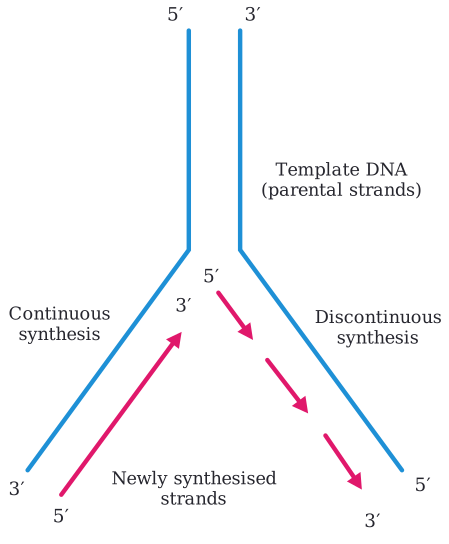
- On the template strand with polarity 3' → 5', the new strand is synthesised continuously in the 5' → 3' direction. This is called the leading strand.
- On the template strand with polarity 5' → 3', the new strand must be synthesised in short, discontinuous fragments. This is called the lagging strand. These fragments are later joined together by the enzyme DNA ligase.
Initiation and the Origin of Replication
DNA polymerase cannot start a new strand from scratch. It can only add nucleotides to an existing 3' end. Therefore, replication does not begin at a random point. It starts at specific sequences called origins of replication. In E. coli, there is a defined region where replication originates.
This requirement for an origin of replication has a practical consequence in biotechnology. When a piece of foreign DNA needs to be replicated inside a bacterial cell (as in recombinant DNA technology), it must be attached to a vector — a DNA molecule that carries its own origin of replication. Without this origin, the foreign DNA would not be copied. …
Drawn by us to help you understand the concept clearly, and verified to make sure it's accurate. For exams, practice from your textbook's own diagram.
Figure 5.8 is a schematic of the replication fork — the Y-shaped region where the parental DNA double helix is unwound and new strands are being built. The figure is divided into two sides by the central vertical axis of the fork, with the two parental template strands running in opposite directions.
On the left side of the fork, the template strand runs 3′ → 5′ (the arrow points downward). Along this template, a single, continuous new strand is shown being synthesised in the 5′ → 3′ direction — this is the leading strand. The DNA polymerase molecule is drawn attached to this strand, moving toward the fork as it adds nucleotides without interruption.
On the right side of the fork, the template strand runs 5′ → 3′ (arrow pointing upward). Here, the figure shows several short, separate segments of newly synthesised DNA — these are Okazaki fragments, each labelled as a discontinuous piece. Each fragment is being made in the 5′ → 3′ direction, but because the template runs the opposite way, the polymerase must work away from the fork, then restart repeatedly. A small gap is visible between each fragment.
At the very bottom of the figure, an arrow points to the DNA ligase enzyme, which is shown sealing the nicks between adjacent Okazaki fragments, converting them into a continuous strand — the lagging strand.
The figure also includes a small inset or label near the fork opening indicating the direction of fork movement (usually an arrow pointing left or right, showing that the fork is advancing as replication proceeds). The two parental strands are drawn as solid lines, the newly synthesised strands as dashed or thinner lines, and the 5′ and 3′ ends are marked on each strand. …