Biology · Ch 11 — Photosynthesis in Higher Plants
The Calvin Cycle
The Calvin Cycle
Calvin and his co-workers worked out the whole pathway and showed that it operates in a cyclic manner, with RuBP being regenerated at the end so the cycle can continue. It is important to understand clearly that the Calvin pathway occurs in all photosynthetic plants; it does not matter whether they have the C3 or the C4 (or any other) pathway. For ease of understanding, the Calvin cycle can be described under three stages: carboxylation, reduction and regeneration.
1. Carboxylation — Carboxylation is the fixation of CO2 into a stable organic intermediate. It is the most crucial step of the Calvin cycle, in which CO2 is used for the carboxylation of RuBP. This reaction is catalysed by the enzyme RuBP carboxylase, and results in the formation of two molecules of 3-PGA. Because this enzyme also has an oxygenation activity, it is more correctly called RuBP carboxylase-oxygenase, or RuBisCO.
2. Reduction — These are a series of reactions that lead to the formation of glucose. The steps involve:
- Utilisation of 2 molecules of ATP for phosphorylation, and two of NADPH for reduction, per CO2 molecule fixed.
- The fixation of six molecules of CO2 and 6 turns of the cycle are required for the formation of one molecule of glucose.
3. Regeneration — Regeneration of the CO2 acceptor molecule RuBP is crucial if the cycle is to continue uninterrupted. The regeneration steps require one ATP for phosphorylation to form RuBP. …
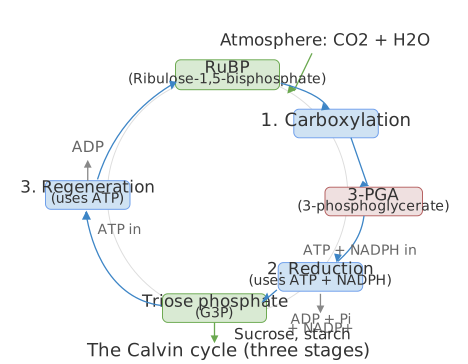
Drawn by us to help you understand the concept clearly, and verified to make sure it's accurate. For exams, practice from your NCERT textbook's own diagram.
This figure shows the Calvin cycle as a closed loop with three stages. In carboxylation (stage 1), CO2 from the atmosphere combines with the 5-carbon ribulose-1,5-bisphosphate to form the 3-carbon 3-phosphoglycerate. In reduction (stage 2), 3-phosphoglycerate is converted, using ATP and NADPH made in the light reaction, into triose phosphate, releasing ADP, Pi and NADP+; this triose phosphate leads to sucrose and starch. In regeneration (stage 3), triose phosphate is rearranged, using ATP, to re-form the acceptor ribulose-1,5-bisphosphate so the cyc …