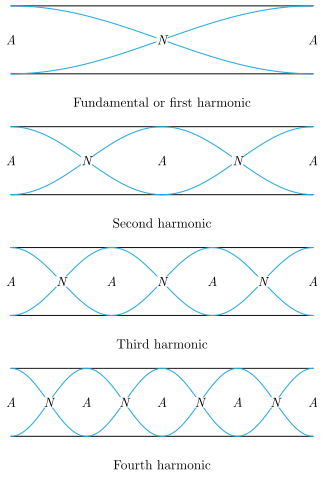
Acoustic Resonance Harmonics
Imagine pushing a child on a swing. If you push at random moments, the swing jerks but never goes high. But if you push exactly when the swing is coming back toward you — matching its natural rhythm — each small push adds to the motion, and soon the swing soars. That is resonance: a small, well-timed force builds up a large response.
Acoustic resonance is the same idea, but with sound. A guitar string, an air column in a pipe, or a wine glass each has certain natural frequencies at which it vibrates easily. When a sound wave (or a periodic push) arrives at one of those frequencies, the object absorbs energy efficiently and its vibration amplitude grows large. That build-up is acoustic resonance.
Harmonics: The Family of Natural Frequencies
An object does not have just one natural frequency — it has a whole ladder of them, called harmonics. The lowest one is the fundamental (first harmonic); the rest are related to it in a way that depends on the boundary conditions of the vibrating system. This is the point most notes skip, and it is exactly what CBSE Class 11 tests.
The statement "harmonic frequencies are whole-number multiples of the fundamental" is only true for systems that are symmetric at both ends (both fixed, or both free). It is not true for every vibrating system — a stretched drum membrane, for instance, has overtones that are not simple whole-number multiples of its fundamental, which is exactly why a drum's note sounds less "musical" than a string's.
Case 1 — Both ends fixed (a stretched string) or both ends open (an open organ pipe)
Here every harmonic is present:
fn=nf1,n=1,2,3,4,…
For a string fixed at both ends, the fundamental f1 is one loop; f2=2f1 is two loops, f3=3f1 is three loops, and so on. A pipe open at both ends behaves the same way for the air column inside it.
Case 2 — One end closed, one end open (a closed organ pipe)
The closed end must be a displacement node and the open end an antinode. That boundary condition rules out the even harmonics — only the odd multiples of the fundamental survive:
fn=nf1,n=1,3,5,7,…
This is why a closed pipe of a given length sounds an octave lower (and tonally different) than an open pipe of the same length — it is missing every even harmonic.
The Precise Statement
Acoustic resonance harmonics occur when a driving sound wave's frequency matches one of the natural frequencies of a vibrating system, causing that system to vibrate with maximum amplitude at that natural frequency. Which harmonics exist — all integers, or only odd integers — depends entirely on the boundary conditions at the two ends of the system.
Why This Matters
- A guitar string vibrates at its fundamental and several of its harmonics simultaneously; the relative strength of each harmonic gives the instrument its characteristic timbre. …