Physics · Ch 5 — Work, Energy and Power
The Conservation of Mechanical Energy
The Conservation of Mechanical Energy
The Principle of Conservation of Mechanical Energy
The most powerful idea in this section is that for a system where only conservative forces do work, the total mechanical energy — the sum of kinetic energy and potential energy — never changes. It is conserved. This is not a new law; it follows directly from the work-energy theorem and the definition of potential energy.
Recall the work-energy theorem: the net work done by all forces (conservative and non-conservative) equals the change in kinetic energy:
Now, separate the net work into work done by conservative forces () and work done by non-conservative forces ():
But we defined the change in potential energy as the negative of the work done by conservative forces: . Substituting gives:
Rearranging:
This is the general statement. It says that the change in total mechanical energy () equals the work done by non-conservative forces.
The core result
If only conservative forces act on the system, then , and we get:
This is the law of conservation of mechanical energy. It means that energy can transform between kinetic and potential forms, but the sum remains fixed.
Properties of Conservative Forces and Energy Conservation
The textbook lists three essential properties that follow from the definition of conservative forces. Each one is a direct consequence of the work-energy relationship we just used.
Property (I): Work done is path-independent
For a conservative force, the work done in moving a particle between two points A and B depends only on the positions of A and B, not on the path taken.
Proof: Consider two different paths from A to B. Let be the work done along path 1, and be the work done along path 2. Now consider a closed loop: go from A to B along path 1, then return from B to A along path 2 (reversed). The total work around this closed loop must be zero for a conservative force (this is the defining property). So:
But along the reversed path 2 is just (because reversing the direction reverses the sign of work). Therefore:
Thus the work is the same for any path.
This is why we can define potential energy as a function of position only — the work done by a conservative force depends only on where you start and end, not how you get there.
Property (II): Work done equals the negative of the change in potential energy
Proof: This is actually the definition of potential energy for a conservative force. We define the potential energy function such that the work done by the conservative force equals the decrease in potential energy. For a small displacement , the work done is . Integrating from initial to final position:
Property (III): Total mechanical energy is conserved
If only conservative forces act, then .
Proof: From the work-energy theorem, . But from Property (II), . Equating:
Therefore is constant.
The Work-Energy Theorem in Terms of Potential Energy …
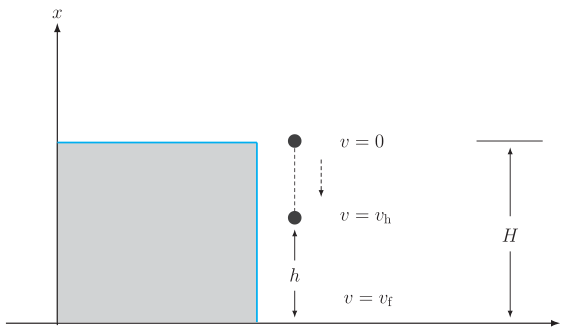
Drawn by us to help you understand the concept clearly, and verified to make sure it's accurate. For exams, practice from your NCERT textbook's own diagram.
Fig. 5.5 is a simple but powerful sketch that captures the entire idea of energy conversion during free fall. The figure shows a vertical cliff of height , with the -axis pointing upward (the vertical direction). A ball of mass is shown at three positions along its fall: at the top (height ), at some intermediate height , and just before hitting the ground (height ). The ball’s path is indicated by a dashed vertical line.
At the top, the ball is momentarily at rest — its velocity is . At the intermediate point, it has fallen a distance and now has speed . At the bottom, just before impact, its speed is . The figure brackets the total height and the remaining height , making it visually clear that the ball has lost gravitational potential energy equal to and gained an equal amount of kinetic energy.
The physical idea is that gravitational potential energy is not a fixed property of the ball alone — it depends on the ball’s position relative to the ground. As the ball falls, its potential energy decreases and its kinetic energy increases, but the sum remains constant (ignoring air resistance). The figure makes this conservation concrete: the energy that was “stored” at the top due to height is gradually “released” as motion.
The key formula the textbook develops from this figure is the conservation of mechanical energy for a freely falling body:
Here, is the mass of the ball, is the acceleration due to gravity, is the initial height, and is the speed just before hitting the ground. The left side is the final kinetic energy, the right side is the initial potential energy. For the intermediate point at height , the relation becomes:
where is the speed at height . This shows that the total mechanical energy (kinetic + potential) at any point equals the initial potential energy. …