Physics · Ch 5 — Work, Energy and Power
Work Done by a Variable Force
Work Done by a Variable Force
Work Done by a Variable Force
In real life, forces are rarely constant. When you stretch a spring, the force you apply increases the further you pull. When a rocket lifts off, the thrust changes as fuel burns. The simple formula only works when the force stays the same throughout the displacement. For a force that changes with position, we need a different approach.
The Basic Idea: Breaking the Motion into Tiny Steps
Imagine a particle moving along the -axis from to , acted upon by a force that depends on the position . The force is different at every point along the path.
We can handle this by dividing the total displacement into a large number of very small intervals, each of width . Over such a tiny interval, the force is approximately constant. If we take the interval from to , the work done over that small step is approximately:
The total work done over the entire displacement is the sum of the work done over all these tiny intervals:
This approximation becomes exact as we make the intervals infinitesimally small — that is, as . In this limit, the sum becomes an integral.
This is the fundamental definition of work done by a variable force in one dimension. The integral literally adds up the force at every point along the path, multiplied by the infinitesimal displacement .
Geometric Interpretation
The integral has a clear geometric meaning: it is the area under the curve of versus , between the limits and .
If you plot force on the vertical axis and position on the horizontal axis, the work done is the area bounded by the curve, the -axis, and the vertical lines at and .
The area counts as positive when the force and displacement are in the same direction (the curve lies above the -axis). If the force opposes the motion (the curve dips below the -axis), the area contributes negative work. The total work is the net signed area — not the total area.
A Concrete Example: Stretching a Spring
Consider a spring that obeys Hooke's law. The force required to stretch or compress the spring by a distance from its natural length is:
Here is the spring constant (a measure of the spring's stiffness), and the negative sign indicates that the spring force always opposes the displacement — it's a restoring force.
If we want to calculate the work done by an external agent (like your hand) in stretching the spring slowly from to , we need the force that the external agent applies. To stretch the spring at constant speed (so that kinetic energy doesn't change), the external force must exactly balance the spring force at every point:
The work done by this external force is:
Evaluating the integral:
…
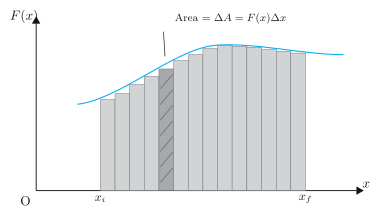
Drawn by us to help you understand the concept clearly, and verified to make sure it's accurate. For exams, practice from your NCERT textbook's own diagram.
The figure shows a graph with force plotted on the vertical axis and displacement on the horizontal axis. The curve itself rises from the origin, then gradually flattens out — it represents a force that changes with position, not a constant one. Two vertical lines are drawn at and , marking the start and end of the motion we care about.
The key visual is this: the area under the curve between and is approximated by a series of tall, thin rectangles. Each rectangle has width and height equal to the force at that particular — so its area is . One of these rectangles is shaded, and next to it the figure labels its area as .
What the figure is teaching is the fundamental idea of integration before you have the integral sign. When the force is not constant, you cannot just multiply by total displacement. Instead, you break the total displacement into many tiny steps . Over each tiny step, the force is approximately constant, so the work done in that step is — exactly the area of that thin rectangle. The total work is then the sum of the areas of all these rectangles.
The physical meaning of the shaded rectangle: it is the work done by the force over a single small displacement at a particular position .
The textbook then takes the limit as , turning the sum of rectangles into the exact area under the curve. That limit is the definite integral:
Here, is the total work done by the variable force as the object moves from to . The symbol stands for the integral — the continuous version of the sum. is the force at each position, and is the infinitesimal displacement (the limit of ). The integral literally means "add up for every tiny step from to ." …
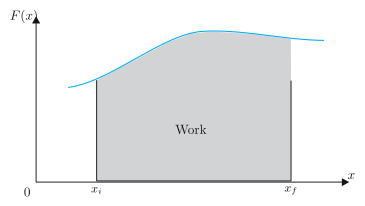
Drawn by us to help you understand the concept clearly, and verified to make sure it's accurate. For exams, practice from your NCERT textbook's own diagram.
The figure is a simple but powerful visual: a graph with force on the vertical axis and position on the horizontal axis. The curve drawn is some arbitrary function that changes with — it is not a straight line, because the force is variable. Two vertical lines are marked at (the initial position) and (the final position). The entire region between the curve, the -axis, and these two vertical boundaries is shaded and labelled "Work".
That shaded area is the central idea. For a constant force, work is just , which is the area of a rectangle. But when changes with , you cannot use a single rectangle. The figure shows the textbook's reasoning: if you slice the region under the curve into many thin vertical rectangles of width , each rectangle has height approximately at that point. The work done over one such slice is roughly . Summing all these rectangles gives an approximation to the total work. As shrinks to zero — the limit shown in the caption — the sum becomes the exact area under the curve.
The physical meaning: the work done by a variable force is the area under the vs graph between the initial and final positions.
This is not a new formula; it is the definition of work for a one-dimensional variable force. The textbook writes it as:
Here is the work done by the force as the object moves from to . The integral symbol is just a shorthand for "sum over infinitesimally thin slices". The expression represents the work done over an infinitesimal displacement , and the integral adds up all those infinitesimal contributions.
The figure does not show the rectangles themselves — it shows the final shaded region after the limit has been taken. The caption's mention of "adding all the rectangles, for " is the conceptual bridge between the discrete sum and the continuous area. …