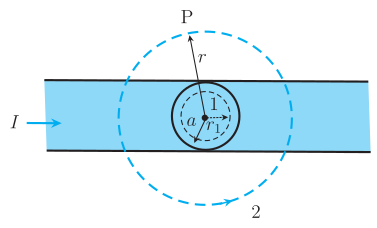
Q.Figure 4.13 shows a long straight wire of a circular cross-section (radius ) carrying steady current . The current is uniformly distributed across this cross-section. Calculate the magnetic field in the region and .
You're viewing a preview — the full solution, concept, methods & PYQ mapping are locked.
Start your 14-day free trial to unlock the full solution →Using Ampère's circuital law, the magnetic field inside a uniformly current-carrying wire grows linearly with distance from the axis, while outside it falls off as . The results are and .
Why Ampère's Circuital Law?
Ampere's law is the cleanest tool here. It says: for any closed loop, the line integral of the magnetic field around it equals times the current passing through the loop. The symmetry of a long straight wire -- cylindrical, infinite -- tells us the field must be azimuthal (circles around the wire) and depend only on the radial distance from the axis. So we pick circular Amperian loops centred on the wire, and the integral becomes simply . The only trick is: how much current actually pierces the loop? That depends on whether the loop lies inside or outside the wire.
- Region (outside the wire) Take a circular Amperian loop of radius , concentric with the wire. The entire current passes through this loop. By symmetry, is constant in magnitude along the loop and tangential to it. Ampère's law gives:
So:
This is exactly the field of a thin wire -- as if all current were concentrated at the axis. Outside the wire, the finite radius doesn't matter.
- Region (inside the wire) Now take a loop of radius . Only a fraction of the total current passes through it. Since the current is uniformly distributed over the cross-section, the current density is:
The area enclosed by the loop is , so the current through it is:
Apply Ampère's law:
Hence:
A common mistake is to use the full current for the inside region. Remember: Ampère's law cares only about the current enclosed by the loop. For , that's less than . …
Unlock everything free for 14 days
- Full step-by-step solutions
- Concept-first explanations
- Methods, shortcuts & mistakes
- PYQ mapping + timed mock tests
Full access for 14 days. No credit card required.