Q.There are many endocrine glands in human body. Name the glands which is absent in male and the one absent in female.
🔒You're viewing a preview — the full solution, concept, methods & PYQ mapping are locked.
🔒 Start your 14-day free trial to unlock the full solution →Concept understanding — Human Endocrine System Overview
The Body's Chemical Messenger System
Imagine your body as a vast, busy city. The nervous system is like the telephone network — instant calls, direct lines, fast but short-lived. The endocrine system is the postal service. It sends chemical letters (hormones) through the bloodstream, which travel more slowly but reach every corner of the city and can keep working for hours or days.
These chemical letters tell different organs when to grow, when to release energy, when to prepare for danger, and when to rest. Without them, your body would have no long-term coordination.
What Exactly Is the Endocrine System?
The human endocrine system is the organised collection of ductless glands and specialised hormone-secreting tissues that release hormones directly into the blood. These hormones travel to target cells elsewhere in the body, bind to specific receptors, and trigger a response.
A gland is called endocrine (or ductless) because it secretes its product into the bloodstream, not through a duct. Compare this with exocrine glands (like sweat glands or salivary glands) that release their secretions through ducts to a surface.
The Key Players: Major Endocrine Glands
Here are the main glands and what they roughly do:
| Gland | Location | Major Hormones | Primary Functions |
|---|---|---|---|
| Hypothalamus | Brain (above pituitary) | Releasing/inhibiting hormones | Master controller of the pituitary; links nervous and endocrine systems |
| Pituitary | Base of brain (below hypothalamus) | Growth hormone (GH), TSH, ACTH, FSH, LH, prolactin, ADH, oxytocin | The "master gland" — controls other glands |
| Thyroid | Neck (below Adam's apple) | Thyroxine (T₃, T₄), calcitonin | Regulates metabolic rate, growth, calcium balance |
| Parathyroid | Embedded in thyroid (4 tiny glands) | Parathyroid hormone (PTH) | Raises blood calcium levels |
| Adrenal (cortex + medulla) | On top of each kidney | Cortisol, aldosterone, adrenaline, noradrenaline | Stress response, salt/water balance, metabolism |
| Pancreas (islets of Langerhans) | Behind stomach | Insulin, glucagon | Controls blood glucose levels |
| Gonads (ovaries/testes) | Pelvis/scrotum | Oestrogen, progesterone, testosterone | Reproduction, secondary sexual characteristics |
| Pineal | Deep in brain | Melatonin | Regulates sleep-wake cycles (circadian rhythm) |
The hypothalamus is technically part of the brain, but it secretes hormones into a special blood vessel system that directly reaches the pituitary. This is why it's considered an endocrine gland too.
How It All Works Together
The system is hierarchical, not democratic. The hypothalamus sends orders to the pituitary, which then sends orders to other glands (thyroid, adrenal cortex, gonads). Those glands then release their own hormones, which act on the rest of the body.
A critical feature is feedback control — mostly negative feedback. When a hormone level rises high enough, it signals the hypothalamus and pituitary to stop producing the stimulating hormones. This keeps everything in balance.
Think of a thermostat: when the room gets warm enough, the heater turns off. That's negative feedback. The endocrine system uses this constantly to avoid over- or under-production.
The Precise Statement …
Among the human endocrine glands, the ovary is absent in males and the testis is absent in females.
- The gonads are listed among the organised endocrine glands, with the testis serving as the male gonad and the ovary as the female gonad.
- The testis is the primary male sex organ, located in a pair within the scrotal sac, and is present only in males. …
Among the organised endocrine glands, the ovary is present only in females and absent in males, while the testis is present only in males and absent in females.
The organised endocrine glands include the gonads, which are sex-specific by definition: the testis in males and the ovary in females. Each gonad carries out two roles at once — a reproductive one and an endocrine one, since each secretes its own hormones alongside its reproductive function. …
- AP EAPCET 2023Set ap-2023-05-23-FN1 markMCQQ.Identify of the incorrect statement among the following (A) Sella turcica is a bony cavity in which pituitary gland is located. (B) Parathyroid hormone decreases the Ca+2 levels in blood. (C) Thymosin plays a major role in T- cell differentiation. (D) The middle zone of adrenal cortex is zona fasiculata.
›Reveal solutionSolution
Parathyroid hormone raises, not lowers, blood calcium — it is calcitonin (from the thyroid) that lowers blood calcium — making statement B the incorrect one among the four given.
Concept and Intuition
Calcium homeostasis is jointly regulated by two antagonistic hormones: parathyroid hormone (PTH), secreted by the parathyroid glands, which raises blood calcium levels by stimulating osteoclastic bone resorption, increasing renal tubular reabsorption of calcium, and promoting activation of vitamin D (enhancing intestinal calcium absorption); and calcitonin, secreted by the thyroid's parafollicular (C) cells, which lowers blood calcium by inhibiting bone resorption. The statement that "parathyroid hormone decreases Ca²⁺ levels" reverses this relationship and is therefore false. The other statements are accurate: the pituitary gland does sit in the sella turcica, thymosin does play a key role in T-lymphocyte differentiation/maturation, and the zona fasciculata is indeed the middle layer of the three-layered adrenal cortex (outer zona glomerulosa, middle zona fasciculata, inner zona reticularis).
Step-by-Step Solution
- Verify sella turcica houses the pituitary — correct anatomical fact. …
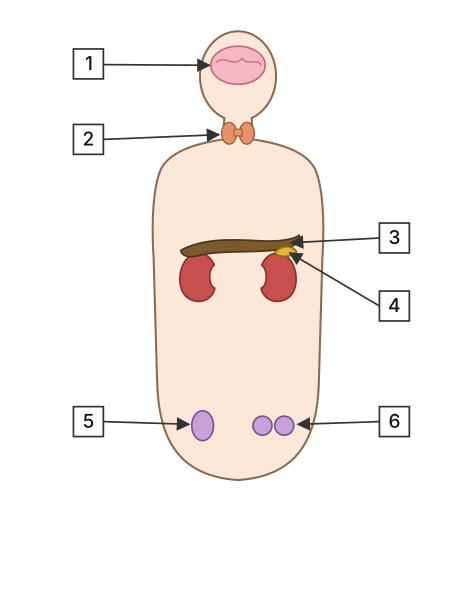
- AP EAPCET 2021Set ap-2021-09-07-FN1 markMCQQ.Recognize the figure and find out the correct matching related to location of endocrine glands? [FIGURE] (an outline diagram of the human body with six numbered labels 1-6, each connected by a leader line/arrow to an endocrine-gland location: 1 at the brain, 2 at the neck/throat, 3 and 4 pointing to structures at the upper-abdomen/kidney region, and 5 and 6 pointing to paired structures in the lower abdomen) (A) 1 – Pituitary, 2 – Thyroid, 3 – Adrenal, 4 – Pancreas, 5 – Testis, 6 – Ovaries (B) 1 – Pituitary, 2 – Thyroid, 3 – Pancreas, 4 – Adrenal, 5 – Testis, 6 – Ovaries (C) 1 – Thyroid, 2 – Pituitary, 3 – Pancreas, 4 – Adrenal, 5 – Testis, 6 – Ovaries (D) 1 – Pituitary, 2 – Thyroid, 3 – Pancreas, 4 – Adrenal, 5 – Ovaries, 6 – Testis
›Reveal solutionSolution
This is a straightforward endocrine-gland location-matching question. Using the position and shape clues in the figure (brain → pituitary, butterfly neck structure → thyroid, gland spanning both kidneys → pancreas, cap on one kidney → adrenal, single oval → testis, paired ovals → ovaries), the labelling in option (B) is the one that is anatomically consistent.
Concept and Intuition
The endocrine system is a set of ductless glands releasing hormones directly into the blood. Their body locations are fixed and distinctive, and diagrams typically test whether a student can recognise a gland from its characteristic shape and position rather than from a name alone:
- The pituitary (hypophysis) is a pea-sized gland attached to the base of the brain by a stalk (infundibulum) — hence a label pointing into the brain region.
- The thyroid is a butterfly/H-shaped gland straddling the trachea in the neck — matching the "butterfly/H-shaped structure in the neck."
- The pancreas is a long, flattened, elongated gland lying transversely across the posterior abdominal wall, behind the stomach, spanning the region near both kidneys — matching "a dark, elongated gland lying across the top of two red bean-shaped organs."
- The adrenal (suprarenal) glands sit like a cap directly on top of each kidney — matching "a small cap-like structure sitting on top of one of the bean-shaped organs."
- The testes are a pair of oval glands in the scrotum, and the ovaries are a pair of small oval bodies in the pelvis; in composite endocrine charts they are often drawn one on each side (male structures on one side, female on the other) purely for illustrative economy.
Step-by-Step Solution
- Label 1 → points into the brain → Pituitary gland (hypophysis).
- Label 2 → the butterfly-shaped neck structure → Thyroid gland. …
🎓Unlock everything free for 14 days
- ✓Full step-by-step solutions
- ✓Concept-first explanations
- ✓Methods, shortcuts & mistakes
- ✓PYQ mapping + timed mock tests
Full access for 14 days. No credit card required.