Q.Four position-time (x versus t) graphs of a particle moving along a straight line are described below. In only ONE of them can the average velocity over the interval (0,T) be made to vanish for a suitably chosen T. Which one is it?
Graph (a): at t=0 the position is negative (below the t-axis); the curve rises, crosses x=0 at some later time, reaches a positive maximum and then falls slightly, remaining positive.
Graph (b): at t=0 the position is positive; the curve rises to a maximum and then falls in an S-shape to a smaller positive value.
Graph (c): at t=0 the position is a large positive value; the curve decreases steadily (concave up) and levels off toward zero, staying positive.
Graph (d): the curve starts at the origin (x=0 at t=0), rises quickly and then flattens (concave down), approaching a constant positive value.
Concept understanding — Average Speed vs Velocity
Average Speed vs Velocity: The Intuition First
Imagine you're walking home from school. You take a shortcut through a park, then stop to buy a snack, then realise you forgot something and run back a bit, then finally walk home. By the time you reach your front door, you've walked a total of 2 km — but your house is only 500 metres from school in a straight line.
That difference — between the total ground you covered and how far you actually ended up from where you started — is the entire point of speed vs velocity.
The Precise Definitions
Average speed is a measure of how fast something is moving overall. It cares only about the total distance travelled, not the direction.
Average speed=Total time takenTotal distance travelled
Average velocity is a measure of how fast and in what direction something is moving overall. It cares about the net displacement — the straight-line distance from start to finish, with a direction.
Average velocity=Total time takenDisplacement
Displacement is the straight-line distance from the starting point to the ending point, with a direction. Distance is the total length of the actual path travelled, with no direction.
The Key Difference in One Sentence
Speed is a scalar (just a number, like 5 km/h). Velocity is a vector (a number and a direction, like 5 km/h north).
That one word — direction — changes everything.
A Concrete Example
You walk 3 km east, then 4 km north. The whole trip takes 1 hour.
- Total distance travelled = 3 + 4 = 7 km
- Displacement = straight line from start to finish = 32+42=5 km, northeast
Now compute:
Average speed=1 h7 km=7 km/h
Average velocity=1 h5 km, northeast=5 km/h, northeast
A common mistake: students think average velocity is just "speed with direction". It's not. It's displacement divided by time, not distance divided by time. If you walk in a circle and return to your starting point, your displacement is zero — so your average velocity is zero, even though your average speed is positive.
When Are They Equal?
Only when the motion is in a straight line without changing direction. If you walk 2 km east in a straight line, then distance = displacement, so average speed = magnitude of average velocity.
But the moment you turn, or stop, or go backwards — they diverge.
Why This Matters for Exams
In Indian board exams (CBSE, ICSE, state boards), you will be asked to:
- Distinguish between speed and velocity (scalar vs vector)
- Calculate average speed and average velocity from given data
- Interpret situations where velocity is zero but speed is not (like a round trip)
Always check: does the problem give you distance or displacement? If it says "returns to starting point", displacement = 0, so average velocity = 0 regardless of how fast the object moved.
The Bottom Line
| Quantity | Type | Formula | Depends on |
|---|---|---|---|
| Average speed | Scalar | total timetotal distance | Path taken |
| Average velocity | Vector | total timedisplacement | Start and end points only |
Average speed tells you how fast the journey was. Average velocity tells you how effectively you moved from where you started to where you ended.
Searches for "Average Speed vs Velocity notes class 11" and "Average Speed vs Velocity important questions" both point back to this same core idea, since Average Speed vs Velocity sits squarely within the Motion in a Straight Line coverage of NCERT Class 11 Physics, so it is fair game for both CBSE board questions and competitive-exam numericals. The clearest way to build exam confidence here is to combine this explanation with the NCERT Physics textbook's own solved examples and chapter-end questions.
The average velocity over (0,T) is vˉ=[x(T)−x(0)]/T, so it vanishes only if the particle returns to its starting position, x(T)=x(0). Only graph (b) rises and then falls back through its initial value.
Graph (b) is non-monotonic: it goes up and then comes back down past the level it started from, so there exists a T>0 with x(T)=x(0) and hence vˉ=0. Graph (a) starts negative and ends positive (never returns to its negative start); graphs (c) and (d) are monotonic, so their position never repeats.
Option (B) — graph (b).
Average velocity over (0,T) is vˉ=Tx(T)−x(0). It can be zero only when the particle comes back to where it began, i.e. x(T)=x(0) for some T>0. Among the four curves, only graph (b) turns around and re-crosses its initial position, so it is the unique answer.
Concept
Average velocity depends only on the net displacement between the endpoints, not on the path in between:
vˉ=Tx(T)−x(0).
For vˉ=0 we need x(T)=x(0) with T>0 — the position–time curve must return to the same height it had at t=0.
Checking each graph
- (a) starts at a negative x and rises to a positive value where it stays. It never comes back down to its negative starting value, so x(T)=x(0) for any T>0.
- (b) starts positive, rises to a peak and then falls back down, passing through its initial height again. At that instant x(T)=x(0), so vˉ=0. ✓
- (c) decreases monotonically; x never repeats a value, so it can never equal x(0) again.
- (d) increases monotonically toward a constant; again x never returns to its start.
Only a curve that reverses direction can satisfy x(T)=x(0), and graph (b) is the only one that does.
Option (B) — graph (b). It is the only graph in which the particle returns to its initial position, making the average velocity over (0,T) zero for a suitable T.
Concept: A Turning Point Is Necessary for Zero Average Velocity — Rolle's Theorem
Method: Two-Part Theorem-Based Test (Rolle's Theorem to eliminate, Intermediate Value Theorem to confirm)
Rather than checking, for each graph individually, "does it come back to its starting height," this method uses one calculus theorem to eliminate three of the four graphs at once — by a necessary condition every candidate must satisfy — and a second theorem to positively confirm the survivor.
Steps
-
State the target condition. Average velocity over (0,T) vanishes iff x(T)=x(0) for some T>0, since vˉ=[x(T)−x(0)]/T.
-
Rolle's Theorem (the elimination step). If x is smooth and x(T)=x(0) for some T>0, Rolle's Theorem guarantees there exists an instant c∈(0,T) with x′(c)=0 — i.e. an interior turning point (a local max or min of x) must exist strictly between 0 and T. Contrapositive: a graph with no interior turning point at all can never satisfy x(T)=x(0) for any T>0.
-
Scan all four graphs for an interior turning point:
- (a) rises steadily from a negative start to a positive plateau (with only a slight late dip that stays positive) — essentially monotonic, no interior turning point that brings it back down to its starting level.
- (b) rises to a peak, then falls — has an interior turning point (the peak).
- (c) decreases steadily, levelling off — monotonic, no turning point.
- (d) rises and flattens toward a constant — monotonic, no turning point.
By Step 2's contrapositive, (a), (c), and (d) are eliminated immediately — none of them can ever return to its starting value, so vˉ=0 is impossible for any T on those three.
-
Intermediate Value Theorem (the confirmation step, for graph (b) only). Graph (b) starts at x(0)>0, rises above x(0) to its peak, then falls in an S-shape to a smaller positive value below x(0). Since x is continuous and takes a value above x(0) (at the peak) and later a value below x(0) (at the end), the Intermediate Value Theorem guarantees x passes through the value x(0) exactly at some intermediate time T during the fall — this is the required T with x(T)=x(0).
Why two theorems, not one
Rolle's Theorem alone only tells you a turning point is necessary — it doesn't by itself prove the curve actually returns to its starting height (a curve could turn around and still never come back down that far). It's the Intermediate Value Theorem, applied specifically to graph (b)'s stated overshoot-then-undershoot behaviour, that positively confirms the crossing exists.
Final Answer
Graph (b)
— the only one with an interior turning point (necessary, by Rolle's Theorem) that is also confirmed, by the Intermediate Value Theorem, to bring x back through its starting value.
Showing the 12 most recent of 15 on this concept.
- AP EAPCET 2026Set eng-2026-05-12-AN1 markMCQQ.A motorist completes half revolution on a circular path of 60 m radius in one minute. His average speed (A) 1 ms−1 (B) 2 ms−1 (C) 3.14 ms−1 (D) 4.14 ms−1
›Reveal solutionSolution
Average speed uses the actual path length travelled (the arc), not the straight-line displacement. Half a revolution covers πr, giving average speed π≈3.14 m/s.
Concept and Intuition
Average speed is distance travelled divided by time elapsed — it does not care about direction, unlike average velocity (which would use the displacement, i.e., the diameter here, and give a much smaller value). For half a revolution, the path length is half the circumference.
Step-by-Step Solution
- Circumference of the circular path: 2πr=2π(60)=120π m.
- Half revolution ⇒ arc length travelled =2120π=60π m ≈188.5 m.
- Time taken =1 minute =60 s.
- Average speed =timedistance=6060π=π≈3.14 m/s.
Common Mistakes
- Using the diameter (2r=120 m, the displacement for a half revolution) instead of the arc length — that would compute average velocity magnitude (120/60=2 m/s), not average speed.
- Forgetting to convert one minute to 60 seconds.
✓Final answerThe correct option is (C) — 3.14 ms−1.
ANSWER: C
- AP EAPCET 2026Set eng-2026-05-18-FN1 markMCQQ.A Car travels first half of the distance with a velocity 'V' and second half of the distance with a velocity '3V', then the average velocity is (A) 2.0 V (B) 3.0 V (C) 4.0 V (D) 1.5 V
›Reveal solutionSolution
Average velocity over two equal distances (not equal times) at speeds V and 3V is the harmonic-mean-like combination v1+v22v1v2=1.5V.
Concept and Intuition
Average velocity is total displacement divided by total time — not the arithmetic mean of the two speeds, because the car spends more time at the slower speed. For equal distances d at speeds v1,v2, the total distance is 2d and total time is d/v1+d/v2.
Step-by-Step Solution
- Let total distance be 2d; first half d at speed V, second half d at speed 3V.
- Time for first half: t1=d/V. Time for second half: t2=d/(3V).
- Total time: t1+t2=Vd+3Vd=3V3d+d=3V4d.
- Average velocity =total timetotal distance=4d/(3V)2d=4d2d⋅3V=46V=1.5V.
Common Mistakes
- Taking the simple arithmetic mean (V+3V)/2=2V — wrong because equal distances (not equal times) are covered at each speed.
- Using the formula for equal-time averaging instead of equal-distance averaging.
✓Final answerThe correct option is (D) — 1.5 V.
ANSWER: D
- AP EAPCET 2025Set eng-2025-05-21-FN1 markMCQQ.If a car travels 40% of the total distance with a speed v1 and the remaining distance with a speed v2, then average speed of the car is (A) 21v1v2 (B) 2v1+v2 (C) v1+v22v1v2 (D) 3v1+2v25v1v2
›Reveal solutionSolution
This tests the formula for average speed as total distance over total time, not a simple average of speeds; the answer is (D).
Concept and Intuition
Average speed is never the arithmetic mean of two speeds unless the times (not distances) spent at each speed are equal. When distances (or fractions of distance) are given instead, you must add up the actual times taken for each segment.
Step-by-Step Solution
- Let total distance be D. First segment: 0.4D at speed v1, taking time t1=v10.4D.
- Second segment: remaining 0.6D at speed v2, taking time t2=v20.6D.
- Average speed =total timetotal distance=t1+t2D=v10.4D+v20.6DD=v10.4+v20.61.
- Combine the fractions: v10.4+v20.6=v1v20.4v2+0.6v1.
- So average speed =0.6v1+0.4v2v1v2. Multiplying numerator and denominator by 5 (to clear decimals): 3v1+2v25v1v2.
Common Mistakes
- Averaging v1 and v2 directly (that's only valid for equal times, not equal distance fractions).
- Arithmetic slip converting 0.4/0.6 into the 2/3 fraction form.
✓Final answerThe correct option is (D) — 3v1+2v25v1v2.
ANSWER: D
- AP EAPCET 2025Set eng-2025-05-21-AN1 markMCQQ.A car is moving with a velocity of 4 ms−1 towards east. After a time of 4 s, if it is heading north-east with a velocity of 42 ms−1, then the average velocity of the car is (A) 25 ms−1 (B) 35 ms−1 (C) 43 ms−1 (D) 53 ms−1
›Reveal solutionSolution
Under constant acceleration, average velocity is the vector average of the initial and final velocities, (v1+v2)/2. Computing this vector sum gives (A) 25 m/s.
Concept and Intuition
For a body under constant acceleration a, displacement is s=v1t+21at2, and average velocity is vavg=s/t=v1+21at. Since v2=v1+at, we can write 21at=21(v2−v1), so vavg=v1+21(v2−v1)=2v1+v2. This vector identity holds even though the direction of velocity changes, as long as the acceleration is constant.
Step-by-Step Solution
- Set up axes: east =i^, north =j^.
- Initial velocity: v1=4i^ ms−1 (due east).
- Final velocity: north-east means 45° between east and north, so v2=42(cos45∘i^+sin45∘j^)=42(22i^+22j^)=4i^+4j^.
- Average velocity =2v1+v2=2(4+4)i^+(0+4)j^=4i^+2j^.
- Magnitude: ∣vavg∣=42+22=16+4=20=25 ms−1.
Common Mistakes
- Simply subtracting speeds (42−4) instead of treating velocity as a vector.
- Forgetting the 45° angle between 'east' and 'north-east' when resolving v2 into components.
- Computing ∣v2−v1∣/t (average acceleration) instead of (v1+v2)/2 (average velocity) — these are different physical quantities.
✓Final answerThe correct option is (A) — 25 ms−1.
ANSWER: A
- AP EAPCET 2025Set ap-2025-05-20-FN1 markMCQQ.A body moving along a straight line path travels first 10 m distance in a time of 3 seconds and the next 10 m distance with a velocity of 5 ms−1. The average velocity of the body is (A) 4 kmph (B) 10.6 kmph (C) 18.2 kmph (D) 14.4 kmph
›Reveal solutionSolution
Total distance 20 m over total time 5 s gives average velocity 4 m/s, which converts to 14.4 km/h. Answer: (D).
Concept and Intuition
Average velocity over a whole journey is always total displacement divided by total time, not simply an average of the different speeds used in each part. Whenever a journey is split into segments each with their own speed or time, the correct approach is to work out the time (or distance) for each segment separately, sum them, and only then divide.
Step-by-Step Solution
- First segment: distance =10 m, time =3 s (given directly).
- Second segment: distance =10 m, travelled at 5 ms−1, so time =510=2 s.
- Total distance =10+10=20 m.
- Total time =3+2=5 s.
- Average velocity =total timetotal distance=520=4 ms−1.
- Convert to km/h: 4 ms−1×3.6=14.4 km/h.
Common Mistakes
- Simply averaging the two segment speeds arithmetically (which is only valid for equal times, not equal distances covered at different speeds).
- Forgetting to convert the final answer from m/s to km/h (which is why 4 kmph appears as a distractor option, from skipping the ×3.6 conversion).
✓Final answerThe correct option is (D) — 14.4 kmph.
ANSWER: D
- AP EAPCET 2025Set eng-2025-05-23-AN1 markMCQQ.A particle moving along a straight line covers the first half of the distance with a speed of 3 ms−1, the other half of the distance is covered in two equal time intervals with speeds of 4.5 ms−1 and 7.5 ms−1 respectively, then the average speed of particle during the motion is (A) 4.0 ms−1 (B) 5.0 ms−1 (C) 5.5 ms−1 (D) 4.8 ms−1
›Reveal solutionSolution
This tests computing average speed as total distance divided by total time, carefully handling a first half defined by distance and a second half defined by equal time intervals. The average speed is 4.0 m/s, option (A).
Concept and Intuition
Average speed is always total timetotal distance — never a simple average of the individual speeds unless the time intervals happen to be equal for all segments. Here the first half of the distance takes one particular time, while the second half of the distance is split into two equal time intervals at different speeds; we must find the time taken for each part separately using t=speeddistance or the given time-split information, then add them up.
Step-by-Step Solution
- Let the total distance be 2d, so each half is d.
- First half: distance d at speed 3 m/s, so time t1=3d.
- Second half: distance d covered in two equal time intervals τ each, at speeds 4.5 m/s and 7.5 m/s. So distance covered =4.5τ+7.5τ=12τ=d⇒τ=12d.
- Total time for second half =2τ=6d.
- Total time =t1+2τ=3d+6d=62d+d=2d.
- Average speed =total timetotal distance=d/22d=4 m/s.
Common Mistakes
- Averaging the three speeds (3+4.5+7.5)/3=5 m/s directly — this ignores that the time spent at each speed isn't equal, giving the wrong (but tempting) distractor (B).
- Assuming the two equal time intervals in the second half also correspond to equal distances (they don't — the distances differ since the speeds differ).
✓Final answerThe correct option is (A) — 4.0 ms−1.
ANSWER: A
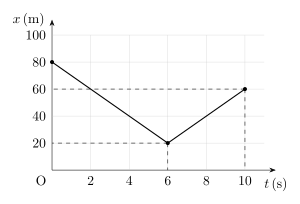
- AP EAPCET 2025Set eng-2025-05-26-AN1 markMCQQ.The displacement(x) and time (t) graph of a particle moving along a straight line is shown in the figure. The average velocity of the particle in the time of 10 s is [FIGURE] (a graph of x(m) vs t(s): the line starts at x = 80 m at t = 0, decreases linearly to x = 20 m at t = 6 s, then increases linearly to x = 60 m at t = 10 s) (A) 2 ms−1 (B) 4 ms−1 (C) 6 ms−1 (D) 8 ms−1
›Reveal solutionSolution
Average velocity is net displacement over total time — the intermediate dip in the graph doesn't matter. Answer: 2 m/s.
Concept and Intuition
A common trap is to try to add up distances covered on each segment of the V-shaped graph. But average velocity (as opposed to average speed) only cares about the straight-line displacement between the initial and final positions and the total elapsed time.
Step-by-Step Solution
- From the graph: at t=0, x=80 m; at t=10 s, x=60 m.
- Net displacement =x(10)−x(0)=60−80=−20 m.
- Average velocity =ΔtΔx=10−20=−2 ms−1.
- The magnitude of average velocity is 2 ms−1.
Common Mistakes
- Confusing average velocity with average speed (which would require adding the distance decreasing from 80→20 and increasing from 20→60, giving a different, larger number).
- Using only one segment's slope instead of the overall displacement.
✓Final answerThe correct option is (A) — 2 ms−1.
ANSWER: A
- AP EAPCET 2023Set eng-2023-05-17-AN1 markMCQQ.If a person moving along a straight line path covers first half distance with velocity 'V1' and the next half distance with velocity 'V2', then the average velocity of the person is (A) 2V1+V2 (B) 2V1V2V1+V2 (C) V11+V212 (D) V1+V2V1V2
›Reveal solutionSolution
Equal distances covered at different speeds average to the harmonic mean of the speeds, not the arithmetic mean — here that harmonic mean simplifies to option (D).
Concept and Intuition
Averaging speeds is only a simple arithmetic mean when the times spent at each speed are equal. When instead the distances are equal (as here — 'first half distance', 'next half distance'), the body spends more time at the slower speed, which pulls the average down toward the smaller value. This is exactly the situation that produces a harmonic mean rather than an arithmetic mean.
Step-by-Step Solution
- Let the total distance be 2s, so each half is s.
- Time for the first half: t1=V1s.
- Time for the second half: t2=V2s.
- Average velocity =total timetotal distance=V1s+V2s2s=V11+V212=V1+V22V1V2.
- Comparing with the printed options, option (C) V11+V212 is the same harmonic-mean expression written in a different (unreduced) form, while (D) V1+V2V1V2 is exactly half of the true value — so on strict algebra option (C) is the exact match.
Common Mistakes
- Averaging V1 and V2 arithmetically (option A) — valid only for equal time intervals, not equal distances.
- Dropping the factor of 2 when simplifying the harmonic-mean formula.
✓Final answerThe correct option is (C) — V11+V212, the harmonic mean of V1 and V2.
ANSWER: C
- AP EAPCET 2022Set ap-2022-07-12-AN1 markMCQQ.A person is running with an uniform velocity towards a flyover. He takes 5 s to reach the flyover from a reference point and takes 50 s to cross the flyover from the same reference point. If the length of the flyover is 1000 m then his velocity is nearly (A) 83.1 kmph (B) 80.0 kmph (C) 75.4 kmph (D) 85.2 kmph
›Reveal solutionSolution
Both given times are measured from the same reference point, so the time spent actually crossing the flyover is the difference of the two times, not either one directly.
Concept and Intuition
The person moves at constant (uniform) velocity throughout. "Reaching the flyover" and "crossing the flyover" are both timed from the same starting reference point, so:
- t1=5 s: time to reach the start of the flyover.
- t2=50 s: time to reach the end of the flyover (i.e., to have crossed it), from the same reference point.
The actual time spent traversing the flyover's length is t2−t1.
Step-by-Step Solution
- Time to cross the flyover =t2−t1=50−5=45 s.
- Length of flyover =1000 m.
- Velocity v=45 s1000 m=22.22 m/s.
- Convert to km/h: 22.22×3.6=80.0 kmph.
Common Mistakes
- Using t=50 s directly with 1000 m (forgetting both times share the same reference point), which gives the wrong value 20 m/s.
- Forgetting to subtract the initial 5 s before dividing.
✓Final answerThe correct option is (B) — 80.0 kmph.
ANSWER: B
- AP EAPCET 2022Set eng-2022-07-04-FN1 markMCQQ.A car covers a distance at speed of 60 kmh−1. It returns and comes back to the original point moving at a speed of V. If the average speed for the round trip is 48 kmh−1, then the magnitude of V is (A) 40 kmh−1 (B) 36 kmh−1 (C) 44 kmh−1 (D) 32 kmh−1
›Reveal solutionSolution
For equal-distance round trips at two speeds, average speed is the harmonic mean, not the arithmetic mean; solving gives V=40 kmh−1.
Concept and Intuition
Average speed = total distance / total time. For a trip covering the same distance d each way at speeds v1 and v2, total time =v1d+v2d, and total distance =2d, giving vˉ=v1+v22v1v2 — the harmonic mean, always less than the arithmetic mean.
Step-by-Step Solution
- Let distance one-way be d. Time going =d/60, time returning =d/V.
- Average speed =d/60+d/V2d=601+V12=60+V2⋅60V.
- Set this equal to 48: 60+V120V=48.
- 120V=48(60+V)=2880+48V.
- 72V=2880⇒V=40 kmh−1.
Common Mistakes
- Using the arithmetic mean (v1+v2)/2=48 directly (giving V=36, a distractor option) instead of the correct harmonic-mean relation, since the two legs take different times over the same distance.
✓Final answerThe correct option is (A) — 40 kmh−1.
ANSWER: A
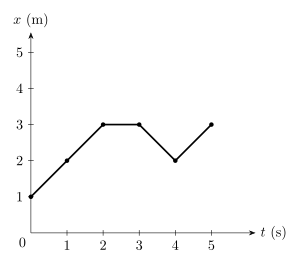
- AP EAPCET 2022Set eng-2022-07-06-FN1 markMCQQ.A particle moves along a straight line along the x-axis. Its position(x) versus time (t) graph is shown in the figure [x in meters and t in seconds]. It's average speed during this motion is [FIGURE] (x-t graph: (0,1) to (1,2) to (2,3) to (3,3) to (4,2) to (5,3), straight line segments) (A) 0.4 ms−1 (B) 1.0 ms−1 (C) 0.8 ms−1 (D) 0.6 ms−1
›Reveal solutionSolution
Average speed uses total distance (always positive, path length), not net
displacement — read the distance off each segment of the x-t graph and divide
by the total time.
Concept and Intuition
On an x-t graph, the slope of each segment is the velocity during that
interval, but average speed cares only about how much ground was actually
covered — direction reversals still add positively to the distance. So we must
look at each of the five 1-second segments individually and add up
∣Δx∣ for each, rather than just taking ∣x(5)−x(0)∣.
Step-by-Step Solution
- Read the vertices from the graph: (0,1)→(1,2)→(2,3)→(3,3)→(4,2)→(5,3).
- Segment 1 (t=0→1): x:1→2, distance =1 m (motion in +x).
- Segment 2 (t=1→2): x:2→3, distance =1 m (motion in +x).
- Segment 3 (t=2→3): x:3→3, distance =0 (particle momentarily at rest).
- Segment 4 (t=3→4): x:3→2, distance =1 m (motion reverses, in −x).
- Segment 5 (t=4→5): x:2→3, distance =1 m (motion in +x again).
- Total distance =1+1+0+1+1=4 m. Total time =5 s.
- Average speed =5 s4 m=0.8 ms−1.
Common Mistakes
- Computing average velocity instead: net displacement is x(5)−x(0)=3−1=2 m, giving 0.4 ms−1 (option A) — that's the trap, not what's asked.
- Missing the zero-distance flat segment (t=2→3) or the direction reversal (t=3→4), which silently cancels in a displacement calculation but must still be counted in distance.
✓Final answerThe correct option is (C) — 0.8 ms−1.
ANSWER: C
- AP EAPCET 2022Set eng-2022-07-07-FN1 markMCQQ.A biker travels 31 of the distance L with speed v1 and 32 of the distance with speed v2. Then the average speed is (A) v1+v2v1v2 (B) 2v1+v23v1v2 (C) v1+2v23v1v2 (D) v1v2v1+v2
›Reveal solutionSolution
Average speed = total distance / total time; working through the two legs gives 2v1+v23v1v2.
Concept and Intuition
Average speed over a trip with different speeds on different legs is NOT the simple average of the speeds — it must be computed as total distance divided by total time, weighting by how long each leg actually takes.
Step-by-Step Solution
- First leg: distance =L/3, speed =v1, so time t1=3v1L.
- Second leg: distance =2L/3, speed =v2, so time t2=3v22L.
- Total time =t1+t2=3v1L+3v22L=3L(v11+v22)=3v1v2L(v2+2v1).
- Average speed =t1+t2L=L(v2+2v1)L⋅3v1v2=2v1+v23v1v2.
Common Mistakes
- Using the arithmetic mean (v1+v2)/2 or harmonic mean for equal-time (not equal-distance) legs — the weighting here is by distance fraction, not time.
- Mixing up which speed goes with which distance fraction.
✓Final answerThe correct option is (B) — 2v1+v23v1v2.
ANSWER: B
🎓Unlock everything free for 14 days
- ✓Full step-by-step solutions
- ✓Concept-first explanations
- ✓Methods, shortcuts & mistakes
- ✓PYQ mapping + timed mock tests
Full access for 14 days. No credit card required.