Q.Show that the angular momentum about any point of a single particle moving with constant velocity remains constant throughout the motion.
You're viewing a preview — the full solution, concept, methods & PYQ mapping are locked.
Start your 14-day free trial to unlock the full solution →For a particle moving with constant velocity, about any fixed point stays constant, because its rate of change involves (always zero) and (zero, since velocity is constant).
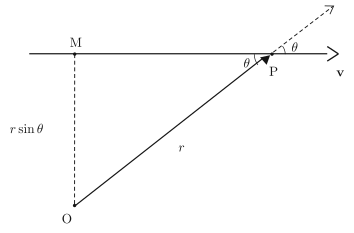
The figure shows a particle moving along a straight horizontal line with constant velocity . A fixed point O is marked below this line. At the instant shown, the particle is at point P on the line. A position vector is drawn from O to P, making an angle with the horizontal line. A dashed vertical line from O meets the horizontal line at point M, so that OM is perpendicular to the direction of motion. The length OM is labelled as .
The key physical idea is that even though the particle moves in a straight line with constant velocity, its angular momentum about point O is constant. The figure makes this obvious geometrically. The angular momentum of the particle about O is . Its magnitude is . But is exactly the perpendicular distance from O to the line of motion — that is, the length OM. Since OM does not change as the particle moves along the line, is constant. Therefore is constant.
Here is the particle's mass, is its speed, is the distance from O to the particle, and is the angle between and . The quantity is the lever arm — the perpendicular distance from the reference point O to the line along which the particle moves.
The figure also shows that the direction of is perpendicular to the plane containing and . For the motion shown, that direction is into or out of the page, depending on the orientation of the velocity relative to O. Since the particle's path is a straight line and O is fixed, this direction also remains constant.
A common mistake is to think angular momentum changes because and both change as the particle moves. The figure shows that the product — the perpendicular distance — stays the same. That is what matters for the magnitude.
The textbook uses this figure to ground the definition of angular momentum for a particle before extending it to systems of particles and rigid bodies. The constancy of angular momentum for a particle moving with constant velocity about any fixed point not on its path is a direct consequence of the cross product geometry. The dashed perpendicular OM is the visual key: it is the same length no matter where the particle is on the line.
Setting up
Let a particle of mass move with constant velocity . Pick any fixed point as the origin. At time , the particle's position relative to is
where is its position at . Its angular momentum about is
Differentiating directly
Differentiate with respect to time using the product rule:
…
Unlock everything free for 14 days
- Full step-by-step solutions
- Concept-first explanations
- Methods, shortcuts & mistakes
- PYQ mapping + timed mock tests
Full access for 14 days. No credit card required.