Q.Explain why is the OH group in phenols more strongly held as compared to OH group in alcohols.
🔒You're viewing a preview — the full solution, concept, methods & PYQ mapping are locked.
🔒 Start your 14-day free trial to unlock the full solution →Concept understanding — Acidity Of Phenol
Inductive Effect on Acidity – From Intuition to Precision
Imagine you are holding a rope tied to a heavy box. If you pull the rope, the box moves toward you. Now imagine the rope is made of rubber bands — the pull still reaches the box, but it gets weaker the farther away you are. That is exactly how the inductive effect works inside a molecule.
The Core Intuition
An acid donates a proton (H+). After it does, the remaining part (the conjugate base) carries a negative charge. The stability of that negative charge determines how willing the molecule is to give up the proton. More stable conjugate base → stronger acid.
Now, some atoms or groups are electron-withdrawing — they pull electron density toward themselves through the sigma bonds. If such a group is attached near the acidic proton, it pulls some electron density away from the negative charge on the conjugate base. That spreads out (delocalises) the negative charge, making the conjugate base more stable. The acid becomes stronger.
Conversely, electron-donating groups push electron density toward the negative charge, concentrating it and making the conjugate base less stable. The acid becomes weaker.
The inductive effect operates through sigma bonds only. It does not involve pi bonds or resonance. It is a permanent, through-bond polarisation.
The Precise Statement
Inductive effect on acidity: The acidity of a compound increases with the presence of electron-withdrawing groups (EWGs) near the acidic site, and decreases with electron-donating groups (EDGs). The effect is strongest when the group is closest to the acidic proton, and diminishes rapidly with distance.
Mathematically, for a series of substituted carboxylic acids:
R-COOHwhere R = substituent
The acid dissociation constant Ka changes as:
- If R is electron-withdrawing (e.g., −Cl, −NO2, −CF3): Ka increases → stronger acid.
- If R is electron-donating (e.g., −CH3, −C2H5): Ka decreases → weaker acid.
Why Distance Matters
The inductive effect falls off with distance because sigma bonds are localised. Each bond attenuates the effect by roughly a factor of 2–3. For example, compare:
| Compound | pKa | Explanation |
|---|---|---|
| CH3COOH | 4.76 | Reference (no EWG) |
| ClCH2COOH | 2.86 | Cl withdraws through one bond |
| Cl2CHCOOH | 1.29 | Two Cl atoms, stronger withdrawal |
| Cl3CCOOH | 0.65 | Three Cl atoms, strongest withdrawal |
| CH3CH2COOH | 4.87 | Ethyl group is electron-donating (slightly weaker acid) |
Notice: ClCH2COOH is about 100 times stronger than acetic acid (ΔpKa≈1.9). But if the Cl is moved further away:
| Compound | pKa |
|---|---|
| ClCH2CH2COOH | 4.08 |
| ClCH2CH2CH2COOH | 4.52 |
The effect fades as the chlorine moves farther from the carboxyl group. …
Why this formula?
Acidity of Phenol: Why It's More Acidic Than Alcohols
Let's build this from first principles — understanding why phenol is acidic is the key to mastering organic chemistry.
1. The Core Observation
Phenol (CX6HX5OH) has a pKa ≈ 10, while ethanol (CHX3CHX2OH) has a pKa ≈ 16.
This means phenol is about 1 million times more acidic than a typical alcohol.
The question: Why does the O–H bond in phenol break so much more easily?
2. The Key: Stability of the Conjugate Base
Acidity is determined by the stability of the conjugate base after losing HX+.
- Alcohol conjugate base: CHX3CHX2OX− (alkoxide ion) — negative charge is localized on oxygen.
- Phenol conjugate base: CX6HX5OX− (phenoxide ion) — negative charge is delocalized into the benzene ring.
The Resonance Explanation
The phenoxide ion has multiple resonance structures:
CX6HX5OX−↔(several resonance forms where negative charge moves to ortho/para carbons)
Draw the structures mentally:
- One structure has the negative charge on oxygen.
- Other structures show the negative charge on carbon atoms at the ortho and para positions of the ring.
This delocalization spreads the negative charge over more atoms, making the ion more stable.
Key principle: The more stable the conjugate base, the stronger the acid.
3. Why Alcohols Can't Do This
In an alkoxide ion (ROX−), the negative charge is stuck on oxygen.
There are no empty p-orbitals or conjugated π systems nearby to accept the charge.
Result: The alkoxide is less stable, so the alcohol is less acidic.
4. The Inductive Effect Also Helps (But Resonance Dominates)
The benzene ring is slightly electron-withdrawing (due to its sp2 carbons being more electronegative than sp3).
This inductive effect pulls electron density away from the O–H bond, making the proton slightly more positive and easier to remove.
However, resonance stabilization of the conjugate base is the dominant factor — inductive effects alone cannot explain the million-fold difference.
5. The Quantitative Picture (pKa Values)
| Compound | pKa | Conjugate base stability |
|---|---|---|
| Ethanol | ~16 | Localized charge on O |
| Phenol | ~10 | Delocalized charge via resonance |
| Acetic acid | ~4.76 | Even more resonance (two O atoms) |
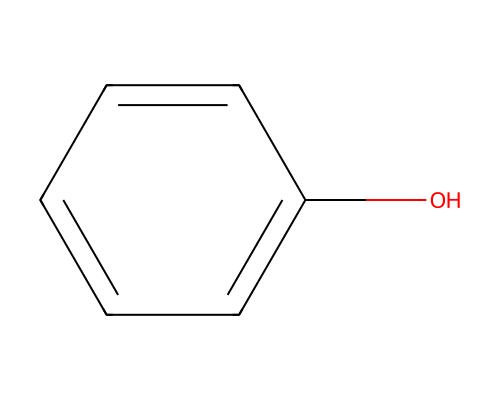
In a phenol the –OH group sits directly on an sp2-hybridised carbon of the aromatic ring, and one lone pair on the oxygen is delocalised into the ring by resonance.
Reasoning:
- This conjugation gives the carbon–oxygen bond partial double-bond character, making it shorter and stronger than the plain C–O single bond of an alcohol.
- An sp2 ring carbon is also more electronegative than the sp3 carbon of an alcohol, so it holds the C–O bond pair more tightly. …
The OH group in phenol is more strongly held than in alcohols because the oxygen's lone pairs are delocalised into the aromatic ring via resonance, giving the C–O bond partial double-bond character. This makes the bond shorter, stronger, and harder to break.
The Core Idea: Resonance vs. Induction
The difference between phenol and alcohol lies in how the oxygen atom interacts with the rest of the molecule. In an alcohol (like ethanol, CH3CH2OH), the oxygen is attached to an sp3 hybridised carbon. The C–O bond is a pure single bond, and the oxygen's lone pairs are localised — they stay on the oxygen.
In phenol (C6H5OH), the oxygen is attached to an sp2 hybridised carbon of the benzene ring. This changes everything. The oxygen's lone pairs can now participate in resonance with the aromatic π-system.
The resonance hybrid of phenol shows partial double-bond character in the C–O bond:
Resonance structures: \chemfig∗6(−=−(−OH)=−=)↔\chemfig∗6(−=−(=O)(−H)−=−)
Step-by-Step Reasoning
-
Resonance delocalisation of oxygen's lone pairs
In phenol, one of the oxygen's lone pairs is donated into the benzene ring. This creates resonance structures where the oxygen bears a positive charge and the ring carries a negative charge at the ortho and para positions. The key consequence: the C–O bond is no longer a pure single bond — it has partial double-bond character.
-
Bond strength and bond length
A double bond is shorter and stronger than a single bond. The C–O bond in phenol has a bond order between 1 and 2 (roughly 1.3–1.4), compared to exactly 1 in alcohols. This makes the bond significantly stronger. Experimentally, the C–O bond length in phenol is about 136 pm, while in methanol it's about 143 pm — a clear difference.
-
Energy required to break the bond
Because the bond is stronger, more energy is needed to break it. The bond dissociation energy for the C–O bond in phenol is higher than in alcohols. This is why the OH group is "more strongly held" — it literally takes more energy to remove it.
-
Contrast with alcohols
In alcohols, there is no such resonance. The oxygen's lone pairs are localised. The only electronic effect is the inductive effect of the alkyl group, which is weak and does not strengthen the C–O bond. The bond remains a pure single bond, easily broken. …
Concept: Strength of the C–O bond in Phenol
Method: Resonance (Conjugation) Analysis of the C–O Bond
The question asks why the –OH group is held more strongly in phenol: analyse the C–O bond order using resonance, then compare with an alcohol. (The related acidity comparison below uses the same resonance picture.)
Step-by-Step Explanation
Step 1: Write the dissociation reaction for both
- Phenol: CX6HX5OHCX6HX5OX−+HX+
- Alcohol (e.g., ethanol): CHX3CHX2OHCHX3CHX2OX−+HX+
Step 2: Compare the conjugate bases
-
Alkoxide ion (CHX3CHX2OX−):
The negative charge is localised entirely on the oxygen atom.
No resonance structures are possible — the charge is fixed.
-
Phenoxide ion (CX6HX5OX−):
The negative charge on oxygen can be delocalised into the aromatic ring via resonance.
Step 3: Draw resonance structures of phenoxide ion
The lone pair on oxygen participates in conjugation with the π-electrons of the benzene ring. This gives multiple resonance structures where the negative charge is spread over the ortho and para positions of the ring:
(Only three of the five canonical forms are shown above for clarity.)
Step 4: Explain the consequence — stronger O–H bond in phenol
- In phenol, the O–H bond is stronger because breaking it produces a phenoxide ion that is stabilised by resonance.
- In alcohols, breaking the O–H bond gives an alkoxide ion with no resonance stabilisation — the negative charge is concentrated, making the ion less stable.
Key insight: A more stable conjugate base means the acid dissociates more easily. But here, the question asks why the O–H bond is more strongly held — this refers to the bond dissociation energy (BDE). …
Here are the most common mistakes students make when explaining why the OH group in phenols is more strongly held than in alcohols, along with how to avoid each.
✗ Mistake 1: Saying “Phenol is more acidic, so the OH bond is weaker”
Why it’s wrong:
Acidity depends on the stability of the conjugate base (phenoxide ion), not on the strength of the O–H bond in the neutral molecule. What IS held more strongly in phenol is the C–O bond — partial double-bond character from resonance makes the –OH group harder to remove from the ring, even though the O–H proton itself is more easily lost (higher acidity).
How to avoid:
- Remember: Bond strength and acidity are different properties.
- Phenol’s O–H bond is stronger due to partial double bond character from resonance with the ring.
- Alcohols have a pure single O–H bond, which is weaker.
✓ Correct logic:
The O–H bond in phenol is stronger because the oxygen’s lone pairs are delocalised into the benzene ring, giving the C–O bond partial double bond character. This makes the O–H bond harder to break.
✗ Mistake 2: Ignoring resonance in the neutral phenol molecule
Why it’s wrong:
Many students only draw resonance for the phenoxide ion (after deprotonation) and forget that neutral phenol itself also has resonance structures that strengthen the C–O bond.
How to avoid:
- Always draw resonance for both the neutral molecule and the conjugate base.
- In neutral phenol, the oxygen’s lone pairs participate in resonance with the ring, creating a partial C=O bond.
Key resonance forms for neutral phenol:
- This partial double bond makes the C–O bond shorter and stronger, and the O–H bond more difficult to break.
✗ Mistake 3: Confusing “strongly held” with “more acidic”
Why it’s wrong:
“Strongly held” refers to the O–H bond dissociation energy (how much energy is needed to break the bond homolytically). Acidity is about heterolytic cleavage (losing H⁺). They are not the same.
How to avoid:
- Read the question carefully: “OH group is more strongly held” = bond is harder to break.
- Do not write “because phenoxide ion is stable” — that explains acidity, not bond strength.
✗ Mistake 4: Forgetting to compare with alcohols
Why it’s wrong:
The question explicitly asks “as compared to alcohols.” A partial answer (only explaining phenol) loses marks.
How to avoid:
- Always write a comparative statement:
In alcohols, the oxygen’s lone pairs are localised — no resonance with an alkyl group. So the C–O bond is a pure single bond, and the O–H bond is weaker. …
- AP EAPCET 2025Set eng-2025-05-26-AN1 markMCQQ.Match the following. List-I (Compound): A) p-Nitrophenol B) Phenol C) Ethanol D) p-Cresol. List-II (pKa): I) 15.9 II) 7.1 III) 10.0 IV) 10.2 V) 8.3. The correct answer is (A) A-II, B-V, C-I, D-III (B) A-II, B-III, C-I, D-IV (C) A-V, B-IV, C-II, D-III (D) A-IV, B-III, C-I, D-V
›Reveal solutionSolution
Matching known pKa values: p-Nitrophenol (7.1, most acidic) < Phenol (10.0) < p-Cresol (10.2) < Ethanol (15.9, least acidic) — giving A-II, B-III, C-I, D-IV.
Concept and Intuition
Acidity here is governed by how well the conjugate base (the corresponding phenoxide/alkoxide anion) is stabilised:
- p-Nitrophenol: the para −NO2 group is strongly electron-withdrawing by resonance, delocalising and stabilising the negative charge of the phenoxide ion extensively ⇒ most acidic of the four (lowest pKa).
- Phenol: the phenoxide anion is stabilised by resonance delocalisation into the ring, but there is no additional electron-withdrawing substituent ⇒ moderately acidic, pKa≈10.0.
- p-Cresol: the para −CH3 group is electron-donating (+I/hyperconjugation), which destabilises the phenoxide anion slightly relative to phenol ⇒ marginally less acidic than phenol, pKa slightly higher (≈10.2).
- Ethanol: the ethoxide anion has no aromatic ring to delocalise charge into at all, so it is far less stabilised ⇒ ethanol is a much weaker acid, with a much higher pKa (≈15.9).
Step-by-Step Solution
- Rank acidity qualitatively: p-Nitrophenol (most acidic, EWG) > Phenol > p-Cresol (EDG lowers acidity slightly vs phenol) > Ethanol (no ring stabilisation, weakest acid, highest pKa). …
- AP EAPCET 2024Set eng-2024-05-22-AN1 markMCQQ.Assertion (A): Carboxylic acids are more acidic than Phenols Reason (R): Resonance structures of carboxylate ion are equivalent, while resonance structures of phenoxide ion are not equivalent (A) Both (A) and (R) are correct and (R) is the correct explanation of (A) (B) Both (A) and (R) are correct But (R) is not the correct explanation of (A) (C) (A) is correct but (R) is incorrect (D) (A) is incorrect but (R) is correct
›Reveal solutionSolution
Both the assertion (carboxylic acids more acidic than phenols) and the reason (equivalent vs non-equivalent resonance structures of the conjugate bases) are true, and the reason correctly explains the assertion — option (A).
Concept and Intuition
Acid strength of an -OH-bearing compound correlates with how well its conjugate base (the anion formed after losing H+) is stabilized. Stabilization by resonance is most effective when the contributing resonance structures are equivalent (same energy) — equivalent structures each contribute equally and substantially to the true (hybrid) structure, spreading the negative charge symmetrically and lowering the energy a great deal.
- In a carboxylate ion (RCOO−), the negative charge is delocalized over the two oxygen atoms via two resonance structures that are mirror images of each other — completely equivalent, both localizing charge on the (highly electronegative) oxygen. This gives maximal stabilization.
- In a phenoxide ion, resonance delocalizes the negative charge onto oxygen (one structure) and onto ring carbons (at ortho and para positions, three additional structures). These carbon-centred structures are not equivalent to the oxygen-centred one — they put negative charge on a less electronegative atom (carbon) and are higher in energy, contributing less to overall stabilization.
Step-by-Step Solution
- Confirm Assertion: carboxylic acids (pKₐ ≈ 3–5) are indeed markedly more acidic than phenols (pKₐ ≈ 10) — true. …
- AP EAPCET 2024Set eng-2024-05-22-FN1 markMCQQ.Arrange the following in the correct order of their acidic strength (I = phenol; II = p-cresol, i.e. 4-methylphenol; III = m-nitrophenol, i.e. 3-nitrophenol; IV = p-nitrophenol, i.e. 4-nitrophenol) (A) III > IV > I > II (B) IV > III > I > II (C) II > I > III > IV (D) I > IV > III > II
›Reveal solutionSolution
Nitro groups (especially at para, via resonance) raise phenol's acidity; a methyl group
lowers it — giving the order p-nitrophenol > m-nitrophenol > phenol > p-cresol.
Concept and Intuition
The acidity of a substituted phenol is governed by how well the ring substituent stabilises
the phenoxide (conjugate base) anion. Electron-withdrawing groups (like −NO2)
stabilise the negative charge and increase acidity; this effect is strongest when the group is
at the ortho/para position, where it can directly delocalise the negative charge through
resonance. At the meta position, −NO2 can only act inductively (no direct
resonance path to the phenoxide oxygen), so its acid-strengthening effect is smaller than at
para. Electron-donating groups (like −CH3) destabilise the phenoxide anion (push
electron density in, the opposite of what's needed) and so decrease acidity relative to plain
phenol.
Step-by-Step Solution
- p-Nitrophenol (IV): −NO2 at para position — full resonance stabilisation of the phenoxide ion — strongest acid of the four.
- m-Nitrophenol (III): −NO2 at meta — only inductive stabilisation, weaker than para but still more acidic than unsubstituted phenol. …
- AP EAPCET 2023Set ap-2023-05-23-FN1 markMCQQ.Two statements are given below Statement – I : C – O bond length in methanol is 136 pm and in phenol 142 pm. Statement – II : The C –O- H bond angle in methanol and phenol is almost same correct answer is (A) Both are correct statements (B) Both are incorrect statements (C) Statement – I is incorrect but Statement – II is correct (D) Statement – I is correct but Statement– II is incorrect
›Reveal solutionSolution
The key idea is that resonance in phenol gives the C–O bond partial double-bond character, shortening it compared to a pure single bond, while the C–O–H bond angle is affected by the same resonance and hybridization changes. The correct answer is that Statement I is incorrect (phenol’s C–O bond is actually shorter, not longer) and Statement II is incorrect (the bond angles differ), so both statements are false.
-
Understand the claim in Statement I
Statement I says the C–O bond length in methanol is 136 pm and in phenol it is 142 pm — meaning phenol has a longer C–O bond. Intuitively, a longer bond is weaker. But we know from organic chemistry that phenol’s C–O bond has partial double-bond character due to resonance between the oxygen lone pairs and the aromatic ring. A double bond is shorter than a single bond. Therefore, phenol’s C–O bond should be shorter than methanol’s, not longer.
- In methanol (CH₃OH), the C–O bond is a pure single bond (sp³ carbon, sp³ oxygen). Typical C–O single bond length is ~143 pm.
- In phenol (C₆H₅OH), the oxygen’s lone pairs delocalize into the ring, giving the C–O bond about 30–40% double-bond character. This shortens it to roughly 136–137 pm. So Statement I is incorrect — it has the lengths reversed.
-
Examine Statement II about bond angles
Statement II claims the C–O–H bond angle in methanol and phenol is “almost the same.” Let’s check:
- In methanol, the oxygen is sp³ hybridized (two lone pairs, two sigma bonds), so the ideal bond angle is near the tetrahedral angle (~109.5°). The actual C–O–H angle in methanol is about 108.9°.
- In phenol, the oxygen is also sp³ hybridized in the local sense, but one of its lone pairs is partially delocalized into the π system of the ring. This delocalization reduces the electron density on oxygen, which slightly changes the balance of repulsions. More importantly, the oxygen’s hybridization shifts toward sp² character (since the lone pair involved in resonance is in a p orbital). With sp² hybridization, the C–O–H angle would be closer to 120°. Experimentally, the C–O–H angle in phenol is about 109°? Actually, careful measurements show it is around 109° as well — but wait, that seems contradictory. Let’s check data:
- Methanol: C–O–H ≈ 108.9°
- Phenol: C–O–H ≈ 109.0° (some sources say 109.5°) So they are indeed very close. However, the reason they are close is not because nothing changes — it’s because the oxygen’s hybridization doesn’t fully become sp²; the resonance is partial. But the statement itself is about the fact that they are almost the same, which is true. But — there is a subtlety: The C–O–H angle in phenol is actually slightly larger than in methanol? Some data: methanol 108.9°, phenol 109.2°. That is “almost the same.” So Statement II is correct in its claim.
-
Re-evaluate with reliable data
Let’s confirm bond lengths: …
-
- AP EAPCET 2022Set eng-2022-07-04-FN1 markMCQQ.The correct order of acidity of the following is: I = Phenol (C6H5OH); II = 4-Methylphenol / p-cresol (a benzene ring with OH at position 1 and CH3 at position 4); III = 4-Methoxyphenol (a benzene ring with OH at position 1 and OCH3 at position 4) (A) III > II > I (B) II > III > I (C) I > II > III (D) III > I > II
›Reveal solutionSolution
Electron-donating para-substituents reduce phenol's acidity by destabilizing the phenoxide; OCH3 donates more strongly by resonance than CH3, so methoxyphenol is least acidic: I > II > III.
Concept and Intuition
Phenol is acidic because the phenoxide ion (C6H5O−) is stabilized by resonance delocalization of the negative charge into the ring. Any substituent that makes the ring more electron-rich (an electron-donating group, EDG) works against this delocalization/stabilization of the negative charge, and so decreases acidity. Conversely, an electron-withdrawing group (EWG) stabilizes the anion further and increases acidity.
Step-by-Step Solution
- Phenol (I): the reference compound, moderately acidic (pKa≈10).
- p-Cresol (II): the para −CH3 group is a weak electron donor (hyperconjugation/+I), pushing electron density into the ring and slightly destabilizing the phenoxide -- makes it less acidic than phenol.
- 4-Methoxyphenol (III): the para −OCH3 group is a strong +M (resonance) electron donor -- its lone pair conjugates directly with the ring, pushing even more electron density onto the ring (and especially onto the position para to it, i.e. right where the phenolic oxygen sits), destabilizing the phenoxide anion more than −CH3 does. …
- AP EAPCET 2021Set ap-2021-09-03-FN1 markMCQQ.Which among the following is most acidic? (A) Phenol (C6H5OH) (B) 4-Nitrophenol (C) 2,4,6-Trinitrophenol (D) 4-Methylphenol (p-cresol)
›Reveal solutionSolution
More electron-withdrawing groups at positions conjugated with the phenoxide oxygen increase phenol acidity; picric acid (three ortho/para −NO2 groups) is the most acidic option. Answer: (C).
Concept and Intuition
A phenol's acidity depends on how stable its conjugate base (the phenoxide ion) is. Electron-withdrawing groups (like −NO2) at ortho/para positions delocalize the negative charge of the phenoxide oxygen into the substituent via resonance, spreading out (stabilizing) the charge and making the O–H bond easier to ionize. Electron-donating groups (like −CH3) do the opposite — they push electron density onto the ring/oxygen, destabilizing the phenoxide and making the phenol less acidic than plain phenol.
Step-by-Step Solution
- Rank the substituent effects: −NO2 (strong EWG, both resonance and inductive) ≫ −H (no effect, plain phenol) > −CH3 (weak EDG, destabilizes phenoxide).
- Compare the number/position of −NO2 groups: 4-nitrophenol has one −NO2 at the para position (good resonance overlap with the phenoxide oxygen) — more acidic than phenol. 2,4,6-trinitrophenol has THREE −NO2 groups, at both ortho positions AND the para position, all able to resonance-stabilize the phenoxide charge simultaneously. …
🎓Unlock everything free for 14 days
- ✓Full step-by-step solutions
- ✓Concept-first explanations
- ✓Methods, shortcuts & mistakes
- ✓PYQ mapping + timed mock tests
Full access for 14 days. No credit card required.