Q.Arrange the following in increasing order of their basic strength:
Concept understanding — Basicity Order Amines
Basicity of Amines: From Intuition to Precision
Imagine you have a nitrogen atom with a lone pair of electrons — that pair is like a key that can grab a proton (H+). The more willing the nitrogen is to share that pair, the stronger the base. That's the core idea.
The Intuition: What Makes a Nitrogen "Want" a Proton?
Amines are organic derivatives of ammonia (NH3), where one or more hydrogen atoms are replaced by alkyl groups (R). Alkyl groups are electron-donating — they push electron density toward the nitrogen. More alkyl groups = more electron density on nitrogen = stronger base.
So you'd expect: tertiary > secondary > primary > ammonia. That's the inductive effect argument.
But reality is more interesting. In water (the usual solvent for basicity measurements), the order is:
Secondary > Primary > Tertiary > Ammonia
Why the reversal for tertiary amines? Because basicity isn't just about the free amine — it's about the stability of the conjugate acid (the ammonium ion RNH3+) once the proton is grabbed.
The Precise Explanation: Three Factors at Play
1. Inductive Effect (pushes electron density)
Alkyl groups donate electrons through sigma bonds. More alkyl groups = more electron density on N = stronger base. This favours: tertiary > secondary > primary > ammonia.
2. Solvation Effect (stabilises the conjugate acid)
Once the amine grabs a proton, the resulting ammonium ion is positively charged. Water molecules surround it, stabilising the charge through hydrogen bonding. The more hydrogens on the nitrogen, the more H-bonds can form.
Primary ammonium (RNH3+) has 3 H's → best solvation.
Secondary (R2NH2+) has 2 H's → good solvation.
Tertiary (R3NH+) has 1 H → poor solvation.
This favours: primary > secondary > tertiary.
3. Steric Hindrance (blocks solvation)
Bulkier alkyl groups physically block water molecules from approaching the charged nitrogen. This further reduces solvation in tertiary amines.
The Net Result: The Actual Order in Water
| Amine Type | Inductive Effect | Solvation | Steric Hindrance | Net Basicity (pKb) |
|---|---|---|---|---|
| Ammonia (NH3) | Weakest | Best (3 H's) | None | 4.75 |
| Primary (RNH2) | Moderate | Good (2 H's) | Minimal | ~3.4 |
| Secondary (R2NH) | Strong | Moderate (1 H) | Some | ~3.2 |
| Tertiary (R3N) | Strongest | Poor (0 H's) | Significant | ~4.2 |
pKb is the negative log of the base dissociation constant. Lower pKb = stronger base. So secondary (pKb ≈ 3.2) is the strongest, then primary (≈3.4), then tertiary (≈4.2), then ammonia (4.75).
The Final Answer
The basicity order of amines in aqueous solution is:
Secondary > Primary > Tertiary > Ammonia
This is the standard order for simple alkyl amines (methyl, ethyl, etc.). The inductive effect dominates from ammonia to secondary, but the loss of solvation and steric hindrance in tertiary amines drops them below primary.
A Quick Check: Why Not Tertiary?
If you only considered electron donation, tertiary would win. But the ammonium ion R3NH+ has only one hydrogen to hydrogen-bond with water, and the three bulky alkyl groups physically block water molecules. The conjugate acid is poorly stabilised, so the equilibrium shifts back toward the free amine — making it a weaker base than expected.
This order applies to aliphatic amines in water. Aromatic amines (like aniline) are much weaker bases because the lone pair is delocalised into the benzene ring. Also, in the gas phase (no solvent), the order reverts to tertiary > secondary > primary > ammonia — confirming that solvation is the key reason for the reversal.
The Takeaway
Basicity is a tug-of-war between:
- Inductive effect (wants tertiary to win)
- Solvation + sterics (wants primary to win)
Secondary amines hit the sweet spot — strong inductive donation and decent solvation — making them the strongest bases in water.
The basicity order of amines in aqueous solution is one of the most frequently asked comparison-type questions in the NCERT Class 12 Chemistry chapter on amines, regularly appearing in CBSE boards, JEE Main and NEET. Anyone searching "basicity order of amines class 12 chemistry" or trying to understand why secondary amines outrank primary and tertiary amines will find the inductive-versus-solvation trade-off above is the standard NCERT-aligned explanation.
Why this formula?
Basicity Order of Amines: Why It Holds
Let's build this from first principles — understanding why amines have different basicities is essential for exams and for deeper chemistry.
1. What Does "Basicity" Mean Here?
Basicity of an amine is its ability to accept a proton (H+).
The stronger the base, the more readily it grabs H+.
The equilibrium is:
R3N+H2O⇌R3NH++OH−
The base dissociation constant Kb measures this:
Kb=[R3N][R3NH+][OH−]
A larger Kb means a stronger base.
2. The Key Factor: Electron Density on Nitrogen
The lone pair on nitrogen is what accepts H+.
More electron density on nitrogen → stronger base.
Why? Because a proton (H+) is attracted to negative charge. If the nitrogen's lone pair is more "available" (less tightly held), it binds H+ more easily.
3. The Two Competing Effects
✓ Inductive Effect (Electron-Donating)
Alkyl groups (−CH3, −C2H5, etc.) are electron-donating via the inductive effect.
They push electron density toward nitrogen.
- More alkyl groups → more electron density on N → stronger base.
This suggests:
3∘>2∘>1∘>NH3
✗ Solvation Effect (Hydration of the Conjugate Acid)
When the amine accepts H+, it forms R3NH+ (a positively charged ion).
This ion is stabilized by water molecules (hydration).
- More H atoms on the NH+ group → more hydrogen bonding with water → better stabilization of the conjugate acid.
- Better stabilization of R3NH+ → stronger base (because the equilibrium shifts toward protonation).
This suggests:
1∘>2∘>3∘ (since 1∘ has 3 H's, 2∘ has 2, 3∘ has 1)
4. The Actual Order (Aqueous Solution)
In water, the observed order for aliphatic amines is:
2° > 1° > 3° > NH3
Wait — that's not simply "more alkyl = stronger". Why?
The Reasoning (Step by Step)
-
From NH3 to 1∘: Adding one alkyl group increases electron density (inductive effect) → stronger base.
So 1∘>NH3.
-
From 1∘ to 2∘: Adding a second alkyl group further increases electron density → even stronger base.
So 2∘>1∘.
-
From 2∘ to 3∘: Here, the solvation effect becomes dominant.
The 3∘ amine has only one H on the NH+ group → poor hydration of the conjugate acid.
The inductive effect is still present, but the loss of solvation outweighs the gain in electron density.
So 3∘ is weaker than 2∘.
Thus, the net order is:
2° > 1° > 3° > NH3
5. The Key Formula(e) to Remember
For gas phase (no solvent):
Only inductive effect matters:
3° > 2° > 1° > NH3
For aqueous solution (common in exams):
Both effects matter — solvation dominates for 3∘:
2° > 1° > 3° > NH3
For aromatic amines (e.g., aniline):
The lone pair is delocalized into the benzene ring → much weaker base.
Aliphatic amines > Aromatic amines
6. Quick Exam Tip
If a question asks "basicity order of amines in water", always write:
2° > 1° > 3° > NH3
And explain:
- Inductive effect increases from NH3 to 3∘
- But solvation of the conjugate acid decreases from 1∘ to 3∘
- The balance gives the above order.
7. Summary Table
| Amine Type | Inductive Effect | Solvation of R3NH+ | Net Basicity (aq) |
|---|---|---|---|
| NH3 | Weakest | Best (3 H's) | Weakest |
| 1∘ | Moderate | Good (2 H's) | Moderate |
| 2∘ | Strong | Moderate (1 H) | Strongest |
| 3∘ | Strongest | Poor (0 H's) | Weaker than 2∘ |
Final takeaway:
Basicity is not just about "more alkyl = stronger". The solvation of the conjugate acid is the deciding factor in water. Always reason from both effects.
Concept: Basicity of amines depends on the combined effect of inductive effects (+I of alkyl groups), resonance delocalisation (in aromatic amines), and solvation of the conjugate acid in water. There is no single universal 2∘>1∘>3∘ rule — the observed aqueous order differs between the methyl and ethyl series.
(i) Aniline (C6H5NH2) is the weakest because the lone pair is delocalised into the benzene ring. Ammonia comes next (no +I alkyl groups). Benzylamine (C6H5CH2NH2) is stronger than ammonia — the CH2 spacer blocks resonance, leaving only a weak inductive pull from the ring — but weaker than a simple alkylamine. Among the ethylamines, secondary > primary.
Order: C6H5NH2<NH3<C6H5CH2NH2<C2H5NH2<(C2H5)2NH
(ii) For the ethyl series in water, the observed order is 2∘>3∘>1∘: the strong +I effect of two/three ethyl groups outweighs triethylamine's poorer solvation, so triethylamine sits above ethylamine (Table 9.3: pKb (C2H5)2NH 3.00 < (C2H5)3N 3.25 < C2H5NH2 3.29). Aniline is weakest.
Order: C6H5NH2<C2H5NH2<(C2H5)3N<(C2H5)2NH
(iii) For the methyl series in water, the order is 2∘>1∘>3∘ (the smaller +I of methyl cannot compensate trimethylamine's poor solvation). Benzylamine is stronger than aniline but weaker than all the methylamines.
Order: C6H5NH2<C6H5CH2NH2<(CH3)3N<CH3NH2<(CH3)2NH
- C6H5NH2<NH3<C6H5CH2NH2<C2H5NH2<(C2H5)2NH
- C6H5NH2<C2H5NH2<(C2H5)3N<(C2H5)2NH
- C6H5NH2<C6H5CH2NH2<(CH3)3N<CH3NH2<(CH3)2NH
Basicity of amines is set by the balance between the inductive effect (alkyl groups increase basicity), resonance (aromatic amines are far weaker), and solvation of the conjugate acid in water. That balance plays out differently for the methyl and ethyl series: in water, methylamines follow 2∘>1∘>3∘, but ethylamines follow 2∘>3∘>1∘. The final orders are: (i) C6H5NH2<NH3<C6H5CH2NH2<C2H5NH2<(C2H5)2NH;
(ii) C6H5NH2<C2H5NH2<(C2H5)3N<(C2H5)2NH;
(iii) C6H5NH2<C6H5CH2NH2<(CH3)3N<CH3NH2<(CH3)2NH.
The Core Idea: What Makes an Amine Basic?
Basicity is about how readily the nitrogen atom donates its lone pair to a proton. In aqueous solution, the equilibrium is:
RNH2+H2O⇌RNH3++OH−
The stronger the base, the more it shifts right. Three factors compete:
- Inductive effect — Alkyl groups (−CH3, −C2H5) are electron-donating. They push electron density toward nitrogen, making the lone pair more available. More alkyl groups = stronger inductive push, and an ethyl group pushes harder than a methyl group.
- Resonance effect — In aniline (C6H5NH2), the lone pair on nitrogen is delocalised into the aromatic ring. This makes it much less available for protonation — aniline is a very weak base.
- Solvation and steric hindrance — In water, the protonated form is stabilised by hydrogen bonding with water. More hydrogen atoms on the nitrogen (i.e., fewer alkyl groups) means better solvation. Bulky alkyl groups also physically crowd the nitrogen.
The "one fixed order" trap
Because factors 1 and 3 pull in opposite directions, there is no single order that fits every alkyl series. For methylamines, the weak +I of methyl loses to solvation for the tertiary amine, giving 2∘>1∘>3∘ in water. For ethylamines, the stronger +I of ethyl compensates for the tertiary amine's poorer solvation, giving 2∘>3∘>1∘ — triethylamine is actually a stronger base than ethylamine in water. This is exactly what NCERT's Table 9.3 pKb data show. In the gas phase (no solvent) the inductive trend 3∘>2∘>1∘ holds for both series.
Basicity orders in water (NCERT)
Methyl series: (CH3)2NH>CH3NH2>(CH3)3N>NH3
Ethyl series: (C2H5)2NH>(C2H5)3N>C2H5NH2>NH3
(i) C2H5NH2, C6H5NH2, NH3, C6H5CH2NH2, (C2H5)2NH
-
Identify the weakest — C6H5NH2 (aniline) has its lone pair delocalised into the benzene ring. This is a massive drop in basicity. It is by far the weakest here.
-
Next weakest — NH3 has no alkyl groups to donate electron density. It is a weaker base than any alkylamine.
-
Benzylamine — C6H5CH2NH2 has the amino group separated from the ring by a −CH2− spacer. The ring cannot delocalise the lone pair (too far away), but it does exert a weak electron-withdrawing inductive effect through the chain. So benzylamine is a weaker base than a simple alkylamine like ethylamine, but stronger than ammonia and much stronger than aniline.
-
Ethylamine vs diethylamine — (C2H5)2NH is secondary, C2H5NH2 is primary. In water, secondary > primary. So diethylamine is the strongest here.
Benzylamine shortcut
The −CH2− group insulates the nitrogen from the ring's resonance effect. So benzylamine behaves like an alkylamine, slightly weakened by the ring's inductive pull — above ammonia, below ethylamine.
Order: C6H5NH2<NH3<C6H5CH2NH2<C2H5NH2<(C2H5)2NH
(ii) C2H5NH2, (C2H5)2NH, (C2H5)3N, C6H5NH2
-
Aniline is weakest — same reason as before. Lone pair delocalised into the ring.
-
Among the ethylamines — this is the ethyl series, so the aqueous order is 2∘>3∘>1∘. The two (or three) ethyl groups exert a strong enough +I push that triethylamine, despite its poorly solvated conjugate acid, stays above ethylamine. Diethylamine, which enjoys both a strong inductive push and reasonable solvation, tops the list.
Let the book's own data arbitrate
NCERT Table 9.3 (pKb, smaller = stronger base): (C2H5)2NH 3.00 < (C2H5)3N 3.25 < C2H5NH2 3.29 ≪ C6H5NH2 9.38. The numbers confirm: diethylamine > triethylamine > ethylamine > aniline.
Don't copy the methyl-series order here
Many students apply the memorised 2∘>1∘>3∘ rule and put ethylamine above triethylamine. That order is right for methylamines but wrong for ethylamines — the stronger +I effect of ethyl flips the 1∘/3∘ positions. For ethylamines in water: 2∘>3∘>1∘.
Order: C6H5NH2<C2H5NH2<(C2H5)3N<(C2H5)2NH
(iii) CH3NH2, (CH3)2NH, (CH3)3N, C6H5NH2, C6H5CH2NH2
-
Aniline is weakest — resonance delocalisation, as before.
-
Benzylamine — the −CH2− spacer prevents resonance but the ring still pulls electron density inductively. So it's weaker than any of the simple methylamines here, though far stronger than aniline.
-
Methylamines — the classic aqueous order for the methyl series: (CH3)2NH>CH3NH2>(CH3)3N. Dimethylamine (secondary) is strongest, then methylamine (primary), then trimethylamine (tertiary, demoted by poor solvation).
The pKb values (NCERT Table 9.3)
| Amine | pKb |
|---|---|
| (CH3)2NH | 3.27 |
| CH3NH2 | 3.38 |
| (CH3)3N | 4.22 |
| C6H5CH2NH2 | 4.70 |
| C6H5NH2 | 9.38 |
| Lower pKb = stronger base. The numbers confirm the order exactly. |
Order: C6H5NH2<C6H5CH2NH2<(CH3)3N<CH3NH2<(CH3)2NH
- C6H5NH2<NH3<C6H5CH2NH2<C2H5NH2<(C2H5)2NH
- C6H5NH2<C2H5NH2<(C2H5)3N<(C2H5)2NH
- C6H5NH2<C6H5CH2NH2<(CH3)3N<CH3NH2<(CH3)2NH
Method: Inductive Effect + Solvation Effect Analysis (for aliphatic amines) and Resonance Effect (for aromatic amines)
This is the standard approach for comparing basic strength of amines in aqueous medium. The one refinement that matters: the inductive and solvation effects pull in opposite directions, and their balance comes out differently for the methyl and ethyl series — so identify the series before applying an order.
The two aqueous orders to know (NCERT Table 9.3):
- Methyl series: (CH3)2NH>CH3NH2>(CH3)3N>NH3 — i.e. 2∘>1∘>3∘
- Ethyl series: (C2H5)2NH>(C2H5)3N>C2H5NH2>NH3 — i.e. 2∘>3∘>1∘ (the stronger +I of ethyl keeps the tertiary amine above the primary)
(i) C2H5NH2, C6H5NH2, NH3, C6H5CH2NH2, (C2H5)2NH
Step 1 — Identify the type of each amine
- C2H5NH2 — 1° aliphatic (ethylamine)
- (C2H5)2NH — 2° aliphatic (diethylamine)
- NH3 — ammonia
- C6H5NH2 — aromatic (aniline)
- C6H5CH2NH2 — aralkyl (benzylamine)
Step 2 — Apply the rules
- Aromatic amines (C6H5NH2) are weakest due to resonance delocalisation of the lone pair into the benzene ring.
- NH3 has no +I alkyl group, so it is weaker than every alkyl/aralkyl amine here — but far stronger than aniline.
- Aralkyl amines (C6H5CH2NH2) sit between ammonia and the simple alkylamines: the CH2 spacer blocks resonance, but the ring's weak inductive pull keeps benzylamine below ethylamine.
- Ethylamines: secondary > primary, so (C2H5)2NH>C2H5NH2.
Step 3 — Arrange in increasing order
C6H5NH2 < NH3 < C6H5CH2NH2 < C2H5NH2 < (C2H5)2NH
(ii) C2H5NH2, (C2H5)2NH, (C2H5)3N, C6H5NH2
Step 1 — Identify types
- C6H5NH2 — aromatic (weakest)
- C2H5NH2 — 1° aliphatic
- (C2H5)2NH — 2° aliphatic
- (C2H5)3N — 3° aliphatic
Step 2 — Apply the ETHYL-series aqueous order
This is the ethyl series, so in water: 2∘>3∘>1∘
So: (C2H5)2NH>(C2H5)3N>C2H5NH2
(Table 9.3 confirms it: pKb 3.00 < 3.25 < 3.29.)
Step 3 — Arrange
C6H5NH2 < C2H5NH2 < (C2H5)3N < (C2H5)2NH
(iii) CH3NH2, (CH3)2NH, (CH3)3N, C6H5NH2, C6H5CH2NH2
Step 1 — Identify types
- C6H5NH2 — aromatic (weakest)
- C6H5CH2NH2 — aralkyl (stronger than aromatic)
- CH3NH2 — 1° aliphatic
- (CH3)2NH — 2° aliphatic
- (CH3)3N — 3° aliphatic
Step 2 — Apply the METHYL-series aqueous order
This is the methyl series, so in water: 2∘>1∘>3∘
So: (CH3)2NH>CH3NH2>(CH3)3N — and benzylamine (pKb 4.70) slots in just below trimethylamine (pKb 4.22).
Step 3 — Arrange
C6H5NH2 < C6H5CH2NH2 < (CH3)3N < CH3NH2 < (CH3)2NH
Key Concept Summary
| Type | Order (increasing basic strength in water) |
|---|---|
| Aromatic | Weakest (lone pair delocalised) |
| Aralkyl | Intermediate (weak –I pull from the ring) |
| Methylamines (aq.) | 2° > 1° > 3° > NH3 |
| Ethylamines (aq.) | 2° > 3° > 1° > NH3 |
| Aliphatic (gas) | 3° > 2° > 1° > NH3 (only +I effect, no solvation) |
Exam tip: First check the medium (aqueous vs gas phase), then check which alkyl series you are ordering. In water the secondary amine tops both series, but the 1∘/3∘ positions swap between the methyl and ethyl series — quoting the book's pKb values (Table 9.3) is the safest justification.
🧠 Core Concept First
Basicity of amines depends on electron density on the nitrogen atom. More electron density → more available to donate → stronger base.
Key factors (in order of importance for these problems):
- Inductive effect — alkyl groups are electron-donating (+I), aryl groups are electron-withdrawing (–I and resonance). An ethyl group donates more strongly than a methyl group.
- Resonance effect — in aniline, the lone pair is delocalised into the ring, drastically reducing basicity.
- Solvation & steric hindrance — in aqueous solution, more H atoms on N allow better solvation of the conjugate acid, increasing basicity.
Because factors 1 and 3 oppose each other, the aqueous order is a compromise that differs by series: methylamines follow 2∘>1∘>3∘, ethylamines follow 2∘>3∘>1∘.
✗ Common Mistake #1: Forgetting that Aliphatic > Aromatic always
Example from (i):
C6H5NH2 (aniline) is much weaker than NH3, C2H5NH2, etc.
Why students go wrong:
They compare only inductive effects and forget that in aniline, the lone pair is delocalised into the benzene ring via resonance — making it far less available.
✓ How to avoid:
Always check: is the nitrogen directly attached to an aromatic ring? If yes → resonance delocalisation → very weak base. Place it last (or first in increasing order).
Correct order for (i):
C6H5NH2<NH3<C6H5CH2NH2<C2H5NH2<(C2H5)2NH
✗ Common Mistake #2: Applying one fixed 2∘>1∘>3∘ rule to every alkyl series
Example from (ii):
Students memorise "in water: 2∘>1∘>3∘" from the methylamines and mechanically write C2H5NH2 above (C2H5)3N.
Why that's wrong here:
The aqueous order is a tug-of-war between the +I push (favours 3∘) and solvation of the conjugate acid (favours 1∘). For methyl groups the +I push is weak, so solvation wins and 3∘ drops below 1∘. For ethyl groups the +I push is stronger, so triethylamine stays above ethylamine. NCERT Table 9.3 confirms it: pKb (C2H5)2NH 3.00 < (C2H5)3N 3.25 < C2H5NH2 3.29.
✓ How to avoid:
Learn both series explicitly:
- Methyl (aq.): (CH3)2NH>CH3NH2>(CH3)3N>NH3
- Ethyl (aq.): (C2H5)2NH>(C2H5)3N>C2H5NH2>NH3 (In the gas phase, with no solvation, both series follow 3∘>2∘>1∘>NH3.)
Correct order for (ii) in aqueous medium:
C6H5NH2<C2H5NH2<(C2H5)3N<(C2H5)2NH
✗ Common Mistake #3: Forgetting that benzylamine is aliphatic in behaviour
Example from (iii):
C6H5CH2NH2 (benzylamine) is not like aniline — the nitrogen is not directly attached to the ring.
Why students go wrong:
They see a benzene ring and immediately assume "weak base".
✓ How to avoid:
Check the attachment:
- C6H5—NH2 → aniline (weak, resonance)
- C6H5—CH2—NH2 → benzylamine (no resonance; behaves like an alkylamine slightly weakened by the ring's inductive pull)
Benzylamine (pKb 4.70) is more basic than aniline by far, and slightly weaker than trimethylamine (pKb 4.22) — so in (iii) it sits just below the three methylamines.
Correct order for (iii):
C6H5NH2<C6H5CH2NH2<(CH3)3N<CH3NH2<(CH3)2NH
✗ Common Mistake #4: Placing benzylamine below ammonia in (i)
Why students go wrong:
They over-count the ring's electron-withdrawing pull and drop C6H5CH2NH2 below NH3.
✓ How to avoid:
The CH2 spacer insulates the nitrogen from the ring's resonance; only a weak inductive pull remains. Benzylamine (pKb 4.70) is slightly more basic than ammonia (pKb 4.75) — above NH3, below ethylamine, exactly as the printed NCERT answer for (i) has it.
📋 Quick Summary Table
| Amine type | Basicity (aqueous) | Key reason |
|---|---|---|
| Aniline (C6H5NH2) | Very weak | Resonance delocalisation of lone pair |
| Benzylamine (C6H5CH2NH2) | Just above NH3 | No resonance, weak –I pull through CH2 |
| NH3 | Weakest aliphatic | No alkyl groups |
| Methylamines | 2∘>1∘>3∘ | Weak +I; solvation demotes 3∘ |
| Ethylamines | 2∘>3∘>1∘ | Strong +I keeps 3∘ above 1∘ |
✓ Final Exam Tip
When asked "increasing order of basic strength":
- Separate aromatic from aliphatic — aromatic goes last (weakest).
- Identify the alkyl series: methyl → 2∘>1∘>3∘; ethyl → 2∘>3∘>1∘ (in water).
- Benzylamine = aliphatic in behaviour, just above NH3.
- Always check the medium — if not specified, assume aqueous; in the gas phase both series revert to 3∘>2∘>1∘.
Showing the 12 most recent of 15 on this concept.
- AP EAPCET 2026Set eng-2026-05-15-AN1 markMCQQ.Consider the following C6H5NH2 (I), C2H5NH2 (II), NH3 (III), (C2H5)2NH (IV) The correct pair with lowest pKb and highest pKb values respectively is (A) IV, I (B) III, II (C) II, IV (D) I, IV
›Reveal solutionSolution
Among the four amines, diethylamine is the strongest base (lowest pKb) and aniline is the weakest (highest pKb), because aniline's lone pair is tied up in ring resonance while diethylamine benefits from two electron-donating ethyl groups.
Concept and Intuition
pKb measures how weak a base is — lower pKb means a stronger base (more available lone pair on nitrogen to accept a proton), higher pKb means a weaker base. For aromatic amines like aniline, the nitrogen lone pair is delocalised into the benzene ring (resonance), making it far less available and hence aniline is a much weaker base than any simple alkyl amine. Among aliphatic amines in aqueous solution, secondary amines are generally more basic than primary amines (more alkyl groups donating electron density through +I effect, and NH3 is even less basic still since it has none), though steric hindrance and solvation partially offset this — this net ordering, confirmed by standard pKb tables, is: diethylamine > ethylamine > ammonia > aniline (in basicity).
Step-by-Step Solution
- C6H5NH2 (I): aniline — the lone pair on N delocalises into the aromatic ring, making it a very weak base. Highest pKb.
- C2H5NH2 (II): a simple primary alkyl amine, moderately basic — one ethyl group's +I effect.
- NH3 (III): no alkyl groups at all, less basic than either alkyl amine but more basic than aniline (no resonance loss).
- (C2H5)2NH (IV): a secondary alkyl amine with two ethyl groups donating electron density (+I effect) to nitrogen, and in aqueous solution this out-weighs the modest steric/solvation penalty, making it the strongest base of the four, i.e. lowest pKb.
- So the ordering of pKb (weakest to strongest base) is I > III > II > IV, giving lowest pKb = IV and highest pKb = I.
Common Mistakes
- Assuming primary amines are always more basic than secondary ones (true in the gas phase, but the question is implicitly about aqueous basicity, the standard exam convention, where secondary alkyl amines usually edge out primary).
- Forgetting aniline's resonance delocalisation and treating it like an ordinary amine.
✓Final answerThe correct option is (A) — IV, I.
ANSWER: A
- AP EAPCET 2026Set ap-2026-05-19-AN1 markMCQQ.Consider the given sequence of reactions. C6H5MgBr(i) CO2(ii) H+A(i) NH3(ii) ΔBBr2 ∣ KOHCCH3IPyD The incorrect statement about B, C and D from the following is (A) In the conversion of B to C, one carbon decreases (B) D has lower pKb than C (C) Both C and D respond to carbylamine reaction (D) C undergoes diazotization but not D
›Reveal solutionSolution
Tracing the sequence (Grignard→acid→amide→Hofmann degradation→N-methylation) identifies B = benzamide, C = aniline, D = N-methylaniline; the false statement is that "both C and D respond to carbylamine reaction" — the test is primary-amine-specific, and D is secondary.
Concept and Intuition
The carbylamine (isocyanide) test — heating an amine with CHCl3/alcoholic KOH to give a foul-smelling isocyanide — is a diagnostic test SPECIFIC to primary amines (both aliphatic and aromatic), because it requires an N–H2 group to form the intermediate dichlorocarbene adduct and lose 2 HCl. Secondary and tertiary amines give no reaction. Likewise, diazotisation (with HNO2/HCl, cold) to form a diazonium salt is also primary-amine-specific; secondary amines instead form N-nitrosamines.
Step-by-Step Solution
- C6H5MgBr+CO2 then H+: the Grignard adds across CO2's carbonyl, protonation on workup gives benzoic acid, A=C6H5COOH.
- A+NH3 forms ammonium benzoate; heating dehydrates it to the amide: B=C6H5CONH2 (benzamide).
- BBr2/KOH Hofmann bromamide degradation converts the amide to a primary amine with ONE FEWER carbon (the carbonyl carbon leaves as CO32−/isocyanate intermediate): C=C6H5NH2 (aniline).
- CCH3IPy methylates the amine nitrogen once (pyridine mops up the HI byproduct, limiting over-alkylation here): D=C6H5NHCH3 (N-methylaniline), a secondary amine.
- Check (A): B (7 carbons incl. carbonyl C) → C (6 ring carbons only) — yes, one carbon is lost. TRUE.
- Check (B): alkyl/methyl substitution on the N of aniline increases electron density on N (inductive donation), making D a slightly stronger base (lower pKb) than C in water. TRUE.
- Check (C): carbylamine test requires a primary amine (–NH₂). C is primary → responds. D is secondary (–NH–CH₃, no free NH₂) → does NOT respond. So "both C and D respond" is FALSE.
- Check (D): diazotisation with cold HNO2 needs a primary aromatic amine to form Ar−N2+; C (aniline) does this, while D (secondary) instead gives an N-nitroso amine, not a diazonium salt — so "C undergoes diazotisation but not D" is TRUE.
- The one incorrect statement, therefore, is (C).
Common Mistakes
- Forgetting that N-alkylation converts a primary amine into a secondary one, which then fails both the carbylamine test and diazotisation.
- Assuming basicity always increases monotonically with methyl substitution regardless of solvent/sterics — while true here in water for mono-methylation, it's worth remembering the trend can reverse with further alkylation (di-methyl is often less basic than mono in water) — not needed for this question but a common follow-up trap.
✓Final answerThe correct option is (C) — Both C and D respond to carbylamine reaction.
ANSWER: C
- AP EAPCET 2026Set eng-2026-05-18-AN1 markMCQQ.Consider the following set of reactions and statements given about X and Y Y(i) LiAlH4(ii) H2O [FIGURE] (a benzene ring with a −CONH2 substituent, i.e. benzamide) Br2/OH−X I. pKb of X is greater than Y II. Both on reaction with NaNO2 and HCl at 273-298K form stable diazonium salts III. Both can be prepared by ammonolysis of corresponding chlorides The incorrect statements are (A) I, II only (B) II, III only (C) I only (D) I, III only
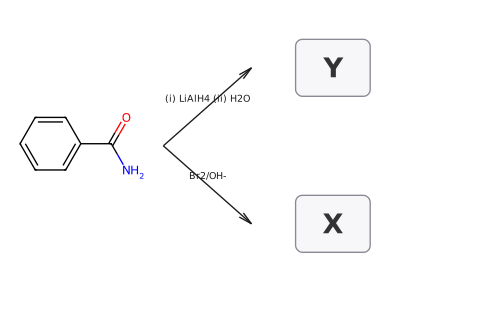
›Reveal solutionSolution
X = aniline (via Hofmann bromamide degradation) and Y = benzylamine (via LiAlH₄ reduction) from benzamide. Statement I (about basicity) is actually true; statements II (diazonium stability) and III (ammonolysis route) are the incorrect ones.
Concept and Intuition
Benzamide, C6H5CONH2, can be converted two different ways:
- LiAlH4 reduces the amide carbonyl all the way to a CH2 group, giving benzylamine, Y = C6H5CH2NH2 (an amine attached to the ring through a CH2 spacer — behaves like an aliphatic primary amine).
- Br2/OH− triggers the Hofmann bromamide degradation, which removes the carbonyl carbon entirely and gives the amine with one less carbon directly on the ring: X = aniline, C6H5NH2 (a genuinely aromatic amine, its N lone pair conjugated with the ring).
Step-by-Step Solution
- Identify X = aniline, Y = benzylamine, as above.
- Statement I — pKb(X)>pKb(Y): aniline's nitrogen lone pair delocalises into the benzene ring, making it far less available for protonation, i.e. aniline is a much weaker base than benzylamine (whose CH2 spacer isolates the lone pair from the ring). A weaker base has a higher pKb. So aniline's pKb (~9.4) is indeed greater than benzylamine's pKb (~4.7) — statement I is true (not one of the incorrect ones).
- Statement II — both form stable diazonium salts with NaNO2/HCl at 273–298 K: only aromatic primary amines (aniline) give diazonium salts stable enough to isolate/use in that temperature range. Benzylamine, though attached to a ring, has its amino nitrogen on an sp3 carbon (behaves as a primary aliphatic amine for this reaction) — its diazonium salt is unstable and decomposes immediately (releasing N2, forming alcohols/alkenes). So statement II is false — it is one of the incorrect statements.
- Statement III — both can be prepared by ammonolysis of the corresponding chloride: benzylamine can indeed be made by ammonolysis of benzyl chloride (C6H5CH2Cl+NH3), which proceeds readily since it's a benzylic (activated) halide. But aniline is not obtained this way from chlorobenzene — aryl C–Cl bonds resist nucleophilic substitution under ordinary ammonolysis conditions due to resonance strengthening of the C–Cl bond, so this route does not work for X. So statement III is false — it is also one of the incorrect statements.
- Incorrect statements = II, III only.
Common Mistakes
- Assuming both amines behave identically towards diazotisation just because both ultimately derive from the same benzamide precursor — the location of the amino group (on the ring vs on a CH2) is what matters.
- Reading statement I's claim at face value as "obviously wrong" without checking it — it is in fact chemically correct here, which is the trap of this question.
✓Final answerThe correct option is (B) — II, III only.
ANSWER: B
- AP EAPCET 2025Set eng-2025-05-21-AN1 markMCQQ.Consider the following Statement-I: CH3NH2 is more basic than NH3 but C6H5NH2 is less basic than NH3. Statement-II: The order of basic strength of amines in aqueous phase follows the order (C2H5)3N>(C2H5)2NH>C2H5NH2 The correct answer is (A) Both statement-I and statement-II are correct (B) Both statement-I and statement-II are not correct (C) Statement-I is correct, but statement-II is not correct (D) Statement-I is not correct, but statement-II is correct
›Reveal solutionSolution
Statement-I (relative basicity of methylamine/ammonia/aniline) is a correct, standard fact. Statement-II's claimed order 3°>2°>1° for ethylamines in water is wrong — aqueous basicity is not simply +I count, because steric hindrance to solvation of the bulky ammonium ion matters too.
Concept and Intuition
Basicity of amines depends on how available the nitrogen lone pair is to accept a proton, AND (in aqueous solution specifically) on how well the resulting ammonium cation is stabilised by hydrogen-bonding solvation. Alkyl groups donate electron density (+I), which should increase basicity with more alkyl substitution, but each alkyl group also sterically blocks water molecules from approaching and solvating the −NH+ centre. In water, this steric/solvation effect competes with (and for bulky groups, dominates) the electronic effect, producing the experimentally observed non-monotonic order for simple trialkylamines.
Step-by-Step Solution
- Statement-I: CH3NH2 vs NH3 — the methyl group donates electron density inductively onto N, making methylamine a stronger base than ammonia. C6H5NH2 (aniline) vs NH3 — the nitrogen lone pair conjugates into the benzene ring (resonance delocalisation), making it much less available to bind H+, so aniline is a weaker base than ammonia. Both parts are textbook-correct, so Statement-I is TRUE.
- Statement-II: claims (C2H5)3N>(C2H5)2NH>C2H5NH2 in aqueous phase.
- Experimentally (and as taught in NCERT), the correct aqueous order for these ethylamines is (C2H5)2NH>C2H5NH2>(C2H5)3N>NH3 — the tertiary amine, despite having the most +I donation, drops BELOW the secondary and primary amines because its three bulky ethyl groups sterically hinder solvation of its ammonium ion, reducing the stabilisation of the protonated form.
- So the specific monotonic order given in Statement-II (3°>2°>1°) is not correct as stated (real order places 2°>1°>3°) — Statement-II is FALSE.
- Hence: Statement-I correct, Statement-II incorrect.
Common Mistakes
- Applying a simple "more alkyl groups = more basic" rule uniformly to aqueous-phase amine basicity — this ignores the solvation/steric factor that reverses the naive order for bulkier amines in water.
- Not distinguishing gas-phase basicity trends (where the naive 3°>2°>1° order for amines often does hold, since there's no solvent to hinder) from aqueous-phase trends (where it doesn't) — Statement-II is specifically about the aqueous phase.
✓Final answerThe correct option is (C) — Statement-I is correct, but statement-II is not correct.
ANSWER: C
- AP EAPCET 2025Set ap-2025-05-20-FN1 markMCQQ.Which of the following has the lowest pKb value? (A) CH3−NH2 (B) (CH3CH2)2NH (C) aniline (benzene ring with an NH2 substituent) (D) N-methylaniline (benzene ring with an NH−CH3 substituent)
›Reveal solutionSolution
Basicity order here is: aliphatic secondary amine > aliphatic primary amine >> aromatic secondary amine > aromatic primary amine, so diethylamine has the lowest pKb (strongest base).
Concept and Intuition
Basicity of an amine depends on how available the nitrogen lone pair is to accept a proton.
- In aromatic amines (aniline, N-methylaniline), the nitrogen lone pair is delocalised into the benzene ring by resonance, making it far less available to bind H+. This makes aniline and N-methylaniline much weaker bases (higher pKb, around 9–9.5) than any simple aliphatic amine.
- In aliphatic amines, alkyl groups push electron density onto nitrogen via the +I (inductive) effect, which should make more-substituted amines more basic. In aqueous solution, this trend is moderated by solvation (a more crowded/hydrophobic nitrogen is harder to hydrate and stabilise as R3NH+), so the typically observed order for basicity in water is secondary > primary > tertiary > NH3 for simple alkylamines. Diethylamine (a secondary amine) is therefore a slightly stronger base than methylamine (a primary amine), giving it the lower (more negative-leaning, i.e., smaller) pKb value.
Step-by-Step Solution
- Compare aliphatic vs aromatic amines first: aniline and N-methylaniline both have pKb≈9–9.5 because of resonance delocalisation of the N lone pair into the ring — these are ruled out as "lowest pKb" candidates.
- Between the two aliphatic amines, methylamine (CH3NH2) has pKb≈3.4, while diethylamine ((CH3CH2)2NH) has pKb≈3.0 — lower than methylamine.
- So diethylamine has the lowest pKb among the four, i.e., it is the strongest base.
Common Mistakes
- Assuming aromatic amines are always more basic because of the "bigger" molecule — resonance delocalisation actually makes them weaker bases, not stronger.
- Forgetting that "lowest pKb" means "strongest base," not "weakest."
✓Final answerThe correct option is (B) — (CH3CH2)2NH.
ANSWER: B
- AP EAPCET 2024Set ap-2024-05-16-AN1 markMCQQ.Arrange the following in increasing order of their pKb values. A. Aniline B. Benzylamine C. Ethylamine (A) A < B < C (B) C < B < A (C) B < C < A (D) A < C < B
›Reveal solutionSolution
Basicity (and hence pKb) among these three amines is governed by whether the nitrogen lone pair is conjugated with the benzene ring: aniline (conjugated, weak base, high pKb) < benzylamine (insulated by CH₂, moderately strong base) < ethylamine (purely aliphatic, strongest base, lowest pKb) — so increasing pKb is ethylamine < benzylamine < aniline.
Concept and Intuition
A more basic amine has lower pKb (it is a stronger base, so equilibrium favours accepting a proton more, giving a smaller pKb). Aromatic amines like aniline are weak bases because the nitrogen lone pair delocalizes into the ring (resonance with the ring), making it far less available to accept a proton. Purely aliphatic amines like ethylamine have no such delocalization and are strongly basic (also aided by +I effect and better solvation of the resulting ammonium ion). Benzylamine's nitrogen is separated from the ring by a −CH2− group, so there is no resonance delocalization into the ring — its basicity is close to (but very slightly less than) a simple aliphatic amine, because of a small inductive electron-withdrawing effect transmitted through the CH₂ from the phenyl ring.
Step-by-Step Solution
- Aniline (C6H5NH2): lone pair conjugated with the aromatic ring ⇒ weakest base ⇒ highest pKb (≈9.4).
- Benzylamine (C6H5CH2NH2): no conjugation (CH₂ insulates the nitrogen from the ring) ⇒ moderately strong base, close to an aliphatic amine but slightly weaker due to inductive effect (pKb≈4.7).
- Ethylamine (C2H5NH2): purely aliphatic, +I effect, no ring at all ⇒ strongest base ⇒ lowest pKb (≈3.3).
- Increasing order of pKb: ethylamine (C) < benzylamine (B) < aniline (A), i.e. C < B < A.
Common Mistakes
- Assuming benzylamine is as weak a base as aniline just because it "has a benzene ring" — the key is whether the lone pair is directly conjugated with the ring, which it is not in benzylamine.
- Mixing up pKb (higher = weaker base) with pKa/basicity strength (higher = stronger base) and inverting the order.
✓Final answerThe correct option is (B) — C < B < A.
ANSWER: B
- AP EAPCET 2024Set eng-2024-05-21-FN1 markMCQQ.Arrange the following in decreasing order of their basicity A. 4-methoxyaniline: 4-CH3O-C6H4-NH2 B. 4-methylbenzylamine: 4-CH3-C6H4-CH2NH2 C. 4-nitroaniline: 4-O2N-C6H4-NH2 (A) B > C > A (B) B > A > C (C) A > B > C (D) A > C > B
›Reveal solutionSolution
Whether the amine nitrogen is conjugated with the aromatic ring is the dominant factor: a benzylamine (not conjugated) beats any aniline (conjugated); among anilines, an electron-donating para substituent boosts basicity and an electron-withdrawing one kills it.
Concept and Intuition
Basicity of an amine depends on how available its nitrogen lone pair is to accept a proton.
- In aniline-type amines, the −NH2 is attached directly to the ring, so its lone pair is pulled into resonance with the aromatic π system. This delocalisation makes the lone pair much less available, so anilines are always much weaker bases than comparable aliphatic amines.
- In 4-methylbenzylamine, the −NH2 is on a CH2 group, one carbon removed from the ring. This sp3 methylene completely breaks conjugation between the nitrogen lone pair and the ring — so this amine behaves essentially like a plain primary aliphatic amine (strongly basic, lone pair fully available), and is therefore much more basic than either aniline derivative.
- Among the two anilines: a para-methoxy group is electron-donating (+M, releases electron density into the ring and onto nitrogen), increasing basicity relative to plain aniline; a para-nitro group is strongly electron-withdrawing (-M, actively pulls the lone pair towards itself through the ring), decreasing basicity drastically.
Step-by-Step Solution
- Recognise B (4-methylbenzylamine) is NOT an aniline — its N is isolated from ring conjugation by a CH2 spacer, so it is the strongest base of the three by a wide margin.
- Compare A (4-methoxyaniline) and C (4-nitroaniline), both true anilines whose lone pairs are ring-conjugated.
- −OCH3 at the para position donates electron density by resonance into the ring, partially compensating for the conjugative loss and making A more basic than unsubstituted aniline.
- −NO2 at the para position withdraws electron density strongly by resonance, making the lone pair on N in C even less available than in plain aniline — the weakest base of the three.
- Overall order: B (most basic) > A > C (least basic).
Common Mistakes
- Treating all three as simple anilines and ranking purely by substituent effect, forgetting that B's nitrogen isn't even conjugated to the ring — this is the deciding factor, not a minor correction.
- Reversing the substituent effect: thinking −NO2 increases basicity because it's "electron-withdrawing = more acidic character helps stabilize the free base" — it's the opposite; withdrawing groups always reduce amine basicity by pulling the lone pair away.
✓Final answerThe correct option is (B) — B > A > C.
ANSWER: B
- AP EAPCET 2023Set ap-2023-05-22-FN1 markMCQQ.The decreasing order of pKa of the following aromatic amines(a) C6H5NH2 (aniline)(b) C6H5CH2NH2 (benzylamine)(c) a benzene ring bonded to N(H)−CH3 (N-methylaniline)(d) a benzene ring bonded to N(CH3)2 (N,N-dimethylaniline) (A)(a) >(b) >(d) >(c) (B)(a) >(c) >(d) >(b) (C)(b) >(d) >(c) >(a) (D)(b) >(c) >(d) > (a)
›Reveal solutionSolution
Benzylamine (aliphatic-like, lone pair not conjugated) is the most basic; among the anilines, N,N-dimethylaniline > N-methylaniline > aniline, since alkyl +I effects partly offset the lone-pair delocalization into the ring, giving decreasing pKa order (b) > (d) > (c) > (a).
Concept and Intuition
Basicity of an amine depends on how available its nitrogen lone pair is for protonation. In aniline, the lone pair on N conjugates (delocalizes) into the aromatic ring, making it much less available and hence aniline is a weak base. Benzylamine has a CH2 group between the ring and the nitrogen, which breaks this conjugation — the lone pair behaves like that of a normal aliphatic amine, making benzylamine considerably more basic than any of the anilines. Among the anilines themselves, replacing N–H with N–CH3 groups adds electron density to nitrogen through the inductive (+I) effect of the alkyl groups, which increases basicity somewhat (aniline < N-methylaniline < N,N-dimethylaniline), even though the lone pair is still partly delocalized into the ring in all three.
Step-by-Step Solution
- Benzylamine (b): CH2 spacer prevents conjugation ⇒ most basic, highest pKaH (~9.3).
- N,N-dimethylaniline (d): two methyl (+I) groups increase electron density at N compared to aniline ⇒ pKaH≈5.1.
- N-methylaniline (c): one methyl (+I) group ⇒ pKaH≈4.85, less basic than the dimethyl version but more than plain aniline.
- Aniline (a): no alkyl substitution, lone pair most delocalized into ring ⇒ least basic, pKaH≈4.6.
- Decreasing pKa order: (b) > (d) > (c) > (a).
Common Mistakes
- Assuming more methyl substitution always means more basic without accounting for conjugation with the ring still being present in (c) and (d).
- Forgetting that benzylamine is essentially an aliphatic amine in behavior, not an aromatic amine, and so is far more basic than all the anilines.
✓Final answerThe correct option is (C) — (b) > (d) > (c) > (a).
ANSWER: C
- AP EAPCET 2023Set ap-2023-05-22-FN1 markMCQQ.Given below are two statements Assertion (A): Ethylamine is stronger base than ammonia Reason (R): It is due to -I effect of ethyl group The correct answer is (A) Both A and R are correct and R is correct explanation of A. (B) Both A and R are correct but R is not correct explanation of A. (C) A is correct but R is incorrect. (D) A is incorrect but R is correct.
›Reveal solutionSolution
Ethylamine is a stronger base than ammonia because the ethyl group is electron-donating (+I effect), not electron-withdrawing (-I effect). So Assertion (A) is correct, but Reason (R) is incorrect. The correct option is (C).
Concept & Intuition: Basicity of Amines
Basicity in amines is all about the availability of the lone pair on nitrogen to accept a proton. The more electron-rich the nitrogen, the stronger the base. Alkyl groups like ethyl are electron-donating through the +I effect (inductive effect). They push electron density toward the nitrogen, making the lone pair more available. In contrast, the -I effect withdraws electrons, which would decrease basicity. The question tests whether you know the correct direction of the inductive effect for an alkyl group.
Step-by-step reasoning:
-
Identify the Assertion (A): "Ethylamine is a stronger base than ammonia."
- Ammonia (NH₃) has a nitrogen with a lone pair.
- Ethylamine (CH₃CH₂NH₂) has an ethyl group attached to nitrogen.
- Alkyl groups are electron-releasing (+I effect). This increases electron density on nitrogen, making it more willing to accept a proton.
- Therefore, ethylamine is indeed a stronger base than ammonia. Assertion (A) is correct.
-
Identify the Reason (R): "It is due to -I effect of ethyl group."
- The -I effect means electron-withdrawing (e.g., from groups like -NO₂, -CN, -F).
- The ethyl group is actually electron-donating (+I effect), not withdrawing.
- So the reason given is factually wrong. Reason (R) is incorrect.
-
Evaluate the relationship:
- Since (R) is incorrect, it cannot be a correct explanation of (A), even though (A) is true.
- This matches option (C): "A is correct but R is incorrect."
Watch outA common mistake is to think alkyl groups are electron-withdrawing because they are "bigger" or because of some confusion with resonance effects. Remember: alkyl groups always donate electrons via the inductive effect.
TipA quick memory aid: Alkyl = electron donor (think of it as "pushing" electrons toward nitrogen). The more alkyl groups attached (up to a point), the stronger the base — except in solution where steric hindrance and solvation effects can reverse the order.
✓Final answerThe correct option is (C).
ANSWER: C
-
- AP EAPCET 2023Set ap-2023-05-23-FN1 markMCQQ.Basicity order of the following amines in aqueous medium i) N-Methylaniline ii) N, N-Dimethylaniline iii) Aniline (A) i > ii > iii (B) i > iii > ii (C) iii > ii > i (D) ii > i > iii
›Reveal solutionSolution
In aqueous medium, the basicity of aniline derivatives is governed by a balance between the +I effect of methyl groups and the loss of resonance stabilisation due to steric hindrance. The order is: N,N-dimethylaniline > N-methylaniline > aniline, so the correct option is (D).
Why This Approach Works
Basicity of amines in water depends on the availability of the lone pair on nitrogen to accept a proton. For aniline and its N-methyl derivatives, two opposing factors are at play:
- Inductive effect (+I): Methyl groups are electron-donating, which increases electron density on nitrogen, making it more basic.
- Resonance effect: In aniline, the lone pair is delocalised into the benzene ring, reducing basicity. N-methylation can hinder this resonance due to steric clash between the methyl groups and the ortho-hydrogens of the ring, forcing the lone pair to be more localised on nitrogen.
In aqueous solution, the solvation of the protonated ammonium ion also matters, but here the key is the balance of these two effects.
Step-by-Step Reasoning
-
Baseline: Aniline (iii)
Aniline’s lone pair is strongly delocalised into the aromatic ring via resonance. This makes it the least basic among the three because the lone pair is less available for protonation. Its conjugate acid is stabilised by resonance, but the free base is even more stabilised, so the equilibrium favours the free base.
-
Effect of one methyl group: N-Methylaniline (i)
Adding one methyl group to nitrogen introduces a +I effect, which pushes electron density toward nitrogen, increasing basicity. However, the methyl group is small enough that the lone pair can still participate in resonance with the ring, though slightly less effectively than in aniline. The net result is a modest increase in basicity over aniline.
-
Effect of two methyl groups: N,N-Dimethylaniline (ii)
Two methyl groups provide a stronger +I effect, which would suggest even higher basicity. But more importantly, the two methyl groups create significant steric hindrance with the ortho-hydrogens of the benzene ring. This forces the N(CH₃)₂ group to twist out of the plane of the ring, breaking the resonance between the lone pair and the aromatic π-system. The lone pair becomes almost entirely localised on nitrogen, making it much more available for protonation. This steric inhibition of resonance outweighs the inductive effect, making N,N-dimethylaniline the most basic of the three.
-
Order in aqueous medium
Combining these:
- N,N-Dimethylaniline (ii) is the most basic.
- N-Methylaniline (i) is intermediate.
- Aniline (iii) is the least basic. Hence, the order is ii > i > iii.
Watch outA common mistake is to think that more methyl groups always mean higher basicity due to the +I effect alone. In aniline derivatives, steric hindrance can dominate, reversing the expected trend. For example, in the gas phase, the order is different because solvation effects are absent.
TipA quick way to remember: If the nitrogen’s lone pair can be planar with the ring, resonance reduces basicity. Bulky substituents force non-planarity, “freeing” the lone pair and boosting basicity.
✓Final answerThe correct option is (D).
ANSWER: D
- AP EAPCET 2023Set eng-2023-05-15-AN1 markMCQQ.Which of the following produces nitrogen gas after the reaction with nitrous acid? (A) (CH3)3N (B) C2H5NHC2H5 (C) (C2H5)3N (D) C2H5NH2
›Reveal solutionSolution
Nitrous acid's reaction with amines depends on how many N–H bonds are available: only primary amines form an unstable diazonium intermediate that decomposes with N₂ evolution, so C2H5NH2 (ethylamine) is the one that liberates nitrogen gas.
Concept and Intuition
The reaction of amines with nitrous acid (HNO2) is a standard qualitative test to distinguish 1°/2°/3° amines:
- Primary amines (one N–H replaced twice, i.e. two N–H bonds present) form a diazonium salt via nitrosation, which for aliphatic amines is thermally unstable even at 0–5°C and decomposes instantly, releasing nitrogen gas and forming an alcohol (plus other minor products) — vigorous effervescence is the visible clue.
- Secondary amines (only one N–H bond) form a stable, often oily, yellow N-nitrosamine (R2N−NO) — no gas evolved.
- Tertiary amines (no N–H bonds) cannot be nitrosated at nitrogen in the same way; they simply form an unstable nitrite salt at low temperature with no clean gas-evolving reaction.
Step-by-Step Solution
- (CH3)3N: a tertiary amine (no N–H) → no diazonium/nitrosamine chemistry possible → no N2.
- C2H5NHC2H5 (diethylamine): a secondary amine (one N–H) → forms a stable N-nitrosamine, not a gas-releasing diazonium salt → no N2.
- (C2H5)3N: a tertiary amine → same reasoning as (1) → no N2.
- C2H5NH2 (ethylamine): a primary amine (two N–H bonds) → reacts with HNO2 to form the diazonium salt C2H5N2+, which is unstable and decomposes immediately at ordinary temperatures, releasing N2 gas and giving ethanol.
- So the amine that produces nitrogen gas is ethylamine, option (D).
Common Mistakes
- Forgetting that aliphatic (unlike aromatic) diazonium salts are too unstable to isolate — they decompose instantly with gas evolution, which is exactly why this is used as a distinguishing test rather than a synthetic route to isolable diazonium salts.
- Confusing secondary amines' nitrosamine formation (no gas) with primary amines' gas-releasing decomposition — both involve "N-nitroso" chemistry but with very different outcomes.
✓Final answerThe correct option is (D) — C2H5NH2.
ANSWER: D
- AP EAPCET 2022Set eng-2022-07-04-FN1 markMCQQ.Arrange the following in decreasing order of their pKb values:(a) CH3NH2;(b) (CH3)3N;(c) Benzylamine (a benzene ring with a CH2NH2 substituent);(d) N-Methylbenzylamine (a benzene ring with a CH2NHCH3 substituent) (A) d > a > c > b (B) a > b > d > c (C) d > c > b > a (D) a > c > d > b
›Reveal solutionSolution
Basicity in water depends on three competing effects (inductive donation, steric hindrance to solvation, and how well the resulting cation is hydrogen-bonded), and the one rock-solid, textbook fact here — that CH3NH2 is a stronger base than (CH3)3N in water — is enough to pick out option (C) uniquely.
Concept and Intuition
Gas-phase basicity of amines increases with more alkyl substitution (more +I groups push electron density onto N). But in water, the picture changes: the protonated ammonium cation must be stabilised by hydrogen-bonding with solvent, and bulky alkyl groups around N get in the way of this solvation. For the methylamine series this gives the well-known aqueous order (CH3)2NH>CH3NH2>(CH3)3N>NH3 — i.e. even though trimethylamine has three +I methyls, steric hindrance to solvation makes it a weaker base than methylamine. The same steric penalty applies even more strongly once a bulky benzyl group is involved, so a benzylic secondary amine can end up weaker than a benzylic primary amine.
Step-by-Step Solution
- pKb is large for a weak base and small for a strong base, so "decreasing pKb" means listing weakest base first.
- Fact: in water, CH3NH2 (a) is a stronger base than (CH3)3N (b) — so pKb(a)<pKb(b), meaning b must be listed before a in a decreasing-pKb list.
- Test each option for the relative position of a and b:
- (A) d > a > c > b — a before b: implies pKb(a)>pKb(b). Contradicts step 2.
- (B) a > b > d > c — a before b: same contradiction.
- (C) d > c > b > a — b before a: consistent with pKb(b)>pKb(a). ✓
- (D) a > c > d > b — a before b: contradiction.
- Only (C) survives. (It is also chemically sensible for the rest of the order: benzylamine's lone −CH2Ph group is bulkier than methyl and gives less solvation-friendly stabilisation than CH3NH2, so benzylamine (c) is weaker than a; and going to the secondary N-methylbenzylamine (d) adds even more steric bulk around N, making it the weakest of all four — matching d > c > b > a.)
Common Mistakes
- Assuming "more alkyl/aryl substitution always means more basic" — this is true in the gas phase but can reverse in water due to solvation/steric effects.
- Forgetting that pKb and base strength are inversely related (a larger pKb means a weaker base).
✓Final answerThe correct option is (C) — d > c > b > a.
ANSWER: C
🎓Unlock everything free for 14 days
- ✓Full step-by-step solutions
- ✓Concept-first explanations
- ✓Methods, shortcuts & mistakes
- ✓PYQ mapping + timed mock tests
Full access for 14 days. No credit card required.