Q.How will you bring about the following conversions?
🔒You're viewing a preview — the full solution, concept, methods & PYQ mapping are locked.
🔒 Start your 14-day free trial to unlock the full solution →Concept understanding — Markovnikov Addition
The Intuition First
Imagine you have an alkene — a carbon-carbon double bond. That double bond is like a crowded room with two doors. When a molecule like HBr comes along, it wants to break that double bond and add across it. The question is: which carbon gets the hydrogen, and which gets the bromine?
You might think it doesn't matter — after all, the two carbons look similar. But they aren't. One carbon usually has more alkyl groups (methyl, ethyl, etc.) attached to it than the other. That carbon is more "electron-rich" — it has more friends pushing electrons toward it.
The hydrogen, being small and positively charged, is picky. It goes to the carbon that already has more hydrogens. Why? Because that carbon is less crowded and can stabilise the positive charge that forms temporarily during the reaction. The bromine, being large and negatively charged, goes to the other carbon — the one with more alkyl groups.
That's the intuition: the rich get richer. The carbon with more hydrogens gets another hydrogen. The carbon with more alkyl groups gets the halogen.
The Precise Statement
Markovnikov's Rule: When an unsymmetrical reagent (like HX, H₂O, etc.) adds to an unsymmetrical alkene, the hydrogen atom attaches to the carbon of the double bond that already has the greater number of hydrogen atoms.
In other words, for an alkene like CH3CH=CH2 (propene) reacting with HBr:
- Carbon 1 (the CH₂ end) has 2 hydrogens.
- Carbon 2 (the CH end) has 1 hydrogen.
- The H goes to carbon 1 (more hydrogens).
- The Br goes to carbon 2 (fewer hydrogens).
So the product is CH3CHBrCH3 (2-bromopropane), not CH3CH2CH2Br (1-bromopropane).
Why Does This Happen? The Real Chemistry
The reaction proceeds through a carbocation intermediate. When the H⁺ attacks the double bond, it can form one of two possible carbocations:
- A primary carbocation (if H⁺ goes to the more substituted carbon) — unstable.
- A secondary carbocation (if H⁺ goes to the less substituted carbon) — more stable.
The reaction chooses the path that gives the more stable carbocation. Alkyl groups stabilise carbocations through hyperconjugation and inductive effect — they donate electron density to the positively charged carbon.
The stability order of carbocations is: tertiary > secondary > primary > methyl. Markovnikov addition always proceeds through the most stable carbocation possible.
A Common Misconception
Many students think Markovnikov's rule means "hydrogen goes to the carbon with more hydrogens" because that carbon already has more hydrogens. That's backwards. The hydrogen goes there because that path leads to a more stable carbocation — the number of hydrogens is just a convenient way to predict the outcome, not the cause.
The One Big Exception …
Why this formula?
Markovnikov Addition: Why the Rule Holds
Markovnikov's rule is not a formula in the algebraic sense — it's a predictive principle for electrophilic addition to unsymmetrical alkenes. The "why" comes from carbocation stability and reaction mechanism.
The Rule in Words
When H–X adds to an unsymmetrical alkene, the hydrogen attaches to the carbon with more hydrogen atoms already attached, and the halogen (or X group) attaches to the carbon with fewer hydrogen atoms.
Example:
Propene (CHX3−CH=CHX2) + HBr → 2-bromopropane (major product), not 1-bromopropane.
Why This Happens: The Step-by-Step Reasoning
1. The Mechanism (Electrophilic Addition)
The reaction proceeds in two steps:
- Slow step (rate-determining): The alkene's π bond attacks the electrophilic HX+ from H–X, forming a carbocation intermediate.
- Fast step: The carbocation is attacked by the nucleophilic XX−.
2. The Key: Carbocation Stability
The more stable carbocation intermediate forms faster and determines the major product.
| Carbocation Type | Stability Order | Reason |
|---|---|---|
| Tertiary (3∘) | Most stable | +3 alkyl groups donate electron density via hyperconjugation and inductive effect |
| Secondary (2∘) | Intermediate | +2 alkyl groups |
| Primary (1∘) | Least stable | +1 alkyl group |
| Methyl (CHX3X+) | Unstable | No alkyl stabilization |
3. Applying to Propene + HBr
Propene: CHX3−CH=CHX2
Two possible protonation sites:
- Path A (Markovnikov): HX+ adds to CHX2 (terminal carbon) → forms secondary carbocation:
CHX3−CHX+−CHX3(2∘)
- Path B (Anti-Markovnikov): HX+ adds to CH (middle carbon) → forms primary carbocation:
CHX3−CHX2−CHX2X+(1∘)
Result: The secondary carbocation is more stable (by ~25–30 kJ/mol), so Path A is faster. The BrX− then attacks the positively charged carbon, giving 2-bromopropane.
The "Formula" — A Stability-Based Prediction
There is no algebraic formula, but a decision rule:
Major product=Product from the more stable carbocation
For alkenes with alkyl substituents, the stability order is:
Tertiary>Secondary>Primary>Methyl …
Concept: Each conversion uses a specific organic reaction — elimination, substitution, addition, or coupling. The key is to identify the functional group change and choose the correct reagent.
- Ethanol → but-1-yne Step 1: Dehydrate ethanol to ethene (conc. H2SO4, 170°C). Step 2: Brominate ethene to 1,2-dibromoethane (Br2). Step 3: Double dehydrohalogenation with NaNH2 in liquid NH3 gives ethyne. Step 4: Alkylate ethyne with CH3CH2Br using NaNH2 to get but-1-yne.
- Ethane → bromoethene Step 1: Free-radical bromination of ethane gives bromoethane (Br2, hv). Step 2: Dehydrohalogenation with alcoholic KOH yields ethene. Step 3: Brominate ethene to 1,2-dibromoethane, then dehydrobrominate with alcoholic KOH to bromoethene.
- Propene → 1-nitropropane Step 1: Add HBr to propene (peroxide effect, anti-Markovnikov) to get 1-bromopropane. Step 2: Treat with aqueous AgNO2 (nitrite) — SN2 gives 1-nitropropane.
- Toluene → benzyl alcohol Step 1: Free-radical chlorination of toluene (Cl2, hv) gives benzyl chloride. Step 2: Hydrolysis with aqueous NaOH yields benzyl alcohol.
- Propene → propyne Step 1: Brominate propene to 1,2-dibromopropane (Br2). Step 2: Double dehydrohalogenation with NaNH2 in liquid NH3 gives propyne.
- Ethanol → ethyl fluoride Step 1: Convert ethanol to ethyl chloride using PCl5 or SOCI2. Step 2: Swarts reaction — treat ethyl chloride with AgF (or Hg₂F₂, CoF₂, SbF₃) to get ethyl fluoride. (Simple NaF does not drive this exchange the way NaI does in a true Finkelstein reaction — fluorination needs one of the Swarts-reaction metal fluorides.)
- Bromomethane → propanone Step 1: Convert CH3Br to CH3MgBr (Mg, dry ether — Grignard reagent). Step 2: React CH3MgBr with CH3CN (acetonitrile), then hydrolyse the resulting imine-magnesium complex with dilute acid to get propanone. (A nitrile is used rather than an acid chloride because the initial addition product is stable to further Grignard attack until hydrolysis — an acid chloride would over-react with excess Grignard to give a tertiary alcohol instead.)
- But-1-ene → but-2-ene Step 1: Add HBr to but-1-ene (no peroxide, Markovnikov addition) to get 2-bromobutane. …
Each conversion is achieved by a specific sequence of organic reactions — the key is to identify the functional-group transformation needed and then apply the correct reagents stepwise. The final products are obtained via standard named reactions like dehydrohalogenation, Wurtz reaction, Sandmeyer reaction, etc.
Let's work through each conversion one by one, focusing on the why behind each step.
(i) Ethanol to but-1-yne
Concept: We need to increase the carbon chain from 2 to 4 carbons and introduce a terminal triple bond. The strategy: convert ethanol to ethene (dehydration), then to 1,2-dibromoethane (bromination), then to ethyne (double dehydrohalogenation), and finally alkylate the terminal alkyne.
-
Ethanol → Ethene: Dehydrate ethanol using concentrated H2SO4 at 170°C.
CH3CH2OHH2SO4,170∘CCH2=CH2+H2O
-
Ethene → 1,2-Dibromoethane: Add bromine across the double bond.
CH2=CH2+Br2→CH2Br−CH2Br
-
1,2-Dibromoethane → Ethyne: Double dehydrohalogenation with alcoholic KOH (or NaNH2).
CH2Br−CH2Bralc.KOH,heatHC≡CH
-
Ethyne → But-1-yne: Alkylate the terminal alkyne. First, treat ethyne with NaNH2 in liquid NH3 to form sodium acetylide. Then react with ethyl bromide (CH3CH2Br).
HC≡CHNaNH2HC≡C−Na+CH3CH2BrHC≡C−CH2CH3 …
Let's tackle these conversions one by one. The key is to think backwards from the product to the reactant, identifying the functional group transformations needed.
Here is one clear, named method for each, with step-by-step reasoning.
(i) Ethanol to but-1-yne
Method: Build ethyne first, then alkylate its acetylide with an ethyl halide
Why this works: But-1-yne is a terminal alkyne — the cleanest NCERT route is to make ethyne from ethanol, deprotonate it to sodium acetylide, and add the remaining two carbons as bromoethane.
Steps:
- Ethanol → Ethene: Acid-catalysed dehydration.
CH3CH2OHconc.H2SO4,443KCH2=CH2
- Ethene → 1,2-Dibromoethane: Electrophilic addition of bromine.
CH2=CH2Br2/CCl4BrCH2CH2Br
- 1,2-Dibromoethane → Ethyne: Double dehydrohalogenation.
BrCH2CH2Br2NaNH2HC≡CH
- Ethyne → Sodium acetylide: Deprotonation of the terminal C–H.
HC≡CHNaNH2HC≡C−Na+
- Acetylide + Bromoethane → But-1-yne: SN2 alkylation adds the two-carbon chain (bromoethane itself is made from ethanol + PBr3).
HC≡C−Na++CH3CH2Br→HC≡C−CH2CH3
Final Product: But-1-yne
(ii) Ethane to bromoethene
Method: Four Steps: Halogenation → Elimination → Addition → Selective Elimination
Why this works: Dehydrohalogenation of bromoethane would remove its ONLY bromine and give plain ethene — a two-step route can never give bromoethene. The vinyl bromide must come from a 1,2-dibromide that loses just ONE HBr.
Steps:
- Free Radical Halogenation: React ethane with Br2 in the presence of UV light (hv). This gives bromoethane.
CH3CH3+Br2hvCH3CH2Br+HBr
- Dehydrohalogenation: Treat bromoethane with alcoholic KOH. This eliminates HBr to form ethene.
CH3CH2Bralc.KOH,ΔCH2=CH2
- Addition of Bromine: Add Br2 (in CCl4) across the double bond to get 1,2-dibromoethane.
CH2=CH2+Br2→CH2Br−CH2Br
- Selective Dehydrohalogenation: Treat with ONE equivalent of alcoholic KOH to eliminate a single HBr.
CH2Br−CH2Bralc.KOH(1eq.),ΔCH2=CHBr
Final Product: Bromoethene (Vinyl bromide)
(iii) Propene to 1-nitropropane
Method: Anti-Markovnikov Addition (via Free Radical Mechanism)
Why this works: Direct nitration of an alkene with HNO3 is messy. We need to add the nitro group (−NO2) to the terminal carbon (C-1), which is the anti-Markovnikov position.
Steps:
- Anti-Markovnikov Addition of HBr: React propene with HBr in the presence of a peroxide (e.g., benzoyl peroxide). This gives 1-bromopropane.
CH3CH=CH2+HBrPeroxideCH3CH2CH2Br
- Nucleophilic Substitution: React 1-bromopropane with alcoholic AgNO2 (silver nitrite). The nitrite ion (NO2−) acts as an ambident nucleophile, but with AgNO2, the major product is the nitroalkane.
CH3CH2CH2Br+AgNO2ΔCH3CH2CH2NO2+AgBr
Final Product: 1-Nitropropane
(iv) Toluene to benzyl alcohol
Method: Free Radical Halogenation followed by Nucleophilic Substitution
Why this works: We need to selectively oxidize the methyl group to a −CH2OH group without touching the ring. Free radical bromination targets the benzylic position.
Steps:
- Benzylic Bromination: React toluene with N-bromosuccinimide (NBS) in the presence of light (hv) and a radical initiator (like benzoyl peroxide). This selectively brominates the methyl group.
C6H5CH3+NBShv,CCl4C6H5CH2Br
- Hydrolysis: Treat benzyl bromide with aqueous NaOH or Na2CO3. This substitutes the bromine with a hydroxyl group.
C6H5CH2Braq.NaOH,ΔC6H5CH2OH
Final Product: Benzyl alcohol
(v) Propene to propyne
Method: Two-Step: Halogenation then Double Dehydrohalogenation
Why this works: We need to introduce a triple bond. This is done by adding two halogen atoms to the double bond, then removing two molecules of HX.
Steps:
- Electrophilic Addition of Bromine: React propene with Br2 in CCl4. This gives 1,2-dibromopropane.
CH3CH=CH2+Br2CCl4CH3CHBrCH2Br
- Double Dehydrohalogenation: Treat the dibromide with a strong base like alcoholic KOH (first elimination) followed by sodamide (NaNH2) in liquid NH3 (second elimination, which is more difficult).
CH3CHBrCH2Br1.alc.KOH,Δ2.NaNH2,liq.NH3CH3C≡CH
Final Product: Propyne
(vi) Ethanol to ethyl fluoride
Method: Nucleophilic Substitution (via a good leaving group)
Why this works: Direct substitution of −OH by F− is poor because OH− is a bad leaving group. We must first convert the alcohol into a better leaving group.
Steps:
- Convert Alcohol to Alkyl Halide (Chloride): React ethanol with PCl5 or SOCl2 to form chloroethane.
CH3CH2OH+PCl5→CH3CH2Cl+POCl3+HCl
- Halogen Exchange (Swarts Reaction): React chloroethane with AgF (or Hg2F2, CoF2, SbF3). The driving force is the precipitation of AgCl. (The name Finkelstein reaction is reserved for the Cl/Br → iodide exchange with NaI in acetone.)
CH3CH2Cl+AgFDMFCH3CH2F+AgCl
Final Product: Ethyl fluoride
(vii) Bromomethane to propanone
Method: Grignard Reaction + Oxidation …
Common Mistakes in Markovnikov Addition & Organic Conversions
Students often lose marks in these conversions due to conceptual confusion and procedural errors. Let's break down the key mistakes and how to avoid them.
(i) Ethanol → But-1-yne
✗ Common Mistakes
- Trying to add 2 carbons directly to ethanol without first converting to a better leaving group.
- Using NaNH₂ directly on ethanol (alcohols are not acidic enough for this).
- Forgetting that but-1-yne has a terminal alkyne (triple bond at C1).
✓ Correct Approach
- Ethanol → Ethene (dehydration with conc. H₂SO₄, 170°C)
- Ethene → 1,2-dibromoethane (Br₂ addition)
- 1,2-dibromoethane → But-1-yne (2 moles NaNH₂ in liq. NH₃ to form sodium acetylide, then alkylate with CH₃CH₂Br — ethyl bromide, not methyl bromide, since ethyne (2 C) + ethyl (2 C) = the 4 carbons but-1-yne needs; using CH₃Br would only reach propyne)
Why this works: The double dehydrohalogenation creates the triple bond, and the alkylation adds the extra carbon.
(ii) Ethane → Bromoethene
✗ Common Mistakes
- Trying direct bromination of ethane (gives bromoethane, not bromoethene).
- Using Br₂/CCl₄ on ethane (no reaction — alkanes need light/heat for substitution).
- Confusing bromoethene (CH₂=CHBr) with bromoethane (CH₃CH₂Br).
✓ Correct Approach
- Ethane → Ethene (cracking or catalytic dehydrogenation, Cr₂O₃/Al₂O₃, 600°C)
- Ethene → 1,2-dibromoethane (Br₂/CCl₄ addition)
- 1,2-dibromoethane → Bromoethene (alc. KOH, heat — dehydrohalogenation)
Key insight: You need a double bond first, then add Br₂, then eliminate one HBr.
(iii) Propene → 1-Nitropropane
✗ Common Mistakes
- Assuming direct nitration of propene (gives mixture of nitroalkenes, not 1-nitropropane).
- Forgetting that Markovnikov addition would give 2-nitropropane, not 1-nitropropane.
- Using HNO₃/H₂SO₄ (nitrating mixture) — this works for aromatics, not alkenes.
✓ Correct Approach (Anti-Markovnikov needed)
- Propene → 1-Bromopropane (HBr with peroxide — anti-Markovnikov addition)
- 1-Bromopropane → 1-Nitropropane (NaNO₂ in DMF or aqueous ethanol, SN2 reaction)
Critical point: The first step must be anti-Markovnikov to get the Br at C1. Without peroxide, HBr adds to C2 (Markovnikov product).
(iv) Toluene → Benzyl Alcohol
✗ Common Mistakes
- Trying direct oxidation of methyl group (gives benzoic acid, not benzyl alcohol).
- Using KMnO₄ or K₂Cr₂O₇ — these over-oxidize to benzoic acid.
- Forgetting that benzyl alcohol is C₆H₅CH₂OH (alcohol, not acid).
✓ Correct Approach
- Toluene → Benzyl chloride (Cl₂/hν or Cl₂/UV light — side-chain chlorination)
- Benzyl chloride → Benzyl alcohol (aq. NaOH or KOH, hydrolysis)
Why this works: Free radical chlorination attacks the benzylic position (CH₃ group), not the ring. Then SN2 hydrolysis gives the alcohol.
(v) Propene → Propyne
✗ Common Mistakes
- Trying one-step elimination (propene → propyne requires two eliminations).
- Using alc. KOH directly on propene (no reaction — no leaving group).
- Forgetting that propyne has a terminal triple bond.
✓ Correct Approach
- Propene → 1,2-Dibromopropane (Br₂/CCl₄ addition)
- 1,2-Dibromopropane → Propyne (2 moles NaNH₂ in liq. NH₃)
Mechanism: Two successive dehydrohalogenations — first gives bromopropene, second gives propyne.
(vi) Ethanol → Ethyl Fluoride
✗ Common Mistakes
- Trying direct reaction with HF (poor yield, dangerous, and HF is weak acid).
- Using F₂ gas (explosive, non-selective).
- Confusing with other halides (Cl, Br, I are easier).
✓ Correct Approach
- Ethanol → Ethene (conc. H₂SO₄, 170°C)
- Ethene → Ethyl fluoride (HF addition — Markovnikov gives ethyl fluoride)
Alternative: Ethanol → Ethyl chloride (SOCl₂) → Ethyl fluoride (metathesis with AgF or KF in polar aprotic solvent).
(vii) Bromomethane → Propanone
✗ Common Mistakes
- Trying direct alkylation of bromomethane (gives ethane, not propanone).
- Forgetting that propanone (acetone) has a carbonyl group (C=O).
- Using Grignard reagent incorrectly.
✓ Correct Approach
- Bromomethane → Methyl magnesium bromide (Mg/dry ether — Grignard reagent)
- CH₃MgBr + CH₃CN → Propanone (react with acetonitrile, then hydrolyse the resulting imine-magnesium complex with dilute acid)
Why a nitrile, not an acid chloride: an acid chloride (e.g. CH₃COCl) reacts with a Grignard reagent to first give a ketone, but that ketone is itself attacked by any remaining Grignard reagent, over-reacting to a tertiary alcohol. A nitrile's initial addition product is stable to further Grignard attack, so hydrolysis cleanly stops at the ketone.
(viii) But-1-ene → But-2-ene
✗ Common Mistakes
- Thinking this is a simple isomerization (it requires bond migration).
- Using H⁺ alone (gives carbocation rearrangement but also polymerization).
- Forgetting that double bond migration needs specific conditions.
✓ Correct Approach
- But-1-ene → But-2-ene (H₂SO₄ (dilute), heat — or Al₂O₃, 300°C)
Mechanism: Protonation gives secondary carbocation (more stable), then deprotonation gives the more substituted alkene (but-2-ene). …
Showing the 12 most recent of 17 on this concept.
- AP EAPCET 2026Set eng-2026-05-12-FN1 markMCQQ.The IUPAC name of the end product Z in the given reaction sequence is CH2=CH−CH3 (propene) $\xrightarrow{\text{(i) } Br_2/CCl_4 \text{(ii) alc. KOH}, \Delta} X \xrightarrow{NaNH_2, \Delta} Y \xrightarrow{\text{Excess HBr}} Z$ (A) 1, 1 – Dibromopropane (B) 1, 2 – Dibromopropane (C) 1, 3 – Dibromopropane (D) 2, 2 – Dibromopropane
›Reveal solutionSolution
The sequence builds propyne from propene, converts it to its sodium acetylide, and then adds excess HBr twice with Markovnikov regiochemistry onto the same carbon, giving Z = 2,2-dibromopropane.
Concept and Intuition
Alkyne chemistry mirrors alkene chemistry but doubled: an unsymmetrical alkyne undergoing addition of 2 equivalents of HX follows Markovnikov's rule at each step, and because the intermediate vinyl halide already has a halogen on the more-substituted carbon (stabilising the next carbocation-like transition state through induction/hyperconjugation from the existing substituents), the second HX addition lands on the same carbon as the first — giving a geminal dihalide, not a vicinal one. Terminal alkynes are also weakly acidic (the sp-hybridised C–H is more acidic than sp²/sp³ C–H) and are deprotonated cleanly by strong bases like NaNH2.
Step-by-Step Solution
- Propene → 1,2-dibromopropane: Br2/CCl4 adds across the propene double bond: CH2=CH−CH3→CH2Br−CHBr−CH3.
- →X (alc. KOH, Δ): Excess alcoholic KOH with heat causes double dehydrohalogenation (elimination of 2 HBr) from the vicinal dibromide, forming the triple bond: X=CH3−C≡CH (propyne).
- X→Y (NaNH2,Δ): Sodamide is a very strong, non-nucleophilic-toward-carbon base; it deprotonates the acidic terminal alkynyl hydrogen of propyne: Y=CH3−C≡C−Na+ (sodium propynylide/prop-1-ynide).
- Y→Z (excess HBr): The acetylide Y is first protonated by HBr back to propyne (simple acid-base neutralisation, since Y is a very strong base). With HBr in excess, the resulting propyne then undergoes two sequential Markovnikov additions of H−Br across the triple bond:
- First addition: H goes to the terminal CH, Br goes to the internal carbon (more substituted, more stable intermediate) ⇒CH3−CBr=CH2 (2-bromopropene). …
- AP EAPCET 2026Set eng-2026-05-12-AN1 markMCQQ.Consider the given sequence of reactions CH3−C≡CHHBrXHBrY Total number of isomers possible for the product Y is (A) 1 (B) 2 (C) 4 (D) 3
›Reveal solutionSolution
Two successive HBr additions to propyne can give 2,2-, 1,1- or 1,2-dibromopropane, and the vicinal isomer is chiral, so Y has 4 possible isomers.
Concept and Intuition
Adding HBr to a terminal alkyne is an electrophilic addition. The first HBr converts the triple bond to a double bond (a bromopropene); the second HBr saturates that double bond to a dibromopropane. Because each addition can place bromine on either of the two triple-bond carbons (C1 or C2), several constitutional dibromides are reachable, and any carbon left with four different groups makes the product optically active.
Step-by-Step Solution
- In propyne CH3−C≡CH, only the two triple-bond carbons (C1 terminal, C2 internal) can receive the incoming H and Br; the methyl carbon is untouched, so a 1,3-dibromide is impossible.
- Both bromines on C2 (Markovnikov twice): CH3−CBr2−CH3, i.e. 2,2-dibromopropane.
- Both bromines on C1: CH3−CH2−CHBr2, i.e. 1,1-dibromopropane.
- One bromine on each of C1 and C2: CH3−CHBr−CH2Br, i.e. 1,2-dibromopropane. Here C2 carries four different groups (CH3, H, Br, CH2Br), so it is a chiral centre giving two enantiomers (R and S). …
- AP EAPCET 2026Set eng-2026-05-14-FN1 markMCQQ.What are X and Y in the following set of reactions respectively? I. 2-Methylpropene H2OH+ X II. 2-Methylpropane KMnO4 Y (A) (CH3)2CHCH2OH ; (CH3)2CHCOOH (B) (CH3)2CHCH2OH ; (CH3)3COH (C) (CH3)3COH ; (CH3)3COH (D) (CH3)3COH ; (CH3)2CHCOOH
›Reveal solutionSolution
Both reactions converge on the same product, tert-butanol: acid-catalysed Markovnikov hydration of 2-methylpropene, and KMnO₄ oxidation of the weak tertiary C–H bond in 2-methylpropane.
Concept and Intuition
Reaction I is acid-catalysed hydration of an alkene, which follows Markovnikov's rule: the proton H+ adds first to the alkene carbon that will generate the more stable carbocation. For 2-methylpropene, (CH3)2C=CH2, protonating the terminal =CH2 carbon produces a tertiary carbocation (CH3)3C+, which is far more stable than the alternative primary carbocation. Water then attacks this tertiary carbocation, and after loss of a proton the product is the tertiary alcohol (CH3)3COH (tert-butyl alcohol).
Reaction II is oxidation of an alkane by hot KMnO4. Alkanes are normally resistant to KMnO4, but a tertiary C–H bond (as found in 2-methylpropane / isobutane, (CH3)3CH) is comparatively weak and more easily abstracted, so vigorous oxidation selectively converts that one C–H bond into a C–OH bond, giving the tertiary alcohol (CH3)3COH. Crucially, a tertiary alcohol has no more hydrogen on that carbon, so it cannot be oxidised further to a ketone or acid — the oxidation naturally stops at the alcohol stage.
Both pathways funnel to the same tertiary alcohol.
Step-by-Step Solution
- Identify 2-methylpropene's structure: (CH3)2C=CH2.
- Apply Markovnikov addition of H2O/H+: H+ to =CH2 (forms 3° carbocation) → OH attaches to the central carbon → X=(CH3)3COH. …
- AP EAPCET 2026Set eng-2026-05-18-FN1 markMCQQ.An alkyne X (C4H6) does not form sodium alkynide. Reaction of X with HBr gave Y. Another reaction of X with Na/liq. NH3 gave Z. Identify Y and Z (A) Y = geminal dibromide ; Z = non-polar compound (B) Y = geminal dibromide ; Z = polar compound (C) Y = vicinal dibromide ; Z = polar compound (D) Y = vicinal dibromide ; Z = non-polar compound
›Reveal solutionSolution
X is the symmetrical internal alkyne but-2-yne; HBr addition gives a geminal dibromide (Y) via two Markovnikov additions on the same carbon, while Na/liq. NH3 reduction gives the non-polar trans-alkene (Z).
Concept and Intuition
An alkyne that fails to form a sodium alkynide with NaNH2/Na has no acidic terminal ≡C−H — it must be an internal alkyne. The only C4H6 internal alkyne is but-2-yne, CH3−C≡C−CH3, which is also symmetric.
When HX adds twice to a symmetrical internal alkyne, the first addition gives a vinylic halide CH3−CBr=CH−CH3. On the second addition, Markovnikov's rule directs the new proton/halide so that the incoming carbocation forms on the carbon that already carries the halogen — a halogen atom can stabilise an adjacent positive charge through lone-pair donation (like a bridged halonium ion), even though inductively it is electron-withdrawing. The net outcome is that both halogens end up on the same carbon, giving a geminal dihalide rather than a vicinal one.
Separately, dissolving-metal reduction of an internal alkyne with Na in liquid NH3 proceeds by a free-radical/anion mechanism that adds hydrogens from opposite faces (anti addition), which for an internal alkyne always delivers the thermodynamically favoured trans-alkene. For but-2-yne this gives trans-2-butene, which — being symmetric about its centre — has its C–CH3 bond dipoles pointing in opposite directions and largely cancelling, making it essentially non-polar (unlike the cis isomer, whose dipoles do not cancel).
Step-by-Step Solution
- X = but-2-yne, CH3−C≡C−CH3 (internal, symmetric, no acidic H).
- X+HBr (excess/2 equiv, Markovnikov both times) → both Br end up on the same carbon → Y = 2,2-dibromobutane, a geminal dibromide.
- X+Na/liq. NH3 → anti addition of two H atoms across the triple bond → Z = trans-2-butene. …
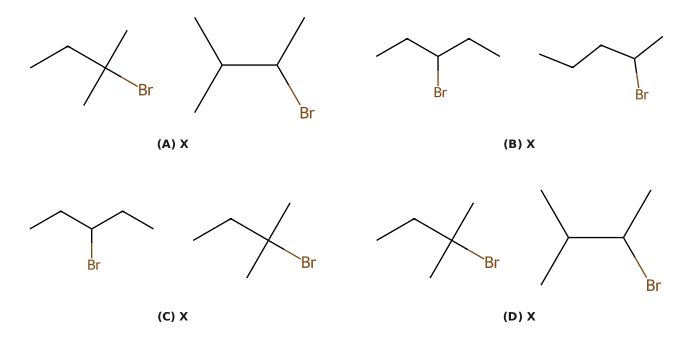
- AP EAPCET 2026Set ap-2026-05-20-FN1 markMCQQ.A and B are two position isomers of an alkene C5H10. Both A and B do not exhibit cis-trans isomerism. Addition of HBr with A forms X (major product) and B adds HBr to form Y (major product). What are X and Y respectively? (A) [FIGURE] (two skeletal bromoalkane structures separated by a semicolon: the first is a 4-carbon zigzag chain ending in a carbon bearing two methyl branches plus a Br substituent, i.e. a tertiary bromide CH3CH2C(CH3)2Br; the second is a shorter zigzag chain with one methyl branch near one end and a Br substituent near the other end) (B) [FIGURE] (two skeletal bromoalkane structures separated by a semicolon: the first is a 5-carbon zigzag chain with a Br substituent hanging from a middle carbon; the second is a 5-carbon zigzag chain with a Br substituent, labelled above the chain, on a carbon near one end) (C) [FIGURE] (two skeletal bromoalkane structures separated by a semicolon: the first is the same 5-carbon chain with a mid-chain Br as in option B; the second is the same tertiary-bromide structure as the first structure in option A, CH3CH2C(CH3)2Br, drawn in a mirrored orientation) (D) [FIGURE] (two skeletal bromoalkane structures separated by a semicolon, the same two structures as option A but drawn in mirrored/reversed left-right orientation)
›Reveal solutionSolution
Markovnikov addition of HBr places bromine on the more substituted (more stable carbocation) carbon. A and B are the two position-isomeric pentenes on the 2-methylbutane skeleton that lack cis-trans isomerism — 2-methyl-2-butene and 3-methyl-1-butene — and they give a tertiary and a secondary bromide respectively, matching option (A).
Concept and Intuition
For an alkene to lack cis-trans (geometric) isomerism, at least one carbon of the C=C must carry two identical substituents (e.g., two H's, or a terminal =CH₂). Addition of HBr follows Markovnikov's rule: H⁺ adds to the carbon that already has more hydrogens, generating the more stable (more substituted) carbocation, to which Br⁻ then adds.
Step-by-step solution
-
Identify A and B. Both are C₅H₁₀ alkenes without cis-trans isomerism. The pair that fits the pictured products is 2-methyl-2-butene, (CH₃)₂C=CHCH₃ (no cis-trans: one alkene carbon bears two identical methyl groups), and 3-methyl-1-butene, (CH₃)₂CH-CH=CH₂ (no cis-trans: the terminal =CH₂ carbon has two identical H's).
-
HBr addition to 2-methyl-2-butene. The double bond is between a carbon bearing two methyls and a carbon bearing one methyl and one H. Markovnikov addition puts H⁺ on the CH (giving H two neighbours already) and generates the tertiary carbocation at the other carbon; Br⁻ attacks there. Product: 2-bromo-2-methylbutane, CH₃CH₂C(CH₃)₂Br — a tertiary bromide.
-
HBr addition to 3-methyl-1-butene. The double bond is terminal: (CH₃)₂CH-CH=CH₂. Markovnikov addition puts H⁺ on the terminal CH₂ and generates a secondary carbocation at the adjacent CH (flanked by an isopropyl group and the new CH₃); Br⁻ attacks there. Product: 2-bromo-3-methylbutane, (CH₃)₂CH-CHBr-CH₃ — a secondary bromide. …
-
- AP EAPCET 2025Set ap-2025-05-19-FN1 markMCQQ.What are X and Z in the following reaction sequence ? (X forms sodium alkynide.) X(C4H6)partial reductionYH2O/H+Z(major) (A) CH3C≡CCH3 , CH3CH2CH(OH)CH3 (B) CH3C≡CCH3 , CH3CH2CH2CH2OH (C) CH3CH2C≡CH , CH3CH2CH(OH)CH3 (D) CH3CH2C≡CH , CH3CH2CH2CH2OH
›Reveal solutionSolution
The alkynide clue fixes X as the terminal alkyne 1-butyne; partial (Lindlar-type)
reduction gives 1-butene, and Markovnikov hydration of that alkene gives butan-2-ol as
the major product Z.
Concept and Intuition
Only a terminal alkyne (−C≡CH) has an acidic proton on the sp carbon (pKa
~25), acidic enough to be removed by a strong base like sodium amide to form a sodium
alkynide (acetylide) salt. Of the two possible C4H6 alkyne isomers (1-butyne,
terminal, and 2-butyne, internal), only 1-butyne can do this — 2-butyne has no terminal
≡C−H.
"Partial reduction" of an alkyne (using H2 with Lindlar's poisoned catalyst, or
Na/liquid NH3) stops at the alkene stage rather than going all the way to the alkane.
Acid-catalysed hydration of an alkene proceeds through a carbocation intermediate and
therefore follows Markovnikov's rule: the proton adds to the carbon that already has
more hydrogens, and −OH ends up on the carbon that can form the more stable
(more substituted) carbocation.
Step-by-Step Solution
- X (C4H6) forms a sodium alkynide ⟹ X must have a terminal ≡C−H ⟹ X=CH3CH2C≡CH (1-butyne).
- Partial reduction of X (e.g. Lindlar H2/Pd-BaSO4/quinoline) reduces the triple bond to a double bond only: Y=CH3CH2CH=CH2 (1-butene).
- YH2O/H+: the alkene is protonated at the terminal (CH2) carbon (giving the more stable secondary carbocation on C2), then water attacks that secondary carbon. …
- AP EAPCET 2025Set eng-2025-05-26-FN1 markMCQQ.What is 'Z' in the following reaction sequence? (alcohol = ఆల్కహాల్; colourless = రంగులేనిది) C3H6Br2CCl4X (colourless)(i) KOH/alcohol(ii) NaNH2, ΔYH2O, 333 KHg2+, H+Z (A) Acetone (B) Propanal (C) Propanol-2 (D) Methoxy ethane
›Reveal solutionSolution
A three-step conversion from propene to a vicinal dibromide, then to a terminal alkyne (propyne) via double dehydrohalogenation with sodalime's 'zipper' effect, then Markovnikov hydration of the alkyne to a methyl ketone. Z = acetone. Answer: (A).
Concept and Intuition
This sequence tests three classic named transformations in one chain:
- Anti-addition of Br2 to an alkene gives a colourless vicinal dihalide (the decolourisation of bromine water/Br2-CCl4 is the standard test for unsaturation).
- Double dehydrohalogenation with NaNH2 — sodamide is a very strong, non-nucleophilic base. When a vicinal dihalide is treated first with alcoholic KOH (one elimination to a bromoalkene) and then with excess NaNH2/heat, a second elimination occurs to give an alkyne, and NaNH2's strongly basic conditions also isomerise any internal alkyne toward the thermodynamically favoured terminal (acetylenic) position — the 'alkyne zipper' reaction — because the terminal alkynyl proton is acidic enough to be removed, locking the triple bond there as its conjugate-base acetylide until work-up.
- Markovnikov hydration of a terminal alkyne (H2O/Hg2+, H2SO4) proceeds via Markovnikov addition of −OH to the more substituted alkyne carbon, giving an unstable enol that tautomerises to a methyl ketone.
Step-by-Step Solution
- C3H6=CH3−CH=CH2 (propene).
- Br2/CCl4 adds across the double bond: CH3−CHBr−CH2Br = X (1,2-dibromopropane), colourless (the orange bromine colour is consumed) — matches the clue 'colourless'.
- (i) Alcoholic KOH removes one HBr (E2) from X, giving a bromopropene (e.g. CH2=CBr−CH3 or CH3−CH=CHBr).
- (ii) NaNH2, heat, removes the remaining HBr to form the carbon–carbon triple bond, and drives the triple bond to the terminal position (zipper effect): Y = propyne, CH3−C≡CH. …
- AP EAPCET 2024Set ap-2024-05-17-FN1 markMCQQ.Observe the following set of reactions C3H4Hg2+/H+ΔX(i) MeMgBr(ii) H2OY C3H6(BH3)2AH2O2/OH−B Correct statement regarding Y and B is (A) Both Y and B are dehydrated with Conc. H2SO4/443 K (B) Both Y and B are dehydrated with 20% H3PO4/358 K (C) Y is dehydrated with Conc. H2SO4/443 K and B with 20% H3PO4/358 K (D) B is dehydrated with Conc. H2SO4/443 K and Y with 20% H3PO4/358 K
›Reveal solutionSolution
Y turns out to be tert-butanol (3° alcohol, easy to dehydrate — mild conditions) and B
turns out to be n-propanol (1° alcohol, needs harsh conditions) — matching option (D).
Concept and Intuition
This problem chains two independent synthetic routes to two different alcohols, then
tests the well-known rule that ease of acid-catalysed dehydration follows 3° > 2° > 1° (more substituted carbocation intermediates form more easily). Because
1° alcohols form the least stable carbocation, they need the harshest conditions
(concentrated acid, high temperature) to dehydrate, while 3° alcohols dehydrate readily
even with a dilute acid at a lower temperature.
Step-by-Step Solution
- Route 1: C3H4 (propyne) + Hg2+/H+ (acid-catalysed, Markovnikov hydration of an alkyne) → the enol tautomerizes to the ketone, giving X = acetone (CH3COCH3).
- X + (i) MeMgBr (ii) H2O: Grignard addition to the ketone carbonyl, followed by aqueous workup, gives a tertiary alcohol: Y = (CH3)3C−OH (tert-butanol).
- Route 2: C3H6 (propene) + (BH3)2 (hydroboration, boron adds to the less hindered/terminal carbon, anti-Markovnikov) → A = a trialkylborane with boron on C1.
- A + H2O2/OH− (oxidation, retention of configuration, anti-Markovnikov overall): gives a primary alcohol, B = CH3CH2CH2OH (n-propanol).
- Since Y is a tertiary alcohol, it dehydrates under mild conditions: 20% H3PO4 at 358 K. …
- AP EAPCET 2024Set eng-2024-05-20-FN1 markMCQQ.An alkene X (C4H8) on reaction with HBr gave Y (C4H9Br). Reaction of Y with benzene in the presence of anhydrous AlCl3 gave Z which is resistant to oxidation with KMnO4−KOH. What are X, Y, Z respectively? (A) X = (CH3)2C=CH2 (isobutylene); Y = (CH3)3CBr (tert-butyl bromide); Z = C6H5C(CH3)3 (tert-butylbenzene) (B) X = (CH3)2C=CH2 (isobutylene); Y = (CH3)2CHCH2Br (isobutyl bromide); Z = C6H5CH2CH(CH3)2 (isobutylbenzene) (C) X = CH3CH2CH=CH2 (1-butene); Y = CH3CH2CH(Br)CH3 (sec-butyl bromide); Z = C6H5CH(CH3)CH2CH3 (sec-butylbenzene) (D) X = CH3CH2CH=CH2 (1-butene); Y = CH3CH2CH2CH2Br (n-butyl bromide); Z = C6H5CH2CH2CH2CH3 (n-butylbenzene)
›Reveal solutionSolution
The clue "resistant to KMnO4-KOH oxidation" identifies Z as tert-butylbenzene (no benzylic hydrogen), which traces back to isobutylene (X) and tert-butyl bromide (Y) — answer (A).
Concept and Intuition
KMnO4 (with KOH, i.e. under alkaline oxidative conditions) oxidizes an alkyl side chain on benzene only if it has at least one benzylic hydrogen (a C–H bond directly on the carbon attached to the ring); the oxidation proceeds via that benzylic C–H, ultimately converting the entire side chain to −COOH. If the ring-attached carbon has no hydrogen (i.e. is fully substituted/quaternary, as in a tert-butyl group), there is no benzylic C–H to abstract, and the side chain survives oxidation intact.
Step-by-Step Solution
- Z resists KMnO4-KOH oxidation ⇒ Z's ring-attached carbon has no benzylic hydrogen ⇒ Z must be tert-butylbenzene, C6H5C(CH3)3 (the carbon attached to the ring bears three methyls and no H).
- Z is made by Friedel–Crafts alkylation of benzene with Y in presence of anhydrous AlCl3; for the tert-butyl group to end up on the ring, Y must be tert-butyl bromide, (CH3)3CBr (its ionization gives the stable 3° carbocation that alkylates benzene). …
- AP EAPCET 2023Set eng-2023-05-17-AN1 markMCQQ.Identify X and Y in the following reaction CH2=CH2(i) X(ii) YCH3CH2I (A) HBr, NaI/dry CH3COCH3 (B) HBr, I2/dry CH3COCH3 (C) Br2, NaI/dry CH3COCH3 (D) Br2, I2/dry CH3COCH3
›Reveal solutionSolution
Ethylene is first hydrohalogenated with HBr to bromoethane, then converted to iodoethane via the Finkelstein reaction with NaI in dry acetone.
Concept and Intuition
Alkyl iodides are usually not made by direct addition of I2/HI to alkenes; the standard route is: add HBr to the alkene to get the bromide, then perform halide exchange (Finkelstein) using NaI in dry acetone. Acetone dissolves NaI but not NaBr, pulling the reaction forward.
Step-by-Step Solution
- CH2=CH2+HBr→CH3CH2Br (addition; unambiguous since ethylene is symmetric).
- CH3CH2Br+NaIdry acetoneCH3CH2I+NaBr↓ - an SN2 halide exchange. …
- AP EAPCET 2023Set eng-2023-05-18-AN1 markMCQQ.Which of the following reactions is not correct? (A) CH2Br−CH2BrZnCH2=CH2 (B) CH3−C≡C−CH3Liq. NH3Natrans-CH3CH=CHCH3 (drawn as H3C and H on the left carbon, H and CH3 on the right carbon of the double bond) (C) CH3−C≡CHH2OHg+2, H+CH3−CH2−CHO (D) Ph−CH2−BrNaDry etherPh−(CH2)2−Ph
›Reveal solutionSolution
Mercuric-ion-catalyzed hydration of a terminal alkyne follows Markovnikov's rule and gives a methyl ketone, not the aldehyde shown in (C); so (C) is the wrong reaction.
Concept and Intuition
Alkyne hydration under Hg2+/H+ catalysis proceeds via Markovnikov addition of water: the OH adds to the more substituted carbon of the triple bond, producing an enol that tautomerizes to the more stable ketone (for terminal alkynes, this is always a methyl ketone, never an aldehyde, because an aldehyde would require anti-Markovnikov addition).
Step-by-Step Solution
- Check (A): 1,2-dibromoethane with Zn dust undergoes debromination (removal of vicinal halogens) to give ethene — this is a standard, correct reaction.
- Check (B): internal alkynes with Na/liquid NH3 undergo dissolving-metal reduction which stereospecifically gives the trans-alkene — this is correctly represented.
- Check (C): propyne + H2O with Hg2+/H+ catalyst should add water to the more substituted (internal, C2) carbon by Markovnikov's rule, giving the enol CH3−C(OH)=CH2, which tautomerizes to acetone, CH3−CO−CH3 — NOT propanal (CH3−CH2−CHO), which would require anti-Markovnikov addition (only seen with hydroboration-oxidation, not this acid-catalyzed method). So (C) as written is incorrect. …
- AP EAPCET 2023Set eng-2023-05-18-FN1 markMCQQ.Among the following the appropriate reactants for the preparation of 1-ethyl cyclohexanol are (A) Ethylidenecyclohexane (structure: a cyclohexane ring with an exocyclic =CHCH3 double bond) + H3O+ (B) Vinylcyclohexane (structure: a cyclohexane ring bearing a −CH=CH2 substituent) + BH3 (C) Cyclohexylmagnesium bromide (structure: a cyclohexane ring bearing a −MgBr substituent) + CH3COCH3 (D) Cyclohexyl methyl ketone (structure: a cyclohexane ring bonded to −C(=O)CH3) + NaBH4
›Reveal solutionSolution
1-Ethylcyclohexanol needs OH and ethyl on the same ring carbon; Markovnikov (acid-catalysed) hydration of ethylidenecyclohexane delivers exactly that product via the more stable tertiary carbocation.
Concept and Intuition
The target, 1-ethylcyclohexan-1-ol, is a tertiary alcohol: the ring carbon (C-1) carries both –OH and an ethyl group, plus its two ring bonds.
- Option (A): Ethylidenecyclohexane has an exocyclic double bond, ring-C=CH–CH3. Protonating this alkene under Markovnikov control places H+ on the less substituted alkene carbon (the exocyclic =CHCH3 carbon), completing it into a full −CH2CH3 (ethyl) group, and generating the carbocation on the more substituted ring carbon — a tertiary carbocation (bonded to two ring carbons + the new ethyl carbon). Water then attacks this cation, installing –OH exactly where the ethyl group also sits: 1-ethylcyclohexanol. This matches perfectly.
- Option (B): Anti-Markovnikov hydroboration–oxidation of vinylcyclohexane puts OH on the terminal carbon, giving 2-cyclohexylethanol — wrong connectivity.
- Option (C): Grignard addition of cyclohexylMgBr to acetone gives ring–C(CH3)2OH (two methyls on the carbinol carbon, not one ethyl on the ring) — a different, isomeric tertiary alcohol.
- Option (D): NaBH4 reduction of cyclohexyl methyl ketone gives ring–CH(OH)–CH3, a secondary alcohol with the OH on an exocyclic carbon, not 1-ethylcyclohexanol.
Step-by-Step Solution
- Draw the target: ring carbon bearing both OH and −CH2CH3. …
🎓Unlock everything free for 14 days
- ✓Full step-by-step solutions
- ✓Concept-first explanations
- ✓Methods, shortcuts & mistakes
- ✓PYQ mapping + timed mock tests
Full access for 14 days. No credit card required.