Q.Give the IUPAC names of the following compounds:
Concept understanding — Structural Isomerism
Structural Isomerism: The First Meeting
Imagine you have a box of identical Lego bricks — four red, ten blue, and six yellow. You build two different models: a car and a house. Both use exactly the same number of each colour brick, but the structures are completely different. That is the core idea of isomerism: same atoms, different arrangement.
In chemistry, molecules are not just a list of atoms. How those atoms are connected matters enormously. Two molecules can have the exact same molecular formula (same number of each atom) but be connected in different ways. Those are structural isomers (also called constitutional isomers).
The Precise Statement
Structural isomers are compounds that have the same molecular formula but different connectivity of atoms — that is, different structural formulas.
The key word is connectivity. Which atom is bonded to which? If you change that, you get a different substance with different physical and chemical properties.
A Concrete Example: C₄H₁₀
Take butane, C₄H₁₀. There are exactly two ways to connect four carbon atoms and ten hydrogen atoms:
- n-Butane — a straight chain: C–C–C–C
- Isobutane (2-methylpropane) — a branched chain: a central carbon bonded to three methyl groups
Both have formula C₄H₁₀. But n-butane boils at –0.5 °C, while isobutane boils at –11.7 °C. Same atoms, different connectivity → different substance.
Structural isomers are not the same molecule. They are distinct compounds that happen to share a molecular formula. You cannot rotate or flip one to get the other — you must break and reform bonds.
The Three Main Types
Structural isomerism comes in three flavours:
| Type | What changes | Example (C₃H₆O) |
|---|---|---|
| Chain isomerism | The carbon skeleton (straight vs. branched) | Butane vs. isobutane |
| Position isomerism | The location of a functional group or substituent | Propan-1-ol vs. propan-2-ol (OH on carbon 1 vs. carbon 2) |
| Functional group isomerism | The atoms are rearranged into a different functional group | Propanal (aldehyde) vs. propanone (ketone) — both C₃H₆O |
Do not confuse structural isomers with stereoisomers. Stereoisomers have the same connectivity but differ in spatial arrangement (like left and right hands). That is a completely different chapter. For now: structural isomers = different bond connections.
Why This Matters
Structural isomers can have wildly different properties. Ethanol (C₂H₆O) is a drinkable alcohol; its isomer dimethyl ether is a gas used as a refrigerant. Same atoms, but one is a liquid you can consume, the other is a gas that would kill you. That is why chemists care so much about connectivity — it determines everything.
Quick Check
Question: Are these structural isomers?
Molecule A: CH₃–CH₂–CH₂–CH₃
Molecule B: CH₃–CH(CH₃)–CH₃
Answer: Yes. Both are C₄H₁₀. A is n-butane (straight chain), B is isobutane (branched). Different connectivity → structural isomers.
The molecular formula must be identical. If the formulas differ, they are not isomers at all — just different compounds.
Structural isomerism is introduced in the NCERT/CBSE Class 11 Chemistry chapter on Organic Chemistry: Some Basic Principles and Techniques, and ‘structural isomerism examples class 11’ is a frequently searched important-question topic for board exams, JEE Main and NEET. Correctly distinguishing structural isomers by connectivity, rather than just matching molecular formulas, is a skill tested throughout competitive organic chemistry exams.
Why this formula?
Structural Isomerism: Why the Key Ideas Hold
Structural isomerism arises when molecules share the same molecular formula but differ in the connectivity of atoms. There is no single "formula" for structural isomerism — instead, the key is understanding why different arrangements are possible.
The Core Principle: Connectivity ≠ Composition
A molecular formula tells you how many of each atom are present, but not how they are joined. Structural isomers exist because atoms can form bonds in multiple distinct sequences while satisfying valency rules.
Why This Happens: The Valency Constraint
Each atom has a fixed bonding capacity (valency):
- Carbon: 4 bonds
- Hydrogen: 1 bond
- Oxygen: 2 bonds
- Nitrogen: 3 bonds
Example: For C4H10, the formula satisfies 4(4)+10(1)=26 valence electrons. But the carbon atoms can be arranged as:
- A straight chain: CH3−CH2−CH2−CH3 (n-butane)
- A branched chain: CH3−CH(CH3)−CH3 (isobutane)
Both satisfy valency, but the connectivity differs.
The "Formula" for Counting Isomers: Why It's Not Simple
There is no closed-form formula to count structural isomers for a given molecular formula. The number grows rapidly and depends on:
- Carbon skeleton branching possibilities
- Functional group positions
- Ring formation possibilities
Why No Simple Formula Exists
The problem is combinatorial — the number of possible trees (acyclic graphs) with n carbon atoms grows exponentially. For example:
- C4H10: 2 structural isomers
- C5H12: 3 structural isomers
- C6H14: 5 structural isomers
- C10H22: 75 structural isomers
The pattern follows Cayley's formula for trees, but even that counts only carbon skeletons — not functional group positions.
Key Reasoning: The Branching Principle
The fundamental reason structural isomers exist is that carbon chains can branch. Consider C5H12:
- Straight chain: C−C−C−C−C (n-pentane)
- One branch: C−C−C(C)−C (isopentane) — the branch can be at position 2 or 3, but these are identical due to symmetry
- Two branches: C−C(C)(C)−C (neopentane) — a quaternary carbon
Why position matters: The branch location changes the carbon's environment, altering physical and chemical properties.
The Functional Group Position Rule
For compounds with functional groups (e.g., alcohols CnH2n+2O), the position of the -OH group creates isomers:
- CH3CH2CH2OH (propan-1-ol) — OH at end
- CH3CH(OH)CH3 (propan-2-ol) — OH in middle
Why these are distinct: The OH group's position changes the carbon's hybridization environment and the molecule's polarity.
The Ring-Chain Isomerism Reason
For unsaturated formulas like C4H8, the same formula can represent:
- A straight alkene: CH2=CH−CH2−CH3
- A branched alkene: CH3−C(=CH2)−CH3
- A cycloalkane: cyclobutane (ring)
Why rings form: Carbon atoms can bond to form closed loops, reducing the number of hydrogen atoms needed. The formula CnH2n can be either an alkene (one double bond) or a cycloalkane (one ring).
Summary: The Takeaway
| Aspect | Why It Holds |
|---|---|
| Different connectivity | Atoms can bond in multiple sequences while satisfying valency |
| No simple counting formula | The number of possible trees grows combinatorially |
| Branching creates isomers | Carbon chains can have branches at different positions |
| Position matters | Functional groups at different locations change properties |
| Rings vs. chains | Same formula can represent open chains or closed rings |
The key insight: Structural isomerism exists because molecular formula is a constraint, not a blueprint — it tells you the ingredients, not the recipe.
Concept: Structural Isomerism & IUPAC Nomenclature – The key is to identify the longest carbon chain, number it to give the lowest locants to substituents (using the alphabetical tiebreak when two numbering directions give the same locant set), and name substituents alphabetically (ignoring multiplying prefixes like di, tri).
(i) CH3CH(Cl)CH(Br)CH3
Longest chain is 4 carbons (butane). The locant set {2,3} is the same from either end, so the alphabetical tiebreak decides: bromo outranks chloro, so bromo gets the lower locant.
2-Bromo-3-chlorobutane
(ii) CHF2CBrClF
Two-carbon chain (ethane). Substituents: F, Cl, Br on C1; two F on C2. Alphabetical order: bromo, chloro, difluoro.
1-Bromo-1-chloro-1,2,2-trifluoroethane
(iii) ClCH2C≡CCH2Br
Four-carbon chain with a triple bond (but-2-yne). The locant set {1,4} is tied either way, so the alphabetical tiebreak applies again: bromo outranks chloro.
1-Bromo-4-chlorobut-2-yne
(iv) (CCl3)3CCl
The longest chain runs THROUGH the central carbon and into TWO of its three trichloromethyl branches at once (a genuine 3-carbon chain), leaving the third CCl₃ as a trichloromethyl substituent and the remaining Cl as a plain chloro substituent on the middle carbon. All 7 chain chlorines (3 + 1 + 3) are cited together under one prefix.
1,1,1,2,3,3,3-Heptachloro-2-(trichloromethyl)propane
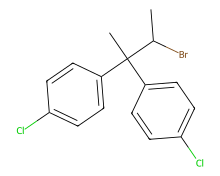
(v) CH3C(p-ClC6H4)2CH(Br)CH3
Longest chain: 4 carbons (butane). Numbering from the end nearer the two aryl groups gives locant set {2,2,3}, which beats the flipped {2,3,3} at the first point of difference.
3-Bromo-2,2-bis(4-chlorophenyl)butane
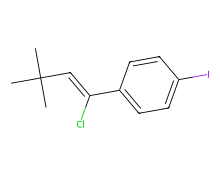
(vi) (CH3)3CCH=CClC6H4I-p
The longest chain absorbs ONE of the tert-butyl group's three methyls (methyl–C–CH=CCl, 4 carbons), leaving the other two methyls as substituents on C-3. Numbered from the C=CCl end so the double bond gets the lowest locant (1, not 3).
1-Chloro-1-(4-iodophenyl)-3,3-dimethylbut-1-ene
- 2-Bromo-3-chlorobutane,
- 1-Bromo-1-chloro-1,2,2-trifluoroethane,
- 1-Bromo-4-chlorobut-2-yne,
- 1,1,1,2,3,3,3-Heptachloro-2-(trichloromethyl)propane,
- 3-Bromo-2,2-bis(4-chlorophenyl)butane,
- 1-Chloro-1-(4-iodophenyl)-3,3-dimethylbut-1-ene.
Applying the longest-chain / lowest-locant / alphabetical rules: (i) 2-bromo-3-chlorobutane,
(ii) 1-bromo-1-chloro-1,2,2-trifluoroethane,
(iii) 1-bromo-4-chlorobut-2-yne,
(iv) 1,1,1,2,3,3,3-heptachloro-2-(trichloromethyl)propane,
(v) 3-bromo-2,2-bis(4-chlorophenyl)butane,
(vi) 1-chloro-1-(4-iodophenyl)-3,3-dimethylbut-1-ene.
(i) CH3CH(Cl)CH(Br)CH3 - parent butane; Br and Cl fall on C2/C3 either way (locants tie), so the alphabetically-first substituent (bromo) takes the lower number -> 2-bromo-3-chlorobutane.
(ii) CHF2CBrClF - parent ethane; numbering from the CBrClF end gives the lower locant set {1,1,1,2,2} (vs {1,1,2,2,2}) -> 1-bromo-1-chloro-1,2,2-trifluoroethane.
(iii) ClCH2C≡CCH2Br - parent but-2-yne; substituent locants {1,4} tie, so bromo takes position 1 -> 1-bromo-4-chlorobut-2-yne.
(iv) (CCl3)3CCl - the longest chain runs through the central carbon between two CCl3 groups, giving a propane parent; C1 and C3 each carry three Cl, the central C2 carries one Cl plus the third CCl3 as a (trichloromethyl) substituent -> 1,1,1,2,3,3,3-heptachloro-2-(trichloromethyl)propane.
(v) CH3C(p-ClC6H4)2CH(Br)CH3 - parent butane; numbering with the two aryl groups at C2 gives the locant set {2,2,3} (aryl, aryl, bromo), which beats numbering the other way with Br at C2 ({2,3,3}) at the first point of difference (2 < 3) -> 3-bromo-2,2-bis(4-chlorophenyl)butane. (The alphabetical rule only breaks a TRUE tie in the locant set -- here the sets themselves already differ, so the lower-locant-set rule decides first.)
(vi) (CH3)3CCH=CClC6H4I-p - the longest chain through the C=C includes one methyl of the tert-butyl group, giving a four-carbon but-1-ene chain; numbering from the doubly-bonded end that bears Cl and the aryl group -> 1-chloro-1-(4-iodophenyl)-3,3-dimethylbut-1-ene.
- 2-bromo-3-chlorobutane;
- 1-bromo-1-chloro-1,2,2-trifluoroethane;
- 1-bromo-4-chlorobut-2-yne;
- 1,1,1,2,3,3,3-heptachloro-2-(trichloromethyl)propane;
- 3-bromo-2,2-bis(4-chlorophenyl)butane;
- 1-chloro-1-(4-iodophenyl)-3,3-dimethylbut-1-ene.
Structural Isomerism — IUPAC Naming Method
Method: Systematic IUPAC Nomenclature (Substitutive Naming)
This method follows the IUPAC Blue Book rules: identify the longest parent chain, number it to give lowest locants to substituents (breaking ties alphabetically when two numbering directions give the same locant set), name substituents alphabetically, and specify multiple bonds where present.
Steps for each compound:
- Identify the longest carbon chain (parent alkane/alkene/alkyne) — check every direction a chain can run, including through a branch point in more than one direction.
- Number the chain to give the lowest possible locants to substituents; if tied, the substituent cited first alphabetically gets the lower locant.
- Name substituents (halogens, alkyl groups, etc.) in alphabetical order.
- Specify multiple bonds with appropriate suffixes (-ene, -yne), giving them priority for low locants.
- Combine identical substituents under one multiplying prefix, citing all their locants together.
Solutions
(i) CH3CH(Cl)CH(Br)CH3
- Parent chain: 4 carbons → butane
- Locant set for the two substituents is {2,3} from either end (symmetric chain) — the alphabetical tiebreak applies: bromo (b) outranks chloro (c), so bromo gets the lower locant.
Answer: 2-bromo-3-chlorobutane
(ii) CHF2CBrClF
- Parent chain: 2 carbons → ethane
- Substituents: F (×2) at C-1, Br, Cl, F at C-2
- Alphabetical: bromo, chloro, difluoro
Answer: 1-bromo-1-chloro-1,2,2-trifluoroethane
(iii) ClCH2C≡CCH2Br
- Parent chain: 4 carbons with triple bond → but-2-yne
- Locant set {1,4} tied either way — alphabetical tiebreak: bromo before chloro, so bromo gets locant 1.
Answer: 1-bromo-4-chlorobut-2-yne
(iv) (CCl3)3CCl
- The central carbon is bonded to Cl and three CCl₃ groups. The longest chain does not stop at the centre — it runs through the centre and into two of the three CCl₃ branches at once, giving a genuine 3-carbon chain (propane), with the third CCl₃ left over as a substituent.
- C-1 and C-3: three chlorines each (from their own CCl₃ origin). C-2 (the original centre): one chlorine + one trichloromethyl branch.
- All 7 chain chlorines (3 + 1 + 3, at locants 1,1,1,2,3,3,3) are cited together as heptachloro.
Answer: 1,1,1,2,3,3,3-heptachloro-2-(trichloromethyl)propane
(v) CH3C(p-ClC6H4)2CH(Br)CH3
- Parent chain: 4 carbons → butane
- Numbering from the end nearer the two aryl groups gives locant set {2,2,3} for (aryl, aryl, bromo) — lower than the flipped {2,3,3} at the first point of difference.
- Substituents: two 4-chlorophenyl groups at C-2, bromo at C-3
- Alphabetical: bromo, chlorophenyl
Answer: 3-bromo-2,2-bis(4-chlorophenyl)butane
(vi) (CH3)3CCH=CClC6H4I-p
- The longest chain is NOT the tert-butyl group treated as an intact substituent on a short chain — it absorbs one of the tert-butyl's three methyls into the chain itself: methyl–C–CH=CCl, 4 carbons (but-1-ene), leaving the other two methyls as substituents on C-3.
- Numbering must start from the C=CCl end so the double bond gets locant 1 (not 3) — the double bond outranks ordinary substituents for low-locant priority.
- Substituents: chloro and 4-iodophenyl at C-1, two methyl at C-3.
- Alphabetical: chloro, iodophenyl, methyl
Answer: 1-chloro-1-(4-iodophenyl)-3,3-dimethylbut-1-ene
Key exam tip: Always check for the lowest locant set first — if two numbering directions give the same set, only then compare alphabetically. And always check whether the "obvious" chain (e.g. treating a tert-butyl or CCl₃ group as a fixed substituent) is really the LONGEST one — a chain can run through a branch point in more than one direction.
This is a classic area where even good students lose marks. Let's go compound by compound, listing the common mistakes and how to avoid each.
(i) CH3CH(Cl)CH(Br)CH3
✗ Common Mistakes
- Wrong parent chain selection — students sometimes number from the wrong end, giving a higher locant sum.
- Alphabetical tiebreak applied backwards — writing "chlorobromo" or defaulting to whichever halogen is drawn first, instead of checking which one is alphabetically first.
- Missing commas and hyphens — e.g.,
2-chloro 3-bromobutaneinstead of the correctly punctuated name.
✓ How to Avoid
- Find the longest carbon chain — here it's 4 carbons (butane).
- Check the locant set first — both Cl and Br sit at positions 2 and 3 regardless of which end you number from, so the locant SET is tied at {2,3}.
- Break the tie alphabetically — the substituent cited first alphabetically (bromo, "b") gets the lower locant, not chloro.
- Write substituents in alphabetical order (ignoring di-, tri- prefixes for alphabetizing).
Correct IUPAC name:
2-bromo-3-chlorobutane
(ii) CHF2CBrClF
✗ Common Mistakes
- Not recognizing this is a haloalkane with multiple different halogens — students often misorder the substituents.
- Wrong parent chain — some pick a 1-carbon chain instead of 2-carbon (ethane).
- Alphabetizing "difluoro" by its "d" rather than remembering that a simple multiplying prefix (di-, tri-) is normally ignored for alphabetization — except that here it doesn't matter, since "difluoro" and "fluoro" both alphabetize as "fluoro" and are tied with each other, not with bromo/chloro.
✓ How to Avoid
- Identify the longest carbon chain — 2 carbons → ethane.
- Number the chain so that substituents get the lowest locants. Comparing the two numbering directions, the one that puts three chlorine-family substituents (Br, Cl, F) on C-1 and both remaining F's on C-2 gives the lower locant set — so C1 = CBrClF, C2 = CHF₂.
- List substituents alphabetically — bromo, chloro, difluoro.
Correct IUPAC name:
1-bromo-1-chloro-1,2,2-trifluoroethane
(iii) ClCH2C≡CCH2Br
✗ Common Mistakes
- Not recognizing the triple bond — students sometimes treat it as an alkane.
- Miscounting the parent chain length — this is a common trap: there are only 4 carbons here (but-2-yne), not 5 — don't count a substituent atom (Cl or Br) as if it were a chain carbon.
- Alphabetical tiebreak applied backwards — same trap as compound (i): the locant set {1,4} is tied either way, so bromo (alphabetically first) must get the lower locant.
✓ How to Avoid
- Identify the functional group — triple bond (alkyne). Parent chain must include it.
- Count only carbon atoms in the chain — Cl–CH₂–C≡C–CH₂–Br has exactly 4 carbons → but-2-yne.
- Break the tied locant set alphabetically — bromo before chloro, so bromo gets locant 1.
Correct IUPAC name:
1-bromo-4-chlorobut-2-yne
(iv) (CCl3)3CCl
✗ Common Mistakes
- Stopping the chain at the central carbon — students often name this as a substituted methane (with three "trichloromethyl" branches), missing that the chain can run straight THROUGH the centre and into two of the branches at once.
- Splitting identical substituents into separate citations — e.g. writing "2-chloro...hexachloro..." as two separate chlorine citations instead of combining every chain chlorine under one multiplying prefix.
✓ How to Avoid
- Draw the structure — central C bonded to Cl and three CCl₃ groups.
- Look for a chain that passes through the branch point — going from one CCl₃'s carbon, through the centre, into a second CCl₃'s carbon gives a genuine 3-carbon chain (propane). This beats stopping at 1 carbon (methane).
- The third CCl₃ becomes a substituent — named "trichloromethyl" — and the Cl on the (now middle) chain carbon is a plain chloro substituent.
- Combine every identical substituent — all 7 chain chlorines (three from each end carbon, one from the middle) are cited together as heptachloro with all their locants listed.
Correct IUPAC name:
1,1,1,2,3,3,3-heptachloro-2-(trichloromethyl)propane
(v) CH3C(p-ClC6H4)2CH(Br)CH3
✗ Common Mistakes
- Not recognizing the aromatic rings — students forget to name the p-chlorophenyl groups.
- Numbering from the wrong end — giving bromo locant 2 and the aryl groups locant 3, instead of checking which direction actually gives the lower locant SET.
✓ How to Avoid
- Identify the longest carbon chain — 4 carbons (butane). The two aromatic rings are substituents, not chain extensions (each aryl ring attaches by a single bond, it isn't a continuation of the carbon chain).
- Compare both numbering directions — locants {aryl, aryl, bromo} = {2,2,3} from one end vs {2,3,3} from the other. {2,2,3} is lower at the first point of difference.
- Alphabetical order — bromo, then chlorophenyl (since "b" < "c"). Use "bis" for two identical aryl groups.
Correct IUPAC name:
3-bromo-2,2-bis(4-chlorophenyl)butane
(vi) (CH3)3CCH=CClC6H4I-p
✗ Common Mistakes
- Treating "tert-butyl" as a fixed, intact substituent — this hides a longer chain: one of the tert-butyl's three methyls can be absorbed into the main chain itself, since it's directly bonded to the chain carbon.
- Numbering the double bond from the wrong end — a double bond gets priority for the lowest possible locant, so the chain must be numbered starting from the C=CCl end, not from the tert-butyl end.
✓ How to Avoid
- Look for a longer chain through the "obvious" substituent — methyl–C(CH₃)₂–CH=CCl– is a genuine 4-carbon chain (but-1-ene) once one methyl of the tert-butyl group is counted as part of the chain; the other two methyls remain as substituents.
- Give the double bond the lowest locant — numbering from the C=CCl end puts it at C-1, not C-3.
- Substituents — chloro and 4-iodophenyl both on C-1, two methyl groups on C-3.
- Alphabetical order — chloro, iodophenyl, methyl.
Correct IUPAC name:
1-chloro-1-(4-iodophenyl)-3,3-dimethylbut-1-ene
Summary Table of Key Mistakes
| Compound | Common Mistake | How to Avoid |
|---|---|---|
| (i) | Alphabetical tiebreak applied backwards | When the locant set is tied, the alphabetically-first substituent gets the lower locant |
| (ii) | Wrong parent chain | Always find longest C chain |
| (iii) | Miscounting chain length / backwards tiebreak | Count only carbon atoms; apply the same alphabetical tiebreak rule |
| (iv) | Stopping the chain at the branch point | Check whether the chain can run through the branch point into two arms at once |
| (v) | Numbering from the wrong end | Compare BOTH numbering directions' full locant sets before choosing |
| (vi) | Treating a common group name (tert-butyl) as fixed | A "named group" can still be split if that gives a longer chain |
Final tip: Always draw the structure first, then apply IUPAC rules step-by-step — longest chain (checking every direction, including through branch points) → numbering (lowest locant set, alphabetical tiebreak) → substituents combined and alphabetized. This eliminates most errors.
Showing the 12 most recent of 15 on this concept.
- AP EAPCET 2026Set eng-2026-05-14-AN1 markMCQQ.An isomer of C4H8 is X, which exhibits cis-trans isomerism. Y is the chain isomer of X. Products obtained from ozonolysis of Y are (A) CH3CHO+CH3CHO (B) CH3CH2CHO+HCOOH (C) CH3COCH3+HCHO (D) CH3CH2COOH+CO2
›Reveal solutionSolution
X (showing cis-trans isomerism) is but-2-ene; its chain isomer Y is isobutylene, whose ozonolysis gives acetone + formaldehyde.
Concept and Intuition
C4H8 has several isomers: but-1-ene, cis/trans-but-2-ene, 2-methylprop-1-ene (isobutylene), plus the cyclic ones (cyclobutane, methylcyclopropane). Cis-trans (geometrical) isomerism needs each double-bond carbon to carry two different substituents — only but-2-ene (CH3−CH=CH−CH3) among the open-chain alkenes satisfies this. So X = but-2-ene.
A chain isomer must differ in the carbon skeleton itself (straight vs branched), not merely in the position of the double bond. But-1-ene is only a position isomer of but-2-ene (both are straight-chain butenes). The genuine chain (skeletal) isomer of but-2-ene is 2-methylprop-1-ene, CH2=C(CH3)2 — a branched C4H8 alkene. So Y = isobutylene.
Step-by-Step Solution
- Identify X: but-2-ene, CH3−CH=CH−CH3 (cis/trans possible).
- Identify Y (chain isomer of X): 2-methylprop-1-ene, (CH3)2C=CH2.
- Ozonolysis of Y breaks the C=C bond and replaces it with C=O on each fragment:
- The =CH2 end becomes HCHO (formaldehyde).
- The =C(CH3)2 end becomes (CH3)2C=O (acetone, CH3COCH3).
- Products: CH3COCH3+HCHO.
Common Mistakes
- Confusing but-1-ene (a position isomer) with the true chain isomer of but-2-ene.
- Forgetting that ozonolysis products depend on the substitution pattern at each alkene carbon, not just the molecular formula.
✓Final answerThe correct option is (C) — CH3COCH3+HCHO.
ANSWER: C
- AP EAPCET 2026Set eng-2026-05-15-AN1 markMCQQ.The number of monochloro derivatives possible for(i) Isopentane(ii) neopentane and(iii) 2,3-dimethylbutane are x,y and z respectively. The sum of x,y and z is (A) 6 (B) 7 (C) 8 (D) 5
›Reveal solutionSolution
This tests counting distinct monochlorination products via symmetry analysis of hydrogens. The individual counts are 4, 1, 2, summing to 7.
Concept and Intuition
The number of distinct monochloro derivatives of an alkane equals the number of chemically non-equivalent (by molecular symmetry) sets of hydrogen atoms — because replacing any H within an equivalent set by Cl gives the identical product.
Step-by-Step Solution
- Isopentane = 2-methylbutane: CH3−CH(CH3)−CH2−CH3. Label the central CH carbon as C2, which bears two methyl groups (C1 and the branch methyl) that are equivalent to each other by symmetry. Distinct H-environments: (i) the two equivalent terminal methyls attached directly to C2 (C1 and branch-CH3), (ii) the tertiary H on C2, (iii) the CH2 hydrogens (C3), (iv) the terminal CH3 on C4 (different from group (i) since it's attached to a CH2, not to the tertiary C). That's 4 distinct types → x=4.
- Neopentane = 2,2-dimethylpropane, C(CH3)4. All four methyl groups are equivalent by the high (tetrahedral) symmetry of the molecule, so there is only one kind of hydrogen → y=1.
- 2,3-Dimethylbutane = (CH3)2CH−CH(CH3)2. The molecule has a center/axis of symmetry: C2 and C3 are equivalent to each other, and on each of C2/C3 the two attached methyl groups (chain-methyl and branch-methyl) are locally equivalent (free rotation, no stereocenter). This makes all four methyl groups in the molecule equivalent (one type), and the two methine H's (on C2, C3) equivalent to each other (a second type). So there are 2 distinct H-environments → z=2.
- Sum: x+y+z=4+1+2=7.
Common Mistakes
- Forgetting that the two methyls on the central carbon of isopentane are equivalent, and miscounting more or fewer than 4 types.
- Assuming 2,3-dimethylbutane's four methyls are pairwise distinct rather than realizing the whole-molecule symmetry makes them all equivalent.
✓Final answerThe correct option is (B) — 7.
ANSWER: B
- AP EAPCET 2026Set ap-2026-05-19-AN1 markMCQQ.Identify X in the following reaction sequence C4H9BrOHC4H10OCu573 KC4H8 (X) (A) (CH3)3CBr (tert-butyl bromide, i.e. 2-bromo-2-methylpropane) (B) (CH3)2CHCH2Br (isobutyl bromide, i.e. 1-bromo-2-methylpropane) (C) CH3CH2CHBrCH3 (sec-butyl bromide, i.e. 2-bromobutane) (D) CH3CH2CH2CH2Br (n-butyl bromide, i.e. 1-bromobutane)
›Reveal solutionSolution
Reading the final product (C4H8, an alkene, not a carbonyl) backward reveals the alcohol must be tertiary (since only tertiary alcohols dehydrate rather than dehydrogenate over Cu/573K); hence X is tert-butyl bromide.
Concept and Intuition
Copper at ~573 K catalyses two different reactions on alcohols depending on how many H atoms sit on the carbinol (C–OH) carbon:
- Primary alcohol (2 H's on that carbon) → dehydrogenates to an aldehyde.
- Secondary alcohol (1 H) → dehydrogenates to a ketone.
- Tertiary alcohol (0 H's on that carbon) → CANNOT dehydrogenate (no H to remove along with the O–H), so it instead undergoes dehydration (loses H2O) to give an alkene. The molecular formula given for the final product, C4H8, has lost an H2O relative to C4H10O (not just H2, which would give C4H8O), confirming dehydration, i.e. a tertiary alcohol.
Step-by-Step Solution
- Final step: C4H10O→C4H8 over Cu/573K. Formula change is loss of H2O (C4H10O−H2O=C4H8), which is dehydration — only possible (via this heterogeneous Cu route) for a tertiary alcohol, since it lacks the α-H needed for dehydrogenation.
- So the C4H10O intermediate is tert-butanol, (CH3)3C−OH, which indeed dehydrates over Cu/573K to isobutylene, (CH3)2C=CH2 (C4H8).
- First step: C4H9BrOH−C4H10O is simple hydroxide substitution of the halide. For the product to be tert-butanol, the starting halide must already have the same carbon skeleton with Br in place of OH: tert-butyl bromide, (CH3)3CBr.
- Tertiary bromides indeed react readily with OH− (largely SN1) to give the tertiary alcohol as the substitution product.
Common Mistakes
- Forgetting that Cu/573K distinguishes alcohols by dehydrogenation (1°/2°) vs. dehydration (3°) — treating all alcohols as giving a carbonyl product regardless of class.
- Picking a primary or secondary bromide (options B, C, D) without checking that their corresponding alcohols would give a carbonyl (C4H8O), not C4H8.
✓Final answerThe correct option is (A) — (CH3)3CBr (tert-butyl bromide, i.e. 2-bromo-2-methylpropane).
ANSWER: A
- AP EAPCET 2026Set ap-2026-05-19-AN1 markMCQQ.The functional isomer of Z formed in the given sequence of reactions is CH3CH2CH2OHConc. H2SO4443 KX(i) Br2 ∣ CCl4(ii) alc.KOH,Δ (iii) NaNH2YH2O, Hg2+H+ ∣ 333 KZ (A) CH3CH2COOH (propanoic acid) (B) CH2=CH−OH (vinyl alcohol / ethenol) (C) CH3CH2CHO (propanal) (D) CH3CH2−O−CH3 (ethyl methyl ether)
›Reveal solutionSolution
Traces propan-1-ol through dehydration → dihalogenation/double-dehydrohalogenation → Markovnikov alkyne hydration to reach acetone (Z); its functional isomer (same formula, aldehyde instead of ketone) is propanal.
Concept and Intuition
This is a classic hydrocarbon-interconversion chain. Each named condition is a fixed textbook reagent-to-transformation rule: conc. H2SO4 at 443 K = dehydration (E1, alcohol → alkene); Br2/CCl4 = anti addition across a C=C (vicinal dibromide); alc. KOH/Δ = dehydrohalogenation (E2); NaNH2 (excess, strong base/strong nucleophile) = a second dehydrohalogenation to reach a triple bond, and (for longer chains) also isomerises an internal alkyne to the terminal one via the acetylide anion; H2O/Hg2+/H+ = Markovnikov hydration of an alkyne to a carbonyl (via an unstable enol that tautomerises). Two carbonyl compounds sharing the same molecular formula but differing in functional group (aldehyde vs ketone here) are called functional isomers.
Step-by-Step Solution
- CH3CH2CH2OHconc. H2SO4443KX: dehydration removes H2O to give propene, X=CH3−CH=CH2.
- X(i) Br2/CCl4 1,2-dibromopropane, CH3−CHBr−CH2Br (anti addition of Br across the double bond).
- (ii) alc. KOH,Δ removes one HBr (E2) to give a bromopropene.
- (iii) NaNH2 removes the second HBr, giving the alkyne; with only 3 carbons the triple bond can only sit terminally, so Y=HC≡C−CH3 (propyne).
- YH2O, Hg2+/H+333K: Markovnikov hydration of the terminal alkyne places OH on the more substituted alkyne carbon, giving an enol that tautomerises to the methyl ketone: Z=CH3−CO−CH3 (acetone, C3H6O).
- A functional isomer of Z must share its molecular formula (C3H6O) but carry a different functional group: propanal, CH3CH2CHO, is the aldehyde isomer of acetone — same formula, different (aldehyde) group.
- Check the distractors: propanoic acid is C3H6O2 (wrong formula); the "vinyl alcohol" option as drawn is only C2 (wrong carbon count / formula); ethyl methyl ether is C3H8O (wrong formula, no unsaturation) — none of these are isomers of Z.
Common Mistakes
- Forgetting that with only 3 carbons, an "alkyne" can only be terminal — no internal-vs-terminal ambiguity to resolve.
- Confusing Markovnikov (Hg²⁺-catalysed) alkyne hydration, which gives a ketone from a terminal alkyne, with anti-Markovnikov hydroboration-oxidation, which would give an aldehyde.
- Picking an option that "looks like" an isomer without actually checking its molecular formula matches Z's (C3H6O).
✓Final answerThe correct option is (C) — CH3CH2CHO (propanal).
ANSWER: C
- AP EAPCET 2025Set eng-2025-05-21-AN1 markMCQQ.The number of primary (1°), secondary (2°) and tertiary (3°) alcohols possible for the formula C5H12O respectively are (A) 3, 3, 2 (B) 4, 2, 2 (C) 4, 3, 1 (D) 3, 4, 1
›Reveal solutionSolution
Listing all 8 structural isomers of pentanol (C₅H₁₂O) and classifying each by the number of carbons attached to the carbinol carbon gives 4 primary, 3 secondary, and 1 tertiary alcohol. Answer: (C).
Concept and Intuition
A saturated monohydric alcohol CnH2n+2O is classified 1°/2°/3° by how many carbon groups are attached to the carbon bearing the -OH. For C₅, we must enumerate every distinct carbon skeleton (n-pentane and 2-methylbutane; 2,2-dimethylpropane skeleton also, once we allow the OH to sit on any carbon of any skeleton) and every distinct OH position on each, discarding symmetry-equivalent positions.
Step-by-Step Solution
- Straight (n-pentane) skeleton CH3−CH2−CH2−CH2−CH2−OH type: OH can go on C1, C2, or C3 (C4, C5 are equivalent to C2, C1 by the chain's symmetry).
- 1-pentanol (OH on C1): primary.
- 2-pentanol (OH on C2): secondary.
- 3-pentanol (OH on C3): secondary.
- 2-methylbutane skeleton (CH3)2CH−CH2−CH3: OH can go on the terminal methyl of the branch (giving 2-methyl-1-butanol), on the branch/tertiary CH carbon (2-methyl-2-butanol), on the CH₂ (2-methyl-3-butanol = 3-methyl-2-butanol by renumbering), or the far methyl (3-methyl-1-butanol, i.e., isoamyl alcohol).
- 2-methyl-1-butanol: primary.
- 3-methyl-1-butanol (isoamyl alcohol): primary.
- 2-methyl-2-butanol (tert-amyl alcohol): tertiary (the carbinol carbon has 3 alkyl groups).
- 3-methyl-2-butanol: secondary.
- 2,2-dimethylpropane (neopentane) skeleton (CH3)3C−CH2−OH: OH must sit on the single exocyclic CH₂ — neopentyl alcohol: primary (carbinol carbon attached to only one carbon, the quaternary C, but bonded to 1 carbon group so classified 1°... more precisely the carbinol carbon CH2OH is attached to just ONE other carbon, so it's primary).
- Total count: 8 isomers.
- Primary (1°): 1-pentanol, 2-methyl-1-butanol, 3-methyl-1-butanol, neopentyl alcohol → 4.
- Secondary (2°): 2-pentanol, 3-pentanol, 3-methyl-2-butanol → 3.
- Tertiary (3°): 2-methyl-2-butanol → 1.
- So the counts (1°, 2°, 3°) = (4, 3, 1), matching option (C).
Common Mistakes
- Missing the neopentyl alcohol isomer (easy to overlook the fully-branched skeleton).
- Double counting symmetry-equivalent OH positions on the straight chain (e.g., counting both "C4" and "C2" as distinct positions).
✓Final answerThe correct option is (C) — 4, 3, 1.
ANSWER: C
- Straight (n-pentane) skeleton CH3−CH2−CH2−CH2−CH2−OH type: OH can go on C1, C2, or C3 (C4, C5 are equivalent to C2, C1 by the chain's symmetry).
- AP EAPCET 2025Set eng-2025-05-22-FN1 markMCQQ.How many amines with molecular formula C3H9N can react with benzene sulphonyl chloride ? (A) 2 (B) 3 (C) 4 (D) 1
›Reveal solutionSolution
Tests enumerating the isomeric amines of C3H9N and applying the Hinsberg-test rule that only 1° and 2° amines react with benzenesulfonyl chloride.
Concept and Intuition
Benzenesulfonyl chloride (C6H5SO2Cl) reacts with an amine's N–H bond(s) to form a sulfonamide. A primary amine (two N–H) forms an N,N-disubstituted-looking, acidic (soluble in alkali) sulfonamide; a secondary amine (one N–H) forms a neutral (alkali-insoluble) sulfonamide. A tertiary amine has NO N–H bond at all, so it cannot form a stable sulfonamide this way — it does not react (any salt formed simply hydrolyses back).
Step-by-Step Solution
- List all isomers of C3H9N:
- CH3CH2CH2NH2 — n-propylamine (1°)
- (CH3)2CHNH2 — isopropylamine (1°)
- CH3−NH−CH2CH3 — N-methylethanamine (2°)
- (CH3)3N — trimethylamine (3°)
- Both 1° amines have two N–H bonds and react with benzenesulfonyl chloride to give sulfonamides.
- The 2° amine has one N–H bond and also reacts, giving a sulfonamide.
- The 3° amine, trimethylamine, has no N–H bond, so it cannot react to form a sulfonamide.
- Count of amines that react: n-propylamine, isopropylamine, N-methylethanamine = 3.
Common Mistakes
- Forgetting one of the four structural isomers (especially the branched 1° amine, isopropylamine).
- Assuming the tertiary amine still reacts (perhaps by simple acid–base salt formation) and counting all four.
✓Final answerThe correct option is (B) — 3.
ANSWER: B
- List all isomers of C3H9N:
- AP EAPCET 2025Set ap-2025-05-20-AN1 markMCQQ.The number of monochloro derivatives possible for 2,2-Dimethylbutane and 2,3-Dimethylbutane are respectively (A) 3, 2 (B) 2, 3 (C) 4, 2 (D) 2, 4
›Reveal solutionSolution
Counting distinct (non-equivalent) hydrogen environments in each alkane gives the number of possible monochloro derivatives: 3 for 2,2-dimethylbutane and 2 for 2,3-dimethylbutane.
Concept and Intuition
In free-radical monochlorination, each type of chemically distinct hydrogen (by symmetry) gives, in principle, one distinct monochloro product (ignoring stereochemistry/enantiomers, which is the usual convention in these counting questions). So the count of products equals the count of symmetry-distinct C–H environments in the molecule.
Step-by-Step Solution
2,2-Dimethylbutane: CH3−C(CH3)2−CH2−CH3
- The carbon skeleton is C1−C2(−CH3)2−C3−C4, where C2 is quaternary, bearing three methyl groups (C1 and its two substituents) that are all equivalent by the local symmetry around C2.
- Distinct H-types: (i) the three equivalent CH3 groups on C2, (ii) the CH2 at C3, (iii) the terminal CH3 at C4.
- That's 3 distinct environments → 3 monochloro products.
2,3-Dimethylbutane: (CH3)2CH−CH(CH3)2
- This molecule has a center of symmetry: C2 and C3 (each a tertiary CH) are equivalent to each other, and all four methyl groups (one on C1, one substituent on C2, one substituent on C3, one on C4) are equivalent to each other.
- Distinct H-types: (i) the four equivalent methyl groups, (ii) the two equivalent tertiary C–H's.
- That's 2 distinct environments → 2 monochloro products.
Common Mistakes
- Not recognizing the symmetry that makes several methyl groups equivalent, and over-counting products.
- Confusing "number of distinct H atoms" with "number of substituent groups" without checking equivalence.
✓Final answerThe correct option is (A) — 3, 2.
ANSWER: A
- AP EAPCET 2024Set eng-2024-05-21-FN1 markMCQQ.An isomer of C5H12 on reaction with Br2 / light gave only one isomer C5H11Br (X). Reaction of X with AgNO2 gave Y as major product. What is Y? (A) O2N−C(CH3)2−CH2CH3 (B) ONO−C(CH3)2−CH2CH3 (C) (CH3)3C−CH2−ONO (D) (CH3)3C−CH2−NO2
›Reveal solutionSolution
X is neopentyl bromide; AgNO2 gives mainly the nitroalkane, so Y is (CH3)3C-CH2-NO2 → (D).
Concept and Intuition
A C5H12 isomer that yields a single monobromo product under free-radical bromination must have all its hydrogens equivalent — that is neopentane, C(CH3)4. Silver nitrite (AgNO2) reacts with alkyl halides through the more electronegative nitrogen (ambident nucleophile with a covalent Ag salt), giving the nitroalkane as the major product and the alkyl nitrite as minor.
Step-by-Step Solution
- Only-one-product test → neopentane (CH3)4C (12 equivalent H).
- Br2/light → X = neopentyl bromide (CH3)3C-CH2-Br.
- X + AgNO2 (silver salt) → attack via N → major product is the nitroalkane.
- Retaining the neopentyl skeleton → Y =(CH3)3C-CH2-NO2 → option (D).
Common Mistakes
- Choosing the alkyl nitrite (R–ONO): that is the minor product with AgNO2 (it is major only with KNO2).
- Rearranging the carbon skeleton — the neopentyl framework is retained.
✓Final answerThe correct option is (D) — (CH3)3C-CH2-NO2.
ANSWER: D
- AP EAPCET 2023Set eng-2023-05-16-FN1 markMCQQ.Which of the following is the geminal dichloride? (A) 1,1-Dichloropropane (B) 1,2-Dichloropropane (C) 1,3-Dichloropropane (D) 2,3-Dichloropropane
›Reveal solutionSolution
Tests the definition of geminal vs. vicinal dihalides. Answer: 1,1-dichloropropane (option A), since both Cl atoms sit on the same carbon.
Concept and Intuition
"Geminal" (from Latin gemini, twins) means both substituents are on the same carbon atom, while "vicinal" (from vicinus, neighbouring) means the substituents are on adjacent carbons. This distinction matters chemically: geminal dihalides give aldehydes/ketones on hydrolysis, while vicinal dihalides give alkynes on double dehydrohalogenation.
Step-by-Step Solution
- 1,1-Dichloropropane: CH3−CH2−CHCl2 — both Cl on C1 → geminal.
- 1,2-Dichloropropane: CH3−CHCl−CH2Cl — Cl on C1 and C2 (adjacent carbons) → vicinal.
- 1,3-Dichloropropane: ClCH2−CH2−CH2Cl — Cl atoms separated by one carbon, not even vicinal.
- 2,3-Dichloropropane doesn't correspond to a valid propane numbering issue aside — Cl on C2/C3 would be vicinal, not geminal.
- Only option (A) has both chlorines on one carbon, so it is the geminal dichloride.
Common Mistakes
- Confusing geminal (same carbon) with vicinal (adjacent carbons) — a very common mix-up in nomenclature questions.
✓Final answerThe correct option is (A) — 1,1-Dichloropropane.
ANSWER: A
- AP EAPCET 2022Set ap-2022-07-11-AN1 markMCQQ.The number of cyclic isomers possible for C4H6, with one double bond in the ring is (A) 2 (B) 3 (C) 4 (D) 5
›Reveal solutionSolution
C4H6 with a ring double bond has exactly 3 possible cyclic structures: cyclobutene, 1-methylcyclopropene, and 3-methylcyclopropene.
Concept and Intuition
Degree of unsaturation for C4H6 is 22(4)+2−6=2. If the molecule is cyclic AND has one ring C=C, that accounts for both degrees (1 ring + 1 π bond), so there can be no other ring or double bond anywhere else. With only four carbons available, the ring must be either a 4-membered ring (using all 4 carbons in the ring, no substituents) or a 3-membered ring (using 3 carbons in the ring, with the 4th carbon as a methyl substituent).
Step-by-Step Solution
- 4-membered ring: cyclobutane skeleton with one C=C = cyclobutene, molecular formula already C4H6 with no substituent needed. → 1 structure.
- 3-membered ring + methyl: cyclopropene is C3H4; adding a CH3 (replacing one H) gives C4H6.
- Cyclopropene's ring carbons: C1=C2 (each bearing one H) and C3 (sp³, bearing two H). Placing the methyl on C1 or C2 gives the same molecule by the ring's mirror symmetry → 1-methylcyclopropene (1 structure).
- Placing the methyl on C3 gives a distinct molecule → 3-methylcyclopropene (1 structure).
- No cis/trans isomerism arises in either 3- or 4-membered ring alkenes (too strained to have a distinct geometric isomer).
- Total distinct structures = 1 (cyclobutene) + 1 (1-methylcyclopropene) + 1 (3-methylcyclopropene) = 3.
Common Mistakes
- Forgetting that placing the methyl on either double-bond carbon of cyclopropene gives the same compound (symmetry), which would over-count to 4 if not careful.
- Missing the 3-membered-ring possibilities entirely and only counting cyclobutene.
✓Final answerThe correct option is (B) — 3.
ANSWER: B
- AP EAPCET 2022Set eng-2022-07-08-FN1 markMCQQ.The number of possible aromatic benzenoid isomers for C6H4Cl2 are (A) 2 (B) 3 (C) 4 (D) 5
›Reveal solutionSolution
Tests counting positional (structural) isomers for a disubstituted benzene with two identical substituents — ortho, meta, and para are the only 3 distinct arrangements.
Concept and Intuition
Benzene's six carbons are all equivalent by symmetry. When two identical substituents (here, two Cl atoms) are placed on the ring, the relative position between them can only take 3 distinct values due to the ring's symmetry: adjacent (1,2 - ortho), separated by one carbon (1,3 - meta), or directly opposite (1,4 - para). Any other numbering (e.g., 1,5 or 1,6) is just a renamed/rotated version of one of these three because of the ring's six-fold symmetry.
Step-by-Step Solution
- Label ring positions 1 through 6. Fix one Cl at position 1 (by ring symmetry, this loses no generality).
- The second Cl can be at position 2 (ortho), 3 (meta), or 4 (para) — relative to position 1.
- Position 5 relative to 1 is equivalent to position 3 (meta) by symmetry (counting the other way around the ring); position 6 is equivalent to position 2 (ortho).
- So there are exactly 3 distinct isomers: 1,2-; 1,3-; and 1,4-dichlorobenzene.
Common Mistakes
- Counting positions 1–6 naively as 5 distinct pairings without recognizing the ring's mirror symmetry collapses them to 3 unique isomers.
- Forgetting these must all be "benzenoid" (retaining the aromatic ring intact), which the question specifies, ruling out non-aromatic tautomers/isomers.
✓Final answerThe correct option is (B) — 3.
ANSWER: B
- AP EAPCET 2021Set eng-2021-08-20-AN1 markMCQQ.Alcohols with molecular formula CnH2n+2O are isomeric with ________ (A) Acids (B) Ethers (C) Esters (D) Aldehydes
›Reveal solutionSolution
Alcohols and ethers share the same general formula CnH2n+2O, so they are functional isomers of each other.
Concept and Intuition
Isomerism requires identical molecular formula but different structural arrangement/functional group. Alcohols (R−OH) and ethers (R−O−R′) are the textbook example of functional isomerism because both have exactly one oxygen and the same degree of saturation, giving the identical general formula CnH2n+2O (e.g. ethanol C2H6O and dimethyl ether C2H6O).
Step-by-Step Solution
- General formula of saturated alcohols: CnH2n+1OH=CnH2n+2O.
- General formula of saturated ethers (CmH2m+1−O−CkH2k+1 with m+k=n): also simplifies to CnH2n+2O.
- Acids (CnH2nO2), esters (CnH2nO2), and aldehydes (CnH2nO) all have different general formulas (different O count or different H count), so they are ruled out.
- Hence alcohols and ethers are isomeric with each other.
Common Mistakes
- Mixing up the general formula of aldehydes (CnH2nO) with alcohols (CnH2n+2O) — they differ by 2 hydrogens (different degree of unsaturation), so they are NOT isomers.
- Forgetting that acids/esters carry two oxygens, immediately disqualifying them.
✓Final answerThe correct option is (B) — Ethers.
ANSWER: B
🎓Unlock everything free for 14 days
- ✓Full step-by-step solutions
- ✓Concept-first explanations
- ✓Methods, shortcuts & mistakes
- ✓PYQ mapping + timed mock tests
Full access for 14 days. No credit card required.