Q.(a) State the working principle of potentiometer. Explain with the help of circuit diagram how potentiometer is used to determine the internal resistance of the given primary cell.
You're viewing a preview — the full solution, concept, methods & PYQ mapping are locked.
Start your 14-day free trial to unlock the full solution →A potentiometer works on the potential-gradient (null) principle; the internal resistance formula r = R(l_1 - l_2)/l_2 gives r = 1.69 ohm for the given data.
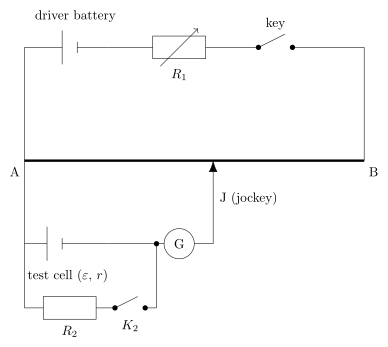
Part (a) - Principle and internal-resistance measurement:
Working principle: A potentiometer consists of a long uniform wire of constant cross-section carrying a steady current from a driver (auxiliary) battery, so there is a uniform fall of potential (potential gradient) along the wire. The potential difference across any length of the wire is directly proportional to that length. To measure an unknown emf or potential difference, it is balanced against the fall of potential along a length of the wire such that no current flows through the galvanometer (null / balance condition). At balance the unknown equals the potential drop across the balancing length.
Measuring internal resistance of a cell: The cell (emf E, internal resistance r) is connected to the potentiometer through a galvanometer and jockey. First, with the external resistance box open (no current drawn from the cell), the balance length l_1 corresponds to the emf E, so E is proportional to l_1. Next, a known resistance R is connected across the cell through a key; now the cell delivers current and the balance length becomes l_2, corresponding to the terminal potential difference V, so V is proportional to l_2.
…
Unlock everything free for 14 days
- Full step-by-step solutions
- Concept-first explanations
- Methods, shortcuts & mistakes
- PYQ mapping + timed mock tests
Full access for 14 days. No credit card required.