Q.State the working principle of potentiometer. Explain with the help of circuit diagram how the potentiometer is used to determine the internal resistance of the given primary cell.
You're viewing a preview — the full solution, concept, methods & PYQ mapping are locked.
Start your 14-day free trial to unlock the full solution →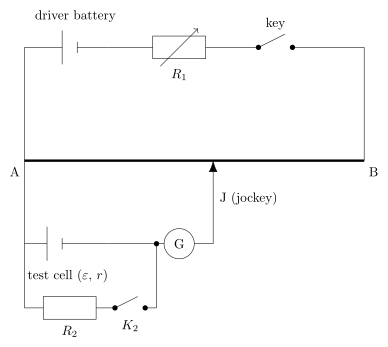
A potentiometer measures potential difference by comparing lengths, drawing no current from the cell at balance; comparing the balancing length with the cell open-circuited to the length with a known resistance connected gives the cell's internal resistance.
Principle of the potentiometer: A potentiometer consists of a long uniform wire of constant cross-section, through which a steady current is maintained (by a driver battery, via a rheostat, in the primary circuit). Since the wire is uniform and is constant, the potential drop per unit length (potential gradient ) is the same everywhere along the wire. Hence, the potential difference across any length of the wire is directly proportional to that length:
This lets an unknown EMF/potential difference be compared against the wire's known potential gradient by finding a balance point (using a galvanometer and jockey) where no current is drawn — making the potentiometer a highly accurate, current-free method of comparison, unlike a voltmeter which always draws some current.
Circuit to find internal resistance of a cell:
The potentiometer wire AB is connected across a driver battery (with a rheostat) to set up a steady potential gradient along it. The cell of EMF and unknown internal resistance (whose is to be found) is connected, through a galvanometer and jockey, to the potentiometer wire. In series with this cell is a resistance box and a key , connected so that can be opened (no current drawn from the cell) or closed (current drawn through ).
Step 1 — Key open: No current is drawn from the cell, so the potentiometer directly balances against the cell's full EMF. Let the balance length be :
…
Unlock everything free for 14 days
- Full step-by-step solutions
- Concept-first explanations
- Methods, shortcuts & mistakes
- PYQ mapping + timed mock tests
Full access for 14 days. No credit card required.