Q.State the working principle of potentiometer. Explain with the help of a circuit diagram, how the potentiometer is used to determine the internal resistance of the given primary cell. In a potentiometer arrangement, a cell of emf 1.25 V gives a balance point at 35.0 cm length of the wire. If the cell is replaced by another cell and the balance point shifts to 63.0 cm, what is the emf of the second cell?
You're viewing a preview — the full solution, concept, methods & PYQ mapping are locked.
Start your 14-day free trial to unlock the full solution →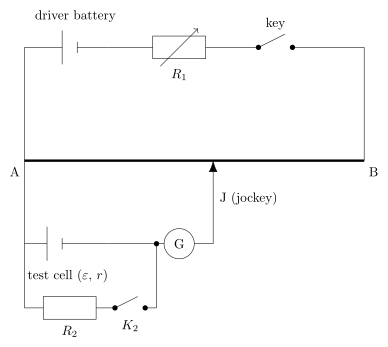
The potentiometer principle (V ∝ l for constant current in a uniform wire) allows a cell's emf/internal resistance to be found by comparing balance-point lengths; here, comparing balance points of two cells gives the second cell's emf as 2.25 V.
Working principle of a potentiometer:
A potentiometer consists of a long uniform wire of resistance per unit length , connected to a driver battery which maintains a constant current through the wire. Since is constant and the wire has uniform cross-section, the potential drop across any length of the wire is:
i.e., the potential difference between any two points on the wire is directly proportional to the length of wire between them, for a constant current. This is the fundamental principle of the potentiometer, and it allows very precise (null-deflection) comparison of emfs/potential differences, since no current is drawn from the cell being measured at the balance point (unlike a voltmeter).
Determining internal resistance of a cell using a potentiometer:
The cell (emf , internal resistance ) whose internal resistance is to be found is connected (through a galvanometer and jockey) to the potentiometer wire, with a resistance box and a key connected across the cell (forming an external circuit for the cell).
- With key open (no current drawn from the cell), the balance point is obtained at length : this balances the full emf, .
- With closed and a known resistance introduced, the cell now sends a current through , so only the terminal potential difference (not the full emf) balances against the wire, at a new (shorter) length : . …
Unlock everything free for 14 days
- Full step-by-step solutions
- Concept-first explanations
- Methods, shortcuts & mistakes
- PYQ mapping + timed mock tests
Full access for 14 days. No credit card required.