Q.Explain with diagram how a potentiometer can be used to find the internal resistance of a cell.
You're viewing a preview — the full solution, concept, methods & PYQ mapping are locked.
Start your 14-day free trial to unlock the full solution →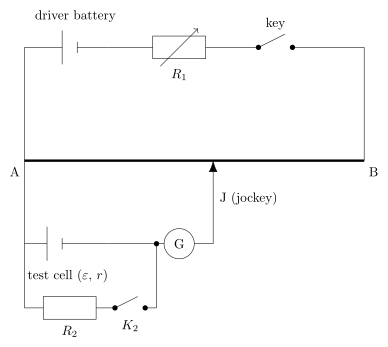
Balance the cell's emf (open circuit) and its terminal voltage across a known resistor (closed circuit) on the same potentiometer wire; the ratio of balance lengths gives internal resistance .
Circuit description. A potentiometer wire AB of uniform cross-section is connected in series with a driver battery, rheostat, and ammeter, establishing a steady current through the wire and hence a uniform potential gradient (V per unit length) along AB. The cell whose internal resistance is to be found (emf ) is connected, through a galvanometer and jockey, to the wire -- first directly (open-circuit branch, key open), and a resistance box is connected in parallel with the cell via key (closed-circuit branch).
Step 1 -- Open circuit (K2 open): measure emf.
With open, no current is drawn from the cell (galvanometer draws negligible current at balance), so the potentiometer measures the full emf. The jockey is slid to find the null (balance) point at length from A:
Step 2 -- Closed circuit (K2 closed): measure terminal voltage.
Now is closed, so current flows through the cell and the external resistance . The potentiometer now balances the terminal potential difference across the cell (= voltage across , since they are in parallel), at a new, shorter balance length :
Step 3 -- relate to internal resistance.
When current flows: and , so . Substituting: …
Unlock everything free for 14 days
- Full step-by-step solutions
- Concept-first explanations
- Methods, shortcuts & mistakes
- PYQ mapping + timed mock tests
Full access for 14 days. No credit card required.